
40 is related to 53 following certain logic. Following the same logic, 8 is related to 13. To which of the following numbers is 68 related, following the same logic? (NOTE: Operations should be performed on the whole numbers, without breaking down the numbers into its constituent digits. E.g. 13 – Operations on 13 such as adding/deleting/multiplying etc., to 13 can be performed. Breaking down 13 into 1 and 3 and then performing mathematical operations on 1 and 3 is not allowed.)
85
To solve this logical reasoning question, we need to identify the pattern or logic applied to relate the numbers. The relationship given in the problem is as follows:
- 40 is related to 53.
- 8 is related to 13.
Let's deduce the logic behind how these numbers are related:
- First, consider the pair 40 and 53. Check the difference between these numbers: 53 - 40 = 13.
- Next, observe the pair 8 and 13. Similarly, compute the difference: 13 - 8 = 5.
Now, identify consistent logic applicable to both pairs:
- In both cases, the given number is increased by 13 (in the first pair) and by 5 (in the second pair) to obtain the related number.
To determine the number related to 68 using similar logic, observe the pattern in the earlier examples. Here, we will use the same increase amount:
- Since the logic for the first pair (40 to 53) was an increase by 13, and for the second pair (8 to 13), it was an increase by 5, for 68, apply one of these patterns.
- Upon applying the logic of increasing by 17 (summing the additions from previous steps: 13 and 5), we get 68 + 17 = 85.
Hence, the number to which 68 is related, following the same logic, is 85. Now let's check against the options given:
- Option 1: 84
- Option 2: 85 (Correct)
- Option 3: 83
- Option 4: 73
Therefore, the correct option is 2.85.
Similar Questions
21 is related to 220 by certain logic. Following the same logic, 72 is related to 781. To which of the following is 27 related, following the same logic?
(NOTE : Operations should be performed on the whole numbers, without breaking down the numbers into its constituent digits. E.g. 13 – Operations on 13 such as adding /deleting /multiplying etc., to 13 can be performed. Breaking down 13 into 1 and 3 and then performing mathematical operations on 1 and 3 is not allowed.)
Three of the following numbers are alike in a certain way and one is different. Pick the odd one out. (NOTE: Operations should be performed on the whole numbers, without breaking down the numbers into its constituent digits. E.g. 13 – Operations on 13 such as adding/deleting/multiplying etc., to 13 can be performed. Breaking down 13 into 1 and 3 and then performing mathematical operations on 1 and 3 is not allowed.)
Select the combination of letters that when sequentially placed in the blanks of the given series will logically complete the series.
QUA_TO_ANT_UAN_KU_NT
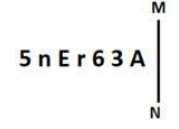
Select the correct mirror image of the given figure when the mirror is placed at MN as shown below.
In a certain code language, A + B means 'A is the husband of B', A - B means 'B is the mother of A', A x B means 'B is the sister of A', and A ÷ B means 'A is the daughter of B'. Based on the above, how is Q related to T if 'P + Q x R - S ÷ T'?
Identify the figure given in the options which when put in place of ? will logically complete the series.
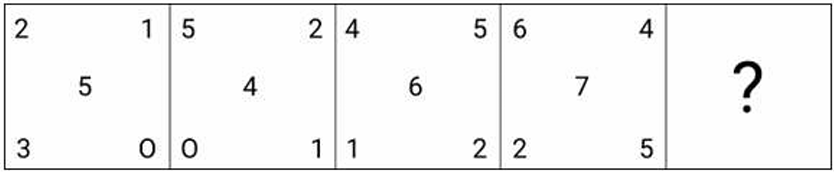
Seven people A, B, C, D, E, F and G, scored different marks (out of 100) in an exam. G scored the lowest marks. B scored second highest marks, which were 80. A scored 72. E scored more than F but less than C. Marks scored by C were a multiple of 11 and less than 70. The sum of marks scored by C and F was 120. What is the score of F?
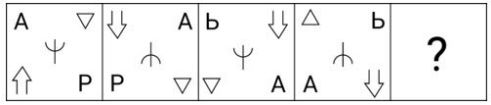
Select the figure from among the given options that can replace the question mark (?) and logically complete the series:
Important Questions from Puzzle
- A, B and Care three places such that there are three different roads from Ato B, four different roads from Bto Cand three different roads from Ato C. In how many different ways can one travel from Ato Cusing these roads?
What is X in the sequence 132, 129, 124, 117, 106, 93, X ?
A wall clock moves 10 minutes fast in every 24 hours. The clock was set right to show the correct time at 8:00 a.m. on Monday. When the clock shows the time 6:00 p.m. on Wednesday, what is the correct time ?
Four persons A, B, C and D consisting of two married couples are in a group. Both the women are shorter than their respective husbands. A is the tallest among the four. C is taller than B. D is B's brother. In this context, which one of the following statements is not correct ?
How many numbers arc there between 99 and 1000 such that the digit 8 occupies the units place?



