Yemen: A Comprehensive Overview
Why in news?
- A nurse from Kerala's Palakkad has been convicted of killing a Yemeni national. The Yemen President approved her death sentence.
Geography of Yemen
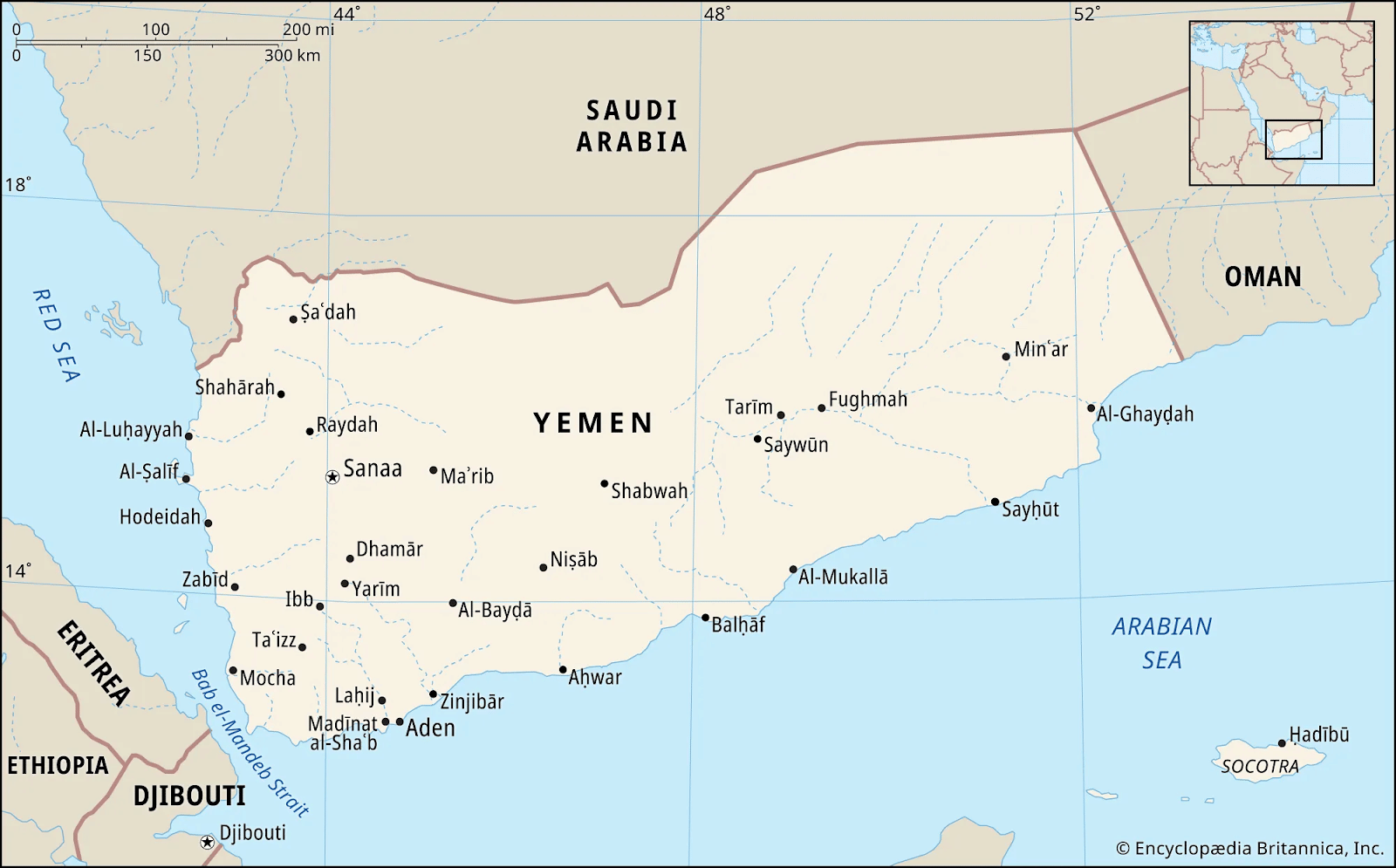
- Yemen is located in the southwestern corner of the Arabian Peninsula in West Asia. It shares borders with Saudi Arabia to the north and Oman to the northeast.
- Yemen also has a coastline along the Red Sea to the west and the Indian Ocean to the south, making it a strategically important region in the Middle East.
Demographics
- Yemen has an estimated population of 34.7 million people, with the majority being Arab Muslims.
- The country is home to diverse ethnic and tribal groups, contributing to its rich cultural heritage.
Historical Significance of Yemen
- Yemen holds a unique place in history as a crossroads of civilizations for over 7,000 years. Some of its most notable ancient kingdoms include the Sabaean (1200 BCE) and the Himyarite (275 CE) civilizations, both of which played significant roles in the region's cultural and trade networks.
Modern History
- In the 19th century, Yemen was divided between the Ottoman Empire in the north and the British Empire in the south.
- North Yemen (Yemen Arab Republic) was established in 1962, and South Yemen (People's Democratic Republic of Yemen) gained independence in 1967.
- The two parts were unified into the Republic of Yemen in 1990, marking a new chapter in the country's history.
Recent Political Situation and Civil War
- Since 2015, Yemen has been embroiled in a civil war, with multiple factions vying for control of the country.
- These factions include the internationally recognized Yemeni government and Houthi rebels, who have received support from various foreign powers.
- The conflict has caused significant instability, making Yemen one of the most volatile regions in the Middle East.
Humanitarian Crisis
- Yemen is facing one of the worst humanitarian crises globally. As of 2019, 75% of the population—approximately 24 million people—was in need of humanitarian aid.
- The ongoing civil war has exacerbated the situation, contributing to widespread poverty, displacement, and health crises.
- Yemen was ranked highest on the Fragile States Index in 2020, highlighting the severity of its political, social, and economic challenges.
Key Issues in Yemen:
- Ongoing Civil War: Factions like the Yemeni government and the Houthi rebels are in conflict.
- Humanitarian Crisis: A vast majority of Yemen's population requires aid, and the country is facing severe economic and infrastructure challenges.
- Foreign Involvement: The conflict is also influenced by external powers, including Saudi Arabia and Iran, with global powers having stakes in the region.
Conclusion
- Yemen is at a crucial juncture, balancing its rich historical legacy with its current political, economic, and humanitarian challenges.
- The ongoing conflict, combined with the country’s dire humanitarian needs, has made it one of the world’s most fragile states.
- Understanding Yemen’s geography, demographics, historical significance, and modern challenges is essential for comprehending the region's complex dynamics and its significance on the global stage.
Download the PREPP App and attempt FREE IAS Exam Mock Tests and get complete study material!
*The article might have information for the previous academic years, please refer the official website of the exam.
How likely are you to recommend Prepp.in to a friend or a colleague?
Not so likely
Highly likely
UPSC CSE (IAS) 2027 Prelims Mock Test Series
Live Quizzes
Quizzes
Live Tests

• Live
Live Test : UPSC CSE Prelims CSAT (Paper-II) (Oct 08 - 11)
120 Minutes
80 Questions
200 Marks
English, Hindi
MEDIUM
Test will end in 05:31:05
Full Tests
Full Test - 04: UPSC CSE Prelims CSAT (Paper-II)
120 Minutes
80 Questions
200 Marks
English, Hindi
MEDIUM
Attempted by 19 aspirants in 12 hours
Full Test - 03: UPSC CSE Prelims CSAT (Paper-II)
120 Minutes
80 Questions
200 Marks
English, Hindi
MEDIUM
Attempted by 20 aspirants in 12 hours
Previous Year Papers
UPSC CSE Prelims 2026 GS Paper 1 Question Paper (24-May-2026)
120 Minutes
100 Questions
200 Marks
2,989 Attempted
English, Hindi
MEDIUM
Attempted by 12 aspirants in 12 hours
UPSC CSE Prelims 2026 CSAT Paper 2 Question Paper (24-May-2026)
120 Minutes
80 Questions
200 Marks
3,167 Attempted
English, Hindi
MEDIUM
Attempted by 13 aspirants in 12 hours
Videos

17 February 2025 | The Hindu Must Read Articles | Current Affairs
7,202 Views
•4
•7 months ago

16 February 2026 | The Hindu Must Read Articles | Current Affairs
6,962 Views
•4
•7 months ago

13 February 2026 | The Hindu Must Read Articles | Current Affairs
8,765 Views
•5
•7 months ago

12 February 2026 | The Hindu Must Read Articles | Current Affairs
5,788 Views
•4
•7 months ago






Also Check
IAS Exam Overview
IAS Exam Admit Card
IAS Exam Question Paper 2026
IAS Exam Mains Syllabus
IAS Exam Application Process
IAS Exam Eligibility
IAS Exam Result
IAS Exam Exam Pattern
IAS Exam CSAT Syllabus
IAS Exam Answer Key
IAS Exam Previous Year Paper
IAS Exam Current Affairs
IAS Exam Mains Question Paper
IAS Exam IAS Courses
IAS Exam UPSC Study Notes
IAS Exam Foundation Course 2024
IAS Exam Prelims Question Paper
IAS Exam Exam Center
IAS Exam Foundation Course 2025
IAS Exam Notification 2026
IAS Exam IAS Success Stories
IAS Exam Salary
IAS Exam Cutoff
IAS Exam Mock Tests
IAS Exam News


Comments