Water Ice on the Moon: New Findings from Chandrayaan-3 Data
Why in the News?
Recent research using Chandrayaan-3 data has revealed that water ice on the Moon is more accessible than previously believed, expanding its potential for future lunar exploration.
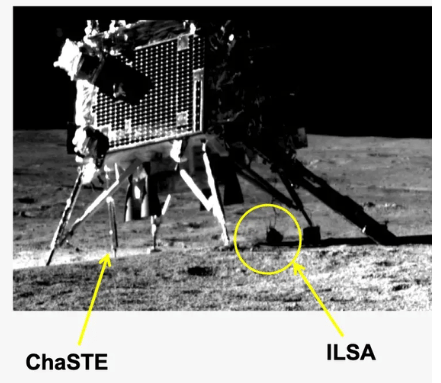
Breakthrough Discoveries on Lunar Water Ice
Scientists from the Physical Research Laboratory (PRL), Ahmedabad, analyzed lunar surface and subsurface temperature variations. Their study suggests that water ice extends beyond the Moon’s polar regions to higher latitudes, making it more widely distributed than earlier thought.
This discovery was made possible by the Chandra’s Surface Thermophysical Experiment (ChaSTE) onboard the Vikram lander. The experiment utilized a thermal probe with 10 custom-designed platinum resistance temperature detector (RTD) sensors to measure temperature variations up to 10 cm below the surface, identifying areas where water ice could remain stable.
What is Lunar Water Ice?
Lunar water ice consists of frozen water molecules trapped in regolith (surface soil) and permanently shadowed craters.
- Origin: Formed by cometary impacts, solar wind interactions, and past volcanic activity.
- Previously Known Locations: Earlier missions, including Chandrayaan-1, confirmed water ice mainly in the Moon’s polar regions, believed to be stable only in permanently shadowed craters.
- New Findings: Chandrayaan-3 data now suggests that water ice exists even at higher latitudes, including areas that experience temporary sunlight exposure.
Significance of the Discovery
1. Boost for Future Lunar Missions
- More accessible water ice reduces reliance on Earth’s water supplies, making long-term lunar exploration and settlements more feasible.
- Could support astronauts with drinking water, sanitation, and food production.
2. Potential for Fuel Production
- Water ice can be split into hydrogen and oxygen, essential for rocket fuel, supporting deep-space exploration.
3. Strategic Importance for Space-Faring Nations
- Countries like the US, China, Russia, and India can leverage this discovery to advance lunar bases and resource utilization.
Conclusion
Chandrayaan-3’s findings significantly enhance our understanding of lunar water ice distribution, paving the way for sustainable lunar exploration. This discovery strengthens India’s role in global space exploration while offering valuable insights for upcoming lunar missions and potential human settlements on the Moon.
Download the PREPP App and attempt FREE IAS Exam Mock Tests and get complete study material!

Live Test : UPSC CSE Prelims CSAT (Paper-II) (Oct 08 - 11)
Full Test - 04: UPSC CSE Prelims CSAT (Paper-II)
Full Test - 03: UPSC CSE Prelims CSAT (Paper-II)
UPSC CSE Prelims 2026 GS Paper 1 Question Paper (24-May-2026)
UPSC CSE Prelims 2026 CSAT Paper 2 Question Paper (24-May-2026)

17 February 2025 | The Hindu Must Read Articles | Current Affairs

16 February 2026 | The Hindu Must Read Articles | Current Affairs

13 February 2026 | The Hindu Must Read Articles | Current Affairs









Comments