All Exams Test series for 1 year @ ₹349 only

UPSC Psychology Syllabus for Optional Paper 1 and Paper 2

UPSC Psychology is an optional subject on the UPSC's list of optional subjects, which includes a total of 48 disciplines. The IAS exam syllabus has been framed by UPSC to test candidates’ ability to understand the subject as a science. Also, how they can apply their knowledge of the subject in solving the problem of people. Check other optional subject syllabi for the UPSC exam. 

Paper 1 Syllabus

UPSC Psychology Optional Paper 1 Syllabus:
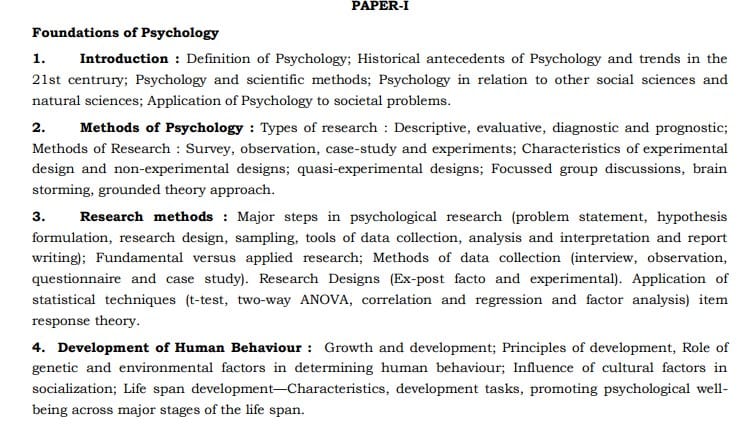
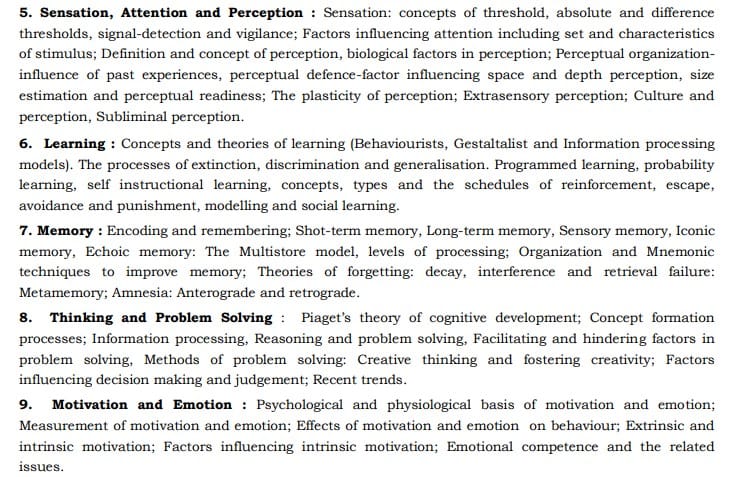
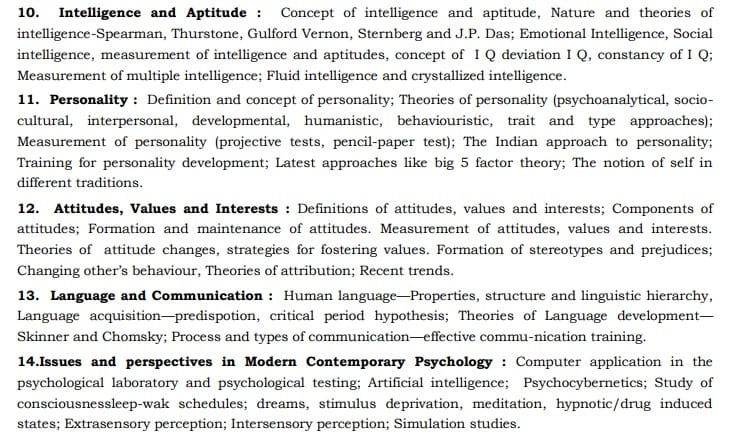
UPSC Psychology Syllabus- Syllabus for UPSC Psychology Paper-I - 1

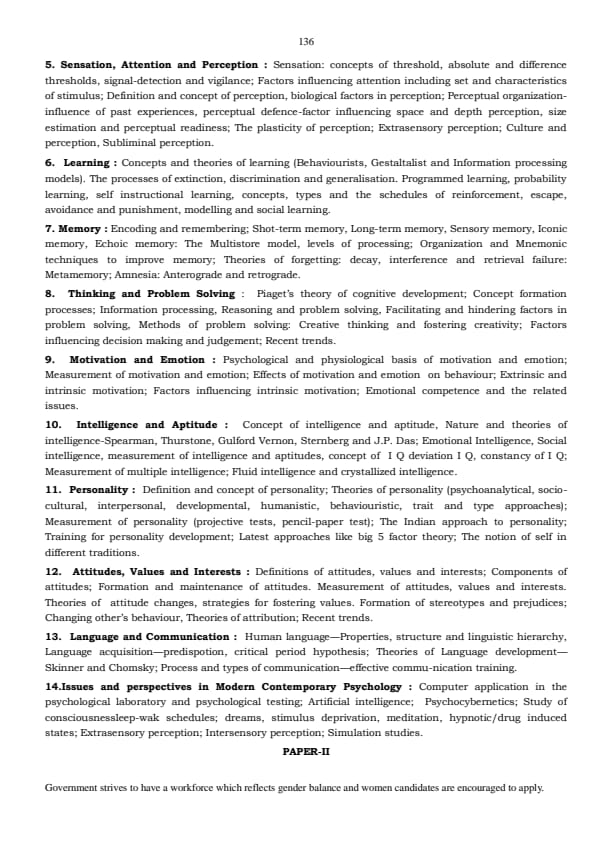
UPSC Psychology Syllabus- Syllabus for UPSC Psychology Paper-I - 2

UPSC Psychology Syllabus- Syllabus for UPSC Psychology Paper-I - 3

UPSC Psychology Optional Paper 1 syllabus is provided in the following table:

Subject Topics
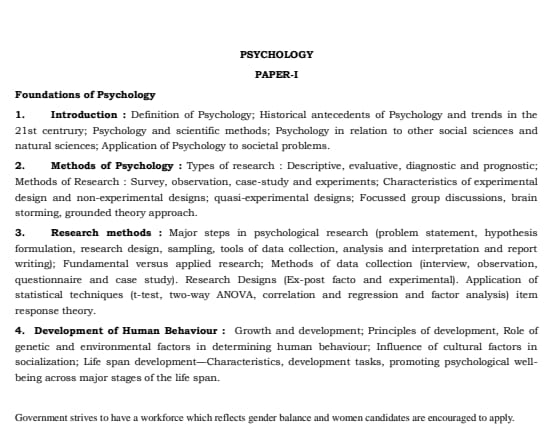
Introduction
  • Definition of Psychology
  • Relationship of psychology to other social and natural sciences
  • Application of Psychology to societal problems.
  • Psychology's historical roots and current tendencies in the twenty-first century
  • Psychology and scientific methods
Methods of Psychology
  • Descriptive, evaluative, diagnostic, and prognostic research
  • Experimental and non-experimental design characteristics; quasi-experimental designs
  • Focussed group discussions, brain storming, grounded theory approach.
  • Surveys, observations, case studies, and experiments were used as research methods.
Research methods
  • Psychological research's major milestones (problem statement, hypothesis formulation, research design, sampling, tools of data collection, analysis and interpretation and report writing)
  • Item response theory and statistical procedures (t-test, two-way ANOVA, correlation and regression, and factor analysis)
  • Methods of data collecting; Fundamental versus applied research (interview, observation, questionnaire and case study).
  • Research Designs (Ex-post facto and experimental).
Development of Human Behaviour
  • Cultural influences on socialisation; Life span development—characteristics, developmental activities, and fostering psychological well-being across key life stages
  • Growth and Development; Developmental Principles; The Role of Genetic and Environmental Factors in Human Behavior
Sensation, Attention and Perception
  • Concepts of threshold, absolute and differential thresholds, signal detection, and vigilance are all used to describe the sensation.
  • Attention is influenced by a variety of factors, including the stimulus's set and qualities. Perception's definition and concept, as well as biological variables that influence perception
  • Perceptual organization—the influence of previous experiences, perceptual defence—a factor influencing the perception of space and depth, size estimation, and perceptual readiness—are all factors that influence the perception of space and depth.
  • The plasticity of perception
  • Extrasensory perception
  • Culture and perception, Subliminal perception.
Learning
  • Learning theories and concepts (Behaviourists, Gestalt List and Information processing models).
  • Programmed learning, probabilistic learning, self-instructional learning, concepts, kinds, and reinforcement schedules, escape, avoidance, and punishment, modelling, and social learning are all examples of programmed learning.
  • The processes of extinction, discrimination and generalisation.
Memory
  • Short-term memory, long-term memory, sensory memory, and iconic memory are all examples of encoding and remembering.
  • Levels of processing in echoic memory: the Multistore model
  • Organization and Mnemonic techniques to improve memory
  • Deterioration, interference, and retrieval failure as theories of forgetting: Metamemory
  • Anterograde and retrograde amnesia.
Thinking and Problem Solving
  • Piaget’s theory of cognitive development
  • Concept formation processes
  • Information processing, reasoning, and problem-solving are all important skills to have. Factors that aid and obstruct issue resolution,
  • Problem-solving techniques include creative thinking and the encouragement of creativity.
  • Recent trends in decision-making and judgement; factors influencing decision-making and judgement
Motivation and Emotion
  • Motivation and emotion have a psychological and physiological basis.
  • Motivation and emotion measurement; motivation and emotion effects on behaviour
  • Extrinsic and intrinsic motivation
  • Factors influencing intrinsic motivation
  • Emotional competence and the related issues
Intelligence and Aptitude
  • Concept of intelligence and aptitude-Spearman, Thurstone, Guilford Vernon, Sternberg, and J.P. Das, Nature and theories of intelligence
  • Emotional intelligence, social intelligence, intelligence and aptitude testing, the notion of I Q variation I Q, and I Q constancy
  • Multiple intelligence measurement; fluid intelligence versus crystallised intelligence
Personality
  • Personality definition and concept; Personality theories (psychoanalytical, socio-cultural, interpersonal, developmental, humanistic, behaviouristic, trait and type approaches)
  • Measurement of personality (projective tests, pencil-paper test)
  • Personality development in India; Personality development training
  • Latest approaches like big 5-factor theory
  • The notion of self in different traditions.
Attitudes, Values and Interests
  • Definitions of attitudes, values and interests
  • Components of attitudes
  • Formation and maintenance of attitudes. Measurement of attitudes, values and interests. Theories of attitude change and ways of promoting values are discussed. Stereotypes and prejudices are formed.
  • Changing other people's behaviour, attribution theories, and current developments
Language and Communication
  • Properties, structure, and linguistic hierarchy of human language The critical period theory and language acquisition—predisposition
  • Skinner and Chomsky's theories of language development; process and forms of communication—effective communication training
Issues and Perspectives in Modern Contemporary Psychology
  • Artificial intelligence; Computer application in the psychological laboratory and psychological testing
  • The study of consciousness is known as psycho cybernetics. Dreams, stimuli deprivation, meditation, and hypnotic/drug-induced states are all examples of sleep-wake schedules.
  • Simulation research; extrasensory perception; intersensory perception
Paper 2 Syllabus

UPSC Psychology Optional Paper 2 Syllabus
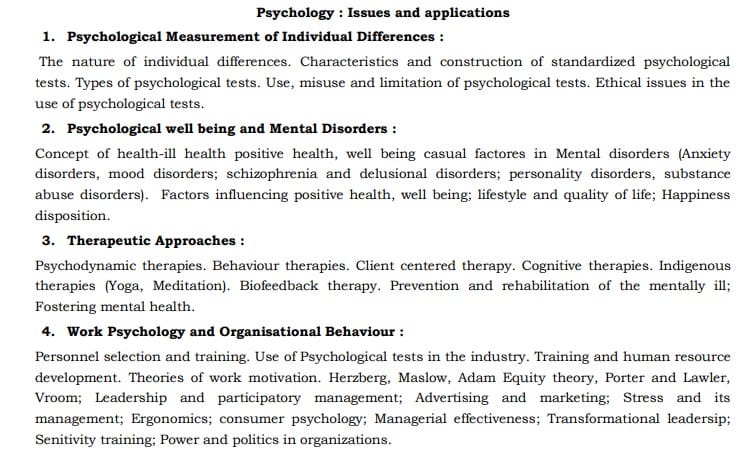
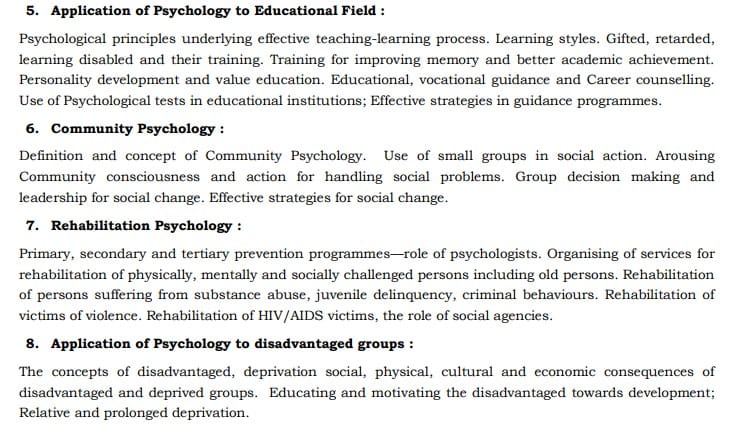
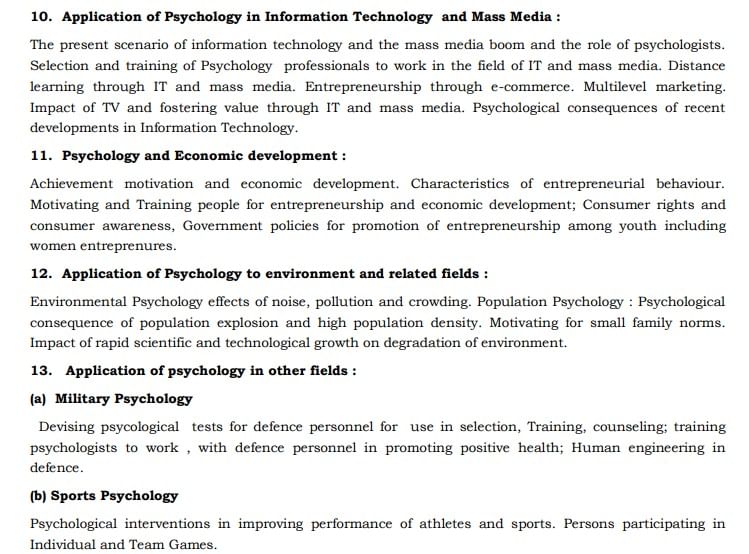
UPSC Psychology Syllabus- Syllabus for UPSC Psychology Paper-I - 1
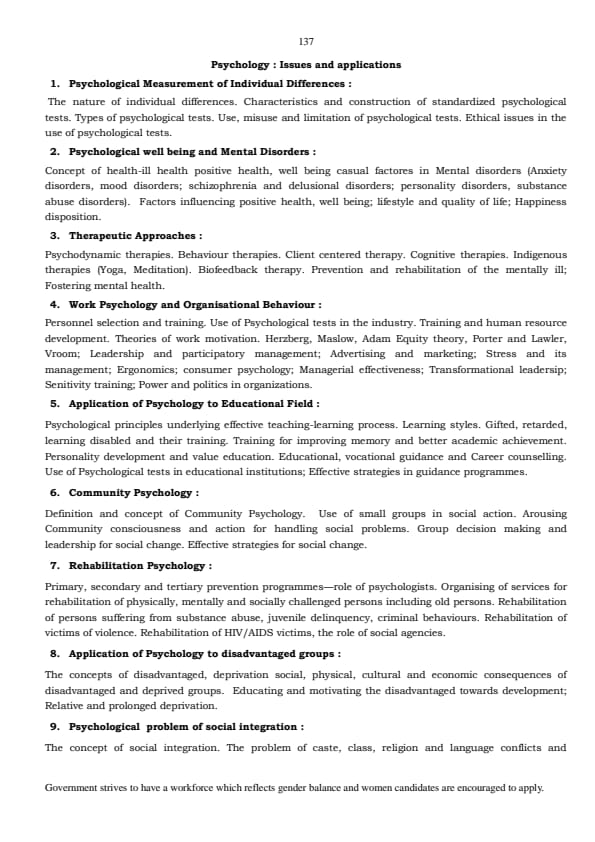
UPSC Psychology Syllabus- Syllabus for UPSC Psychology Paper-II - 2
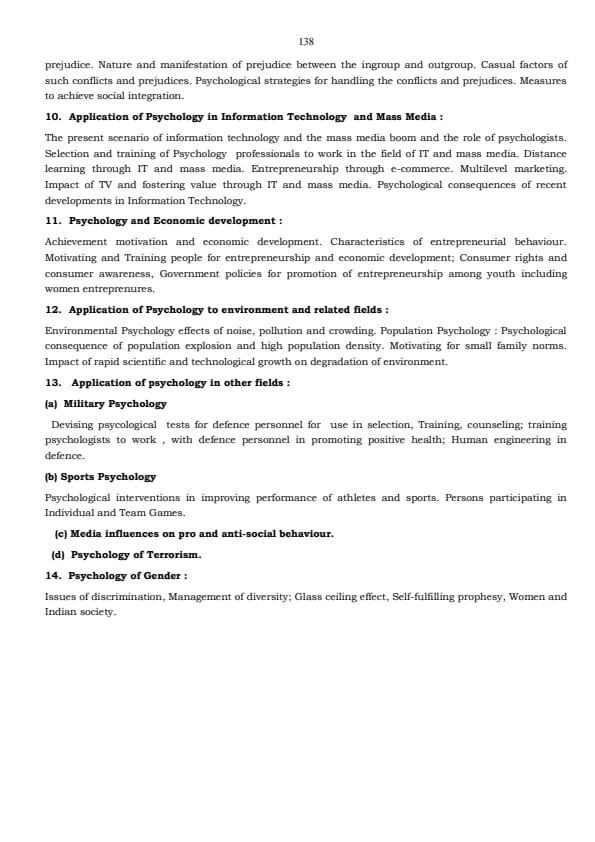
PSC Psychology Syllabus- Syllabus for UPSC Psychology Paper-II - 3
UPSC Psychology Syllabus- Syllabus for UPSC Psychology Paper-II - 4
UPSC Psychology Syllabus- Syllabus for UPSC Psychology Paper-II - 5
UPSC Psychology Syllabus- Syllabus for UPSC Psychology Paper-II - 6

UPSC Psychology Optional Paper 2 syllabus is provided in the following table:

Subject Topics
Psychological Measurement of Individual Differences
  • The nature of individual differences. Characteristics and construction of standardized psychological tests. Types of psychological tests.
  • Use, misuse and limitation of psychological tests.
  • Simulation research; extrasensory perception; intersensory perception
Psychological well being and Mental Disorders
  • Factors that influence good health and happiness; lifestyle and quality of life; and happiness disposition
  • The concepts of health-ill health, positive health, and well-being are causal aspects in mental diseases (Anxiety disorders, mood disorders; schizophrenia and delusional disorders; personality disorders, substance abuse disorders)
Therapeutic Approaches
  • Therapies used by indigenous peoples (Yoga, Meditation).
  • Biofeedback is a type of therapy that involves the use of biofeedback Mental health prevention and rehabilitation; mental health promotion
  • Psychodynamic therapies. Behaviour therapies. Client-centred therapy. Cognitive therapies.
Work Psychology and Organisational Behaviour
  • Leadership and participatory management; Advertising and marketing; Stress and its management; Herzberg, Maslow, Adam Equity theory, Porter and Lawler, Vroom
  • Human resource development and training.
  • Theories of work motivation.
  • Ergonomics; consumer psychology; Managerial effectiveness; Transformational leadership
  • Sensitivity training; Power and politics in organizations
  • Personnel selection and training. Use of Psychological tests in the industry.
Application of Psychology to Educational Field
  • Psychological principles underlying effective teaching-learning processes. Learning styles.
  • Gifted, retarded, learning disabled and their training. Training for improving memory and better academic achievement.
  • Personality development and value education. Educational, vocational guidance and career counselling.
  • Use of Psychological tests in educational institutions
  • Effective strategies in guidance programmes
Community Psychology
  • Definition and concept of Community Psychology. Use of small groups in social action.
  • Increasing community awareness and action in the face of social issues.
  • For social transformation, group decision-making and leadership are essential. Social transformation tactics that work
Rehabilitation Psychology
  • Psychologists' role in primary, secondary, and tertiary preventive programmes.
  • Persons suffering from substance abuse, juvenile delinquency, and criminal behaviour are rehabilitated.
  • Rehabilitation of victims of violence.
  • The involvement of social agencies in the rehabilitation of HIV/AIDS victims
  • Organizing rehabilitation services for physically, intellectually, and socially impaired people, particularly the elderly.
Application of Psychology to disadvantaged groups
  • Relative and long-term deprivation; Educating and encouraging the poor toward growth.
  • Disadvantaged, deprivation, and disadvantaged and deprived populations' social, physical, cultural, and economic effects
The psychological problem of social integration
  • Factors that cause such disagreements and prejudices. Psychological ways for dealing with prejudices and conflicts.
  • Measures to help people integrate into society
  • Social integration is a concept. Conflicts and discrimination are based on caste, class, religion, and language. Prejudice between ingroup and outgroup is both natural and visible.
Application of Psychology in Information Technology and Mass Media
  • The current state of information technology and the proliferation of mass media, as well as the function of psychologists.
  • Selection and training of psychologists to work in the fields of information technology and mass media.
  • Through the use of technology and the media, distance learning is possible. E-commerce as a means of entrepreneurship.
  • MLM stands for multi-level marketing. The impact of television and the promotion of value through technology and mass media
  • Recent advances in information technology have had psychological ramifications.
Psychology and Economic development
  • Achievement motivation and economic development.
  • Characteristics of entrepreneurial behaviour.
  • Motivating and training people for entrepreneurship and economic development
  • Consumer rights and consumer awareness
  • Government policies for the promotion of entrepreneurship among youth including women entrepreneurs.
Application of Psychology to the environment and related fields
  • Environmental Psychology effects of noise, pollution and crowding.
  • Population Psychology
  • Psychological consequence of population explosion and high population density.
  • Motivation for small family norms. Impact of rapid scientific and technological growth on degradation of the environment.
Application of psychology in other fields :
  • Military Psychology: Developing psychological assessments for use in selection, training, and counselling of defence personnel; educating psychologists to work with defence personnel in fostering positive health; Human engineering for defence purposes.
  • Gender Psychology: Discrimination, Diversity Management; Glass Ceiling Effect, Self-fulfilling Prophecy, Women in Indian Society
  • Sports psychology refers to psychological interventions aimed at boosting athletes' and sports' performance. Individuals and teams competing in individual and team games.
Exam Pattern

Download UPSC IAS Psychology Syllabus PDF
UPSC Psychology Exam Pattern 

The UPSC IAS exam is divided into three stages. A prelims exam, a mains exam, and an interview are all required of candidates. There are nine papers in the UPSC Mains exam, two of which are for optional courses. The following are the specifics of the psychological exam pattern for the IAS exam:

  • In the UPSC Mains test, there will be two papers for the psychology optional subject.
  • Each paper consists of 250 marks, for a total of 500 marks.
  • The UPSC psychology paper is of duration 3 hours.
  • There would be objective questions on each paper.
  • There is no negative marking. 

If you have chosen UPSC Psychology as an option for the UPSC Mains, you should solve UPSC Psychology's previous years' papers and analyse the performance. For their Psychology optional preparation, IAS applicants should also consult UPSC psychology books.

FAQs

UPSC Psychology FAQs:

Ques. What are the books to refer to for the UPSC Psychology syllabus?

Ans: Some of the best books to study in the UPSC psychology syllabus:

  • Abnormal Psychology & Modern Life James. C. Coleman
  • Achieving Society David McClelland
  • Theories of Personality Hall & Lindzey
  • Social Psychology Baron & Byrne
  • The Psychology of Small Group Shaw

Ques. Is there any difference between last year's UPSC IAS psychology syllabus and this year's?

Ans: No, there have been no major changes in the psychology syllabus as compared to last year.

Ques. What are the preparation tips for IAS exam?

Ans: The candidates can check out the preparation tips for the IAS exam below:

  • Candidates must prepare for UPSC Psychology as an optional subject.
  • Applicants must also check the IAS syllabus and exam pattern thoroughly.
  • Make short notes for last-minute revision
  • Practice previous year’s IAS question paper PDF.
*The article might have information for the previous academic years, please refer the official website of the exam.
How likely are you to recommend Prepp.in to a friend or a colleague?
Not so likely
Highly likely

Comments

No comments to show
UPSC CSE (IAS) 2027 Prelims Mock Test Series
Live Quizzes
Free
• Live
UPSC IAS : Culture of India: Indian Literature
12 Minutes
10 Questions
20 Marks
English, Hindi
HARD
Test will end in 08:29:20
View More
Quizzes
Free
24 July 2026 Daily CA Quiz for UPSC & State PSCs
8 Minutes
5 Questions
10 Marks
English, Hindi, Telugu +7 More
MEDIUM
Attempted by 434 aspirants in 12 hours
Free
23 July 2026 Daily CA Quiz for UPSC & State PSCs
8 Minutes
5 Questions
10 Marks
English, Hindi, Telugu +7 More
MEDIUM
Attempted by 425 aspirants in 12 hours
View More
Live Tests
Free
• Live
UPSC IAS : GS - Indian Economy - Subject Knowledge Test
35 Minutes
30 Questions
60 Marks
English, Hindi
Test will end in 16:29:20
plus
• Live
Live Test : UPSC CSE Prelims CSAT (Paper-II) (July 22 - 25)
120 Minutes
80 Questions
200 Marks
English, Hindi
MEDIUM
Test will end in 17:29:20
View More
Full Tests
Free
Full Test - 01: UPSC CSE Prelims CSAT (Paper-II)
120 Minutes
80 Questions
200 Marks
English, Hindi
MEDIUM
Attempted by 14 aspirants in 12 hours
Free
Full Test - 01: UPSC CSE Prelims GS 2027
120 Minutes
100 Questions
200 Marks
1,006 Attempted
English, Hindi
MEDIUM
Attempted by 12 aspirants in 12 hours
Previous Year Papers
plus
UPSC CSE Prelims 2026 GS Paper 1 Question Paper (24-May-2026)
120 Minutes
100 Questions
200 Marks
12,979 Attempted
English, Hindi
MEDIUM
Attempted by 107 aspirants in 12 hours
plus
UPSC CSE Prelims 2026 CSAT Paper 2 Question Paper (24-May-2026)

120 Minutes
80 Questions
200 Marks
12,970 Attempted
English, Hindi
MEDIUM
Attempted by 108 aspirants in 12 hours
View More