United Nations Security Council (UNSC) – Overview
Why in news?
On January 1, 2025, Pakistan entered the United Nations Security Council (UNSC) as an elected non-permanent member for a two-year term — its eighth.
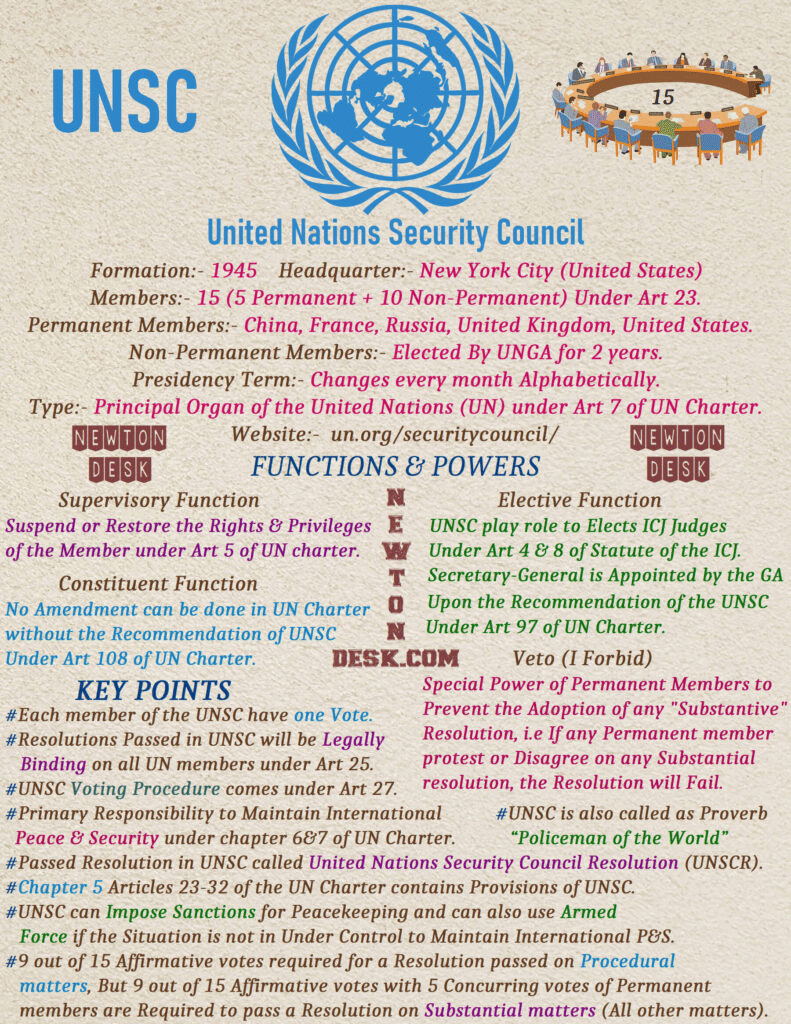
Introduction to UNSC
- The United Nations Security Council (UNSC) is one of the six principal organs of the United Nations (UN), with the primary responsibility of ensuring international peace and security.
- Established: In 1945, under the UN Charter, the UNSC was created to address global security concerns, prevent conflicts, impose sanctions, and authorize military interventions to maintain peace.
Composition of the UNSC
- Total Members: 15 members
- 5 Permanent Members (P5):
- Countries: United States, Russia (formerly the Soviet Union), China, France, and the United Kingdom.
- Veto Power: These nations have permanent membership and the ability to block substantive resolutions, significantly influencing the decisions of the UNSC.
- 10 Non-Permanent Members:
- Election: Elected by the UN General Assembly for a two-year term.
- Regional Groupings:
- Africa: 3 seats
- Asia-Pacific: 2 seats
- Latin America and the Caribbean: 2 seats
- Western Europe and Others: 3 seats
- Eastern Europe: 1 seat
- 5 Permanent Members (P5):
History and Mandate of UNSC
- Formation: The UNSC was established after World War II to prevent further conflicts and ensure global peace.
- Veto Power: The P5 nations were granted veto power to reflect their pivotal roles in the post-war reconstruction and to ensure their cooperation in peacekeeping efforts. However, this structure has faced criticisms over time for its inequity.
- Primary Mandate:
- Maintain International Peace: Identifying and addressing threats to global stability.
- Peacekeeping Operations: Deploying peacekeeping missions in conflict zones.
- Sanctions and Military Actions: The UNSC has the authority to impose sanctions or authorize military interventions to restore peace.
Election Process for Non-Permanent Members
- Term: Non-permanent members serve a two-year term, with five seats up for election annually.
- Regional Groupings: To ensure diverse representation, the seats are allocated based on regional groupings:
- Africa: 3 seats
- Asia-Pacific: 2 seats
- Latin America and the Caribbean: 2 seats
- Western Europe and Others: 3 seats
- Eastern Europe: 1 seat
- Majority Required: A two-thirds majority in the General Assembly is required for the election of non-permanent members.
- Regional Consensus: Regional groups often agree on their candidates, ensuring balanced representation within the UNSC.
Role of the UNSC
- Determine Threats to Peace: The UNSC identifies threats to peace or acts of aggression and takes necessary actions to address them.
- Actions to Restore Peace: The UNSC may authorize military interventions or impose sanctions to restore global peace.
- Peacekeeping Operations: The UNSC can establish and oversee peacekeeping missions to manage conflicts and maintain peace.
- Humanitarian Interventions: The UNSC has the authority to authorize interventions aimed at addressing humanitarian crises.
Demand for UNSC Reforms
- Veto Power: The veto power of the P5 has been widely criticized for allowing a few nations to block key decisions, which undermines the effectiveness of the UNSC in addressing pressing global challenges.
- Representation Issues: Critics argue that the current composition does not reflect the current global power dynamics, especially with emerging economies such as India, Brazil, and the rise of African countries.
- Regional Imbalance: Despite the inclusion of non-permanent members from various regions, some regions like Africa and Latin America argue they are underrepresented in terms of permanent membership.
Challenges Faced by the UNSC
- Veto Power and Inefficiency: The veto power of the permanent members often paralyzes the UNSC, preventing meaningful action on global issues. This is particularly evident when a permanent member has a vested interest in blocking resolutions.
- Calls for Reforms: There is an ongoing debate about the need for reforms in the UNSC to make it more representative and responsive to the evolving geopolitical landscape. Proposals include expanding the number of permanent members and addressing the regional disparities in representation.
Conclusion
- The UNSC remains a crucial body for addressing global security issues and maintaining peace, but its structure and decision-making powers are often viewed as outdated.
- Reforms are increasingly seen as necessary to enhance the UNSC’s legitimacy and effectiveness in dealing with contemporary global challenges. This includes addressing concerns about the P5 veto and improving representation for emerging and underrepresented regions.
Download the PREPP App and attempt FREE IAS Exam Mock Tests and get complete study material!
*The article might have information for the previous academic years, please refer the official website of the exam.
How likely are you to recommend Prepp.in to a friend or a colleague?
Not so likely
Highly likely
UPSC CSE (IAS) 2027 Prelims Mock Test Series
Live Quizzes
Quizzes
Live Tests

• Live
Live Test : UPSC CSE Prelims CSAT (Paper-II) (Oct 08 - 11)
120 Minutes
80 Questions
200 Marks
English, Hindi
MEDIUM
Test will end in 05:31:06
Full Tests
Full Test - 04: UPSC CSE Prelims CSAT (Paper-II)
120 Minutes
80 Questions
200 Marks
English, Hindi
MEDIUM
Attempted by 19 aspirants in 12 hours
Full Test - 03: UPSC CSE Prelims CSAT (Paper-II)
120 Minutes
80 Questions
200 Marks
English, Hindi
MEDIUM
Attempted by 20 aspirants in 12 hours
Previous Year Papers
UPSC CSE Prelims 2026 GS Paper 1 Question Paper (24-May-2026)
120 Minutes
100 Questions
200 Marks
2,989 Attempted
English, Hindi
MEDIUM
Attempted by 12 aspirants in 12 hours
UPSC CSE Prelims 2026 CSAT Paper 2 Question Paper (24-May-2026)
120 Minutes
80 Questions
200 Marks
3,167 Attempted
English, Hindi
MEDIUM
Attempted by 13 aspirants in 12 hours
Videos

17 February 2025 | The Hindu Must Read Articles | Current Affairs
7,202 Views
•4
•7 months ago

16 February 2026 | The Hindu Must Read Articles | Current Affairs
6,962 Views
•4
•7 months ago

13 February 2026 | The Hindu Must Read Articles | Current Affairs
8,765 Views
•5
•7 months ago

12 February 2026 | The Hindu Must Read Articles | Current Affairs
5,788 Views
•4
•7 months ago






Also Check
IAS Exam Overview
IAS Exam Admit Card
IAS Exam Question Paper 2026
IAS Exam Mains Syllabus
IAS Exam Application Process
IAS Exam Eligibility
IAS Exam Result
IAS Exam Exam Pattern
IAS Exam CSAT Syllabus
IAS Exam Answer Key
IAS Exam Previous Year Paper
IAS Exam Current Affairs
IAS Exam Mains Question Paper
IAS Exam IAS Courses
IAS Exam UPSC Study Notes
IAS Exam Foundation Course 2024
IAS Exam Prelims Question Paper
IAS Exam Exam Center
IAS Exam Foundation Course 2025
IAS Exam Notification 2026
IAS Exam IAS Success Stories
IAS Exam Salary
IAS Exam Cutoff
IAS Exam Mock Tests
IAS Exam News


Comments