Understanding Rat-Hole Mining: Issues, Impact, and Solutions in Northeast India
Why in news?
- In Dima Hasao district of Assam, at least nine workers aged between 26 and 57 were trapped in a coal “rat-hole” mine after it was flooded with water on Monday (January 6) morning.
What is Rat-Hole Mining?
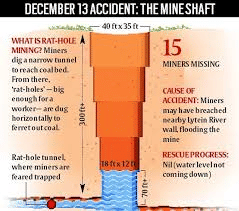
- Rat-hole mining is a traditional method of coal extraction widely used in the northeastern states of India, especially in Meghalaya and Assam.
- It involves digging narrow, horizontal tunnels, just large enough for a single person to crawl through.
- This rudimentary mining method is adopted due to the challenging hilly terrain and the economic reliance on coal mining in the region.
![Rat-Hole Mining]()
Prevalence and Causes of Rat-Hole Mining in Northeast India
- Rat-hole mining is prevalent in areas with steep slopes and coal deposits that are difficult to mine using conventional methods.
- Poverty and the lack of alternative livelihoods are significant drivers, as coal mining provides a source of income for many local communities.
- The economic feasibility and immediate employment benefits make this method continue despite its dangers.
Types of Rat-Hole Mining
- Side-Cutting Mining: Narrow tunnels are dug into hill slopes to reach the coal seam. This method is used when the coal seams are thin, typically under 2 meters deep.
- Box-Cutting Mining: A rectangular opening is created on the surface, followed by the digging of a vertical pit to reach the coal seam. Once the coal is located, horizontal tunnels are created for extraction.
Environmental and Safety Hazards of Rat-Hole Mining
- Environmental Damage: Rat-hole mining has devastating effects on the environment, causing severe land degradation, deforestation, and water pollution. Rivers like Lukha and Myntdu have become too toxic to sustain aquatic life, with high levels of sulphates and toxic heavy metals.
- Health and Safety Risks: The lack of proper ventilation and structural support in rat-hole mines increases the risk of mine collapses and flooding. Workers are also exposed to dangerous coal dust, leading to respiratory diseases.
Legal and Regulatory Issues
- Despite being banned by the National Green Tribunal (NGT) in 2014 due to its hazardous nature, rat-hole mining continues illegally in many areas.
- The Mines and Minerals (Development and Regulation) Act, 1957 and the Environmental Protection Act, 1986 are often bypassed, allowing unregulated mining to persist. Enforcement of mining laws has remained weak, allowing the practice to thrive.
Social Impact of Rat-Hole Mining
- Rat-hole mining has severe social consequences, including child labor and poor working conditions for miners.
- Workers, often from marginalized communities, face exploitation and are paid very little for their labor.
- Additionally, the displacement of local populations due to environmental degradation is a growing concern.
Challenges in Eradicating Rat-Hole Mining
- The high demand for coal and lack of alternative employment opportunities in mining areas make it difficult to phase out rat-hole mining.
- Despite legal bans, enforcement remains weak, and miners continue to rely on this unsafe and unregulated method for survival.
Solutions to Address Rat-Hole Mining in India
- Stronger Legal Enforcement: The government must ensure strict implementation of mining laws such as the Mines and Minerals (Development and Regulation) Act, 1957. Regular inspections and penalties for illegal mining activities will reduce rat-hole mining.
- Adoption of Sustainable Mining Practices: Transitioning to mechanized and scientific mining techniques can minimize the environmental impact and ensure worker safety.
- Promotion of Alternative Livelihoods: Offering education, vocational training, and creating job opportunities in sectors like agriculture, eco-tourism, and handicrafts can help reduce reliance on hazardous mining practices.
- Child Labor Prevention: Strict enforcement of the Child Labor (Prohibition and Regulation) Act, 1986 is crucial. Initiatives to provide education, scholarships, and community development programs can help eradicate child labor in mining areas.
Conclusion
- Rat-hole mining in Northeast India poses significant environmental, health, and social risks. Despite its economic importance to local communities, the long-term costs outweigh the benefits.
- To address this issue, it is essential to strengthen legal enforcement, promote sustainable mining practices, and offer alternative livelihoods.
- By doing so, India can move towards a safer, more environmentally-friendly, and sustainable approach to coal mining.
Download the PREPP App and attempt FREE IAS Exam Mock Tests and get complete study material!
*The article might have information for the previous academic years, please refer the official website of the exam.
How likely are you to recommend Prepp.in to a friend or a colleague?
Not so likely
Highly likely
UPSC CSE (IAS) 2027 Prelims Mock Test Series
Live Quizzes
Quizzes
Live Tests

• Live
Live Test : UPSC CSE Prelims CSAT (Paper-II) (Oct 08 - 11)
120 Minutes
80 Questions
200 Marks
English, Hindi
MEDIUM
Test will end in 05:30:44
Full Tests
Full Test - 04: UPSC CSE Prelims CSAT (Paper-II)
120 Minutes
80 Questions
200 Marks
English, Hindi
MEDIUM
Attempted by 19 aspirants in 12 hours
Full Test - 03: UPSC CSE Prelims CSAT (Paper-II)
120 Minutes
80 Questions
200 Marks
English, Hindi
MEDIUM
Attempted by 20 aspirants in 12 hours
Previous Year Papers
UPSC CSE Prelims 2026 GS Paper 1 Question Paper (24-May-2026)
120 Minutes
100 Questions
200 Marks
2,989 Attempted
English, Hindi
MEDIUM
Attempted by 12 aspirants in 12 hours
UPSC CSE Prelims 2026 CSAT Paper 2 Question Paper (24-May-2026)
120 Minutes
80 Questions
200 Marks
3,167 Attempted
English, Hindi
MEDIUM
Attempted by 13 aspirants in 12 hours
Videos

17 February 2025 | The Hindu Must Read Articles | Current Affairs
7,202 Views
•4
•7 months ago

16 February 2026 | The Hindu Must Read Articles | Current Affairs
6,962 Views
•4
•7 months ago

13 February 2026 | The Hindu Must Read Articles | Current Affairs
8,765 Views
•5
•7 months ago

12 February 2026 | The Hindu Must Read Articles | Current Affairs
5,788 Views
•4
•7 months ago






Also Check
IAS Exam Overview
IAS Exam Admit Card
IAS Exam Question Paper 2026
IAS Exam Mains Syllabus
IAS Exam Application Process
IAS Exam Eligibility
IAS Exam Result
IAS Exam Exam Pattern
IAS Exam CSAT Syllabus
IAS Exam Answer Key
IAS Exam Previous Year Paper
IAS Exam Current Affairs
IAS Exam Mains Question Paper
IAS Exam IAS Courses
IAS Exam UPSC Study Notes
IAS Exam Foundation Course 2024
IAS Exam Prelims Question Paper
IAS Exam Exam Center
IAS Exam Foundation Course 2025
IAS Exam Notification 2026
IAS Exam IAS Success Stories
IAS Exam Salary
IAS Exam Cutoff
IAS Exam Mock Tests
IAS Exam News


Comments