Understanding India's Trade Deficit: Key Trends and Driving Factors
Why in the News?
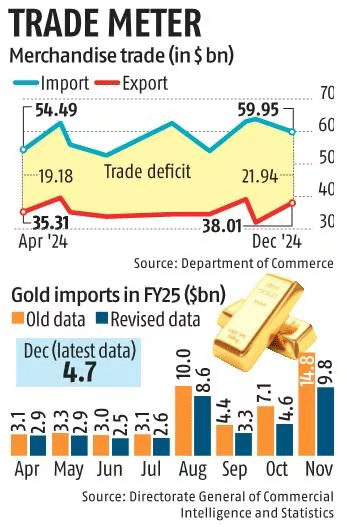
India’s goods exports contracted by 1% year-on-year in December 2024, as per recent reports. This article explores the trends and factors shaping the nation’s trade deficit.
Understanding Trade Deficit
A trade deficit occurs when a country’s imports surpass its exports within a specific period, leading to a negative balance of trade (BOT).
Components of Trade Deficit
- Categories: Trade deficits can involve goods, services, or a combination of both.
- Key Dynamics: While it may reflect increased domestic consumption, it can also signify structural economic issues.
Advantages of a Trade Deficit
- Currency Depreciation: A weaker currency can enhance export competitiveness globally.
- Foreign Investment: Trade deficits may attract foreign investments that bolster economic growth.
Disadvantages of a Trade Deficit
- Dependency Risks: Persistent deficits can increase reliance on imports and harm domestic industries.
- Loss of Control: Foreign entities might gain control over critical national assets.
Current Trends in India’s Trade Deficit
Recent Deficit Data
- Improved Figures: India’s trade deficit narrowed to $21.9 billion in December 2024, marking a three-month low, compared to November’s record-high $31.8 billion.
- Economic Resilience: This improvement highlights the robustness of India’s economy.
Exports and Imports
- Exports: Contracted by 1% year-on-year, totaling $38 billion.
- Imports: Increased by 4.9% to nearly $60 billion.
Annual Cumulative Trends (April to December 2024)
- Exports: Marginal growth of 1.6% to $321.7 billion.
- Imports: Rose by 5.15% to $532.5 billion.
- Total Trade Deficit: Climbed to $210.8 billion, an 11.1% year-on-year increase.
Factors Behind Export Contraction
Commodity Price Volatility
- Global fluctuations, particularly in petroleum prices, caused a 28.6% decline in petroleum product exports during December 2024.
Currency and Logistics Challenges
- Depreciation: Weakening of the Indian Rupee impacted export costs.
- Logistical Issues: Disruptions affected trade flows to Europe, Africa, and the Commonwealth of Independent States (CIS).
Sectoral Dynamics
- Non-Petroleum Exports: Resilient growth of 5.05% in December 2024 and 7.05% for the April–December period.
- Petroleum Products: Weak demand significantly dragged overall performance.
Geopolitical Factors
- Market Access Limitations: Trade restrictions and tariff wars restricted growth opportunities.
- Global Uncertainties: Geopolitical tensions disrupted trade with key partners.
Conclusion
India’s trade deficit reflects complex interplays of global and domestic factors. While recent improvements suggest resilience, persistent challenges necessitate strategic interventions to bolster exports and mitigate dependency on imports. Addressing logistical, sectoral, and geopolitical hurdles will be crucial for sustainable economic growth.
Download the PREPP App and attempt FREE IAS Exam Mock Tests and get complete study material!
Live Test : UPSC IAS : GS - Indian Geography - Subject Knowledge Test

Live Test : UPSC CSE Prelims CSAT (Paper-II) (Oct 08 - 11)
Full Test - 04: UPSC CSE Prelims CSAT (Paper-II)
Full Test - 03: UPSC CSE Prelims CSAT (Paper-II)
UPSC CSE Prelims 2026 GS Paper 1 Question Paper (24-May-2026)
UPSC CSE Prelims 2026 CSAT Paper 2 Question Paper (24-May-2026)

17 February 2025 | The Hindu Must Read Articles | Current Affairs

16 February 2026 | The Hindu Must Read Articles | Current Affairs

13 February 2026 | The Hindu Must Read Articles | Current Affairs









Comments