Understanding Endocrine Glands and Hormonal Regulation
Why in the News?
Researchers at the Weizmann Institute in Israel have recently unveiled why endocrine glands vary in size. Their groundbreaking study reveals that the size of an endocrine gland is directly proportional to the number of target cells it influences.
Key Insights:
- Adrenal Cortex: A larger gland that secretes cortisol, targeting billions of cells throughout the body.
- Parathyroid Gland: Much smaller, focusing on specific organs like the kidneys and pancreas by secreting parathyroid hormone.
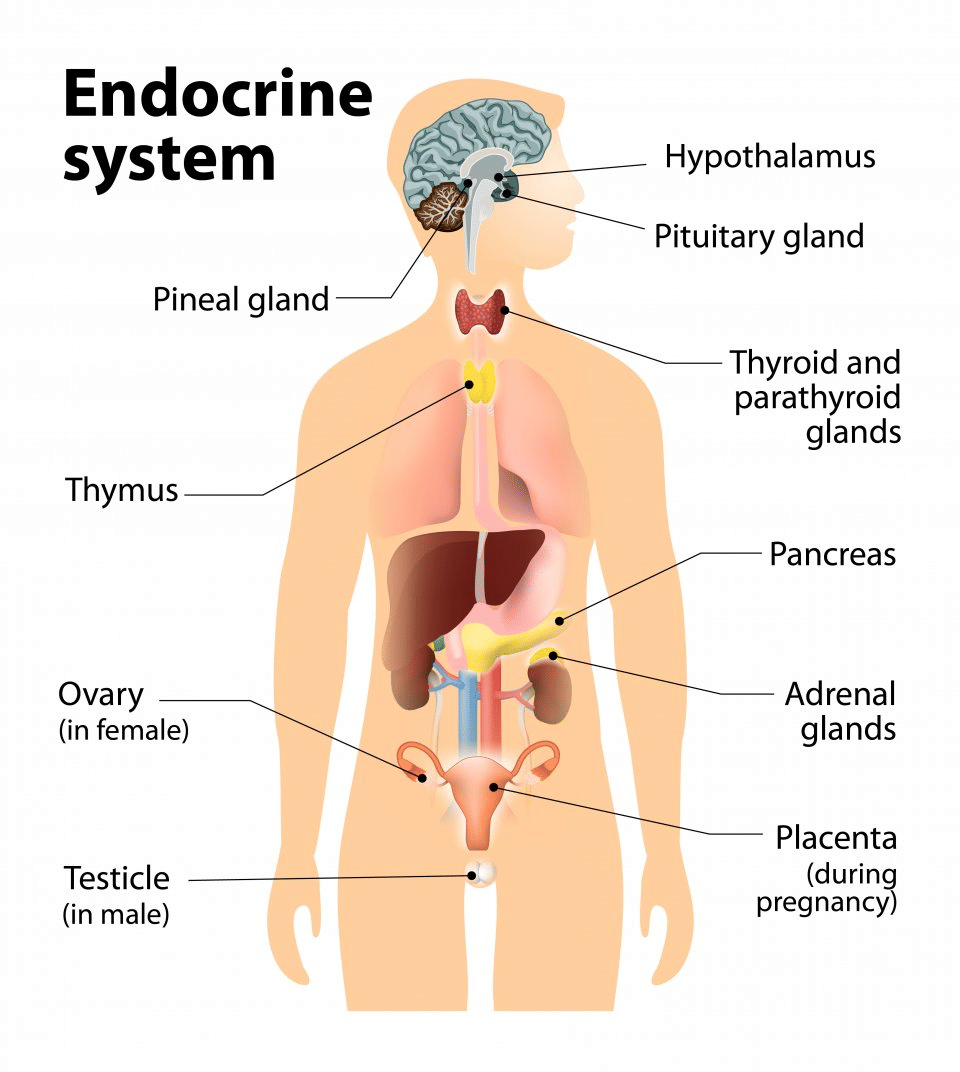
Overview of the Endocrine System
The endocrine system is a sophisticated messenger network that utilizes hormones to regulate various physiological processes in the body.
Components of the Endocrine System:
- Thyroid Gland: Produces thyroxine to regulate metabolism.
- Pituitary Gland: Known as the “Master Gland” for its role in controlling growth, reproduction, and other critical functions.
- Adrenal Glands: Releases adrenaline and cortisol for stress and metabolic regulation.
- Pineal Gland: Secretes melatonin to manage sleep cycles.
- Pancreas: Produces insulin to regulate blood sugar levels.
- Reproductive Organs: Ovaries and testes produce hormones like estrogen and testosterone.
What Makes Endocrine Glands Unique?
- Ductless Nature: Endocrine glands release hormones directly into the bloodstream, enabling them to act on distant organs efficiently.
- Dual Role: Glands like the pancreas serve both endocrine (hormonal) and exocrine (enzyme-producing) functions.
Exploring Hormones: The Body's Chemical Messengers
Hormones are signaling molecules that interact with receptors on target cells to regulate physiology and behavior.
Types of Hormones:
- Amino Acid-Based Hormones: Water-soluble, act on cell surfaces. Examples include insulin and thyroxine.
- Steroid Hormones: Lipid-soluble, penetrate cells to act on their nuclei. Examples include cortisol and testosterone.
- Eicosanoids: Play a role in local signaling processes.
Hormonal Examples:
- Thyroxine: Regulates metabolism (Thyroid Gland).
- Adrenaline: Triggers the fight-or-flight response (Adrenal Glands).
- Insulin: Controls blood sugar levels (Pancreas).
Functions of Endocrine Glands
- Growth and Development: Hormones like growth hormone (pituitary) ensure proper body development.
- Metabolism: Thyroid hormones maintain energy balance and metabolic rate.
- Stress Response: Adrenal glands release cortisol and adrenaline to prepare for emergencies.
- Reproduction: Gonadal hormones (testosterone, estrogen) regulate reproductive health.
- Sleep Regulation: Melatonin from the pineal gland oversees sleep-wake cycles.
- Homeostasis: Maintains balance in blood glucose, calcium levels, and other vital parameters.
Endocrine-Related Diseases
- Diabetes Mellitus:
- Caused by insulin deficiency or resistance, leading to high blood sugar levels.
- Thyroid Disorders:
- Hypothyroidism: Insufficient thyroxine, causing fatigue and weight gain.
- Hyperthyroidism: Excess thyroxine (e.g., Graves’ disease), leading to weight loss and heat intolerance.
- Adrenal Disorders:
- Cushing’s Disease: Excess cortisol, causing obesity and high blood pressure.
- Addison’s Disease: Cortisol deficiency, leading to fatigue and low blood pressure.
- Pituitary Disorders: Hormonal disruptions affecting multiple systems.
Preventive Measures:
- Regular exercise.
- Balanced diet rich in nutrients.
- Routine health check-ups to detect hormonal imbalances early.
Download the PREPP App and attempt FREE IAS Exam Mock Tests and get complete study material!
*The article might have information for the previous academic years, please refer the official website of the exam.
How likely are you to recommend Prepp.in to a friend or a colleague?
Not so likely
Highly likely
UPSC CSE (IAS) 2027 Prelims Mock Test Series
Live Quizzes
Quizzes
Live Tests

• Live
Live Test : UPSC CSE Prelims CSAT (Paper-II) (Oct 08 - 11)
120 Minutes
80 Questions
200 Marks
English, Hindi
MEDIUM
Test will end in 05:30:44
Full Tests
Full Test - 04: UPSC CSE Prelims CSAT (Paper-II)
120 Minutes
80 Questions
200 Marks
English, Hindi
MEDIUM
Attempted by 19 aspirants in 12 hours
Full Test - 03: UPSC CSE Prelims CSAT (Paper-II)
120 Minutes
80 Questions
200 Marks
English, Hindi
MEDIUM
Attempted by 20 aspirants in 12 hours
Previous Year Papers
UPSC CSE Prelims 2026 GS Paper 1 Question Paper (24-May-2026)
120 Minutes
100 Questions
200 Marks
2,989 Attempted
English, Hindi
MEDIUM
Attempted by 12 aspirants in 12 hours
UPSC CSE Prelims 2026 CSAT Paper 2 Question Paper (24-May-2026)
120 Minutes
80 Questions
200 Marks
3,167 Attempted
English, Hindi
MEDIUM
Attempted by 13 aspirants in 12 hours
Videos

17 February 2025 | The Hindu Must Read Articles | Current Affairs
7,202 Views
•4
•7 months ago

16 February 2026 | The Hindu Must Read Articles | Current Affairs
6,962 Views
•4
•7 months ago

13 February 2026 | The Hindu Must Read Articles | Current Affairs
8,765 Views
•5
•7 months ago

12 February 2026 | The Hindu Must Read Articles | Current Affairs
5,788 Views
•4
•7 months ago






Also Check
IAS Exam Overview
IAS Exam Admit Card
IAS Exam Question Paper 2026
IAS Exam Mains Syllabus
IAS Exam Application Process
IAS Exam Eligibility
IAS Exam Result
IAS Exam Exam Pattern
IAS Exam CSAT Syllabus
IAS Exam Answer Key
IAS Exam Previous Year Paper
IAS Exam Current Affairs
IAS Exam Mains Question Paper
IAS Exam IAS Courses
IAS Exam UPSC Study Notes
IAS Exam Foundation Course 2024
IAS Exam Prelims Question Paper
IAS Exam Exam Center
IAS Exam Foundation Course 2025
IAS Exam Notification 2026
IAS Exam IAS Success Stories
IAS Exam Salary
IAS Exam Cutoff
IAS Exam Mock Tests
IAS Exam News


Comments