Understanding Dual Citizenship: Laws, Benefits, and Challenges
Why in the News?
External Affairs Minister S. Jaishankar recently highlighted that the Overseas Citizenship of India (OCI) initiative is a step towards addressing the demand for dual citizenship, stating that the debate around dual citizenship in India remains "still alive."
What is Dual Citizenship?
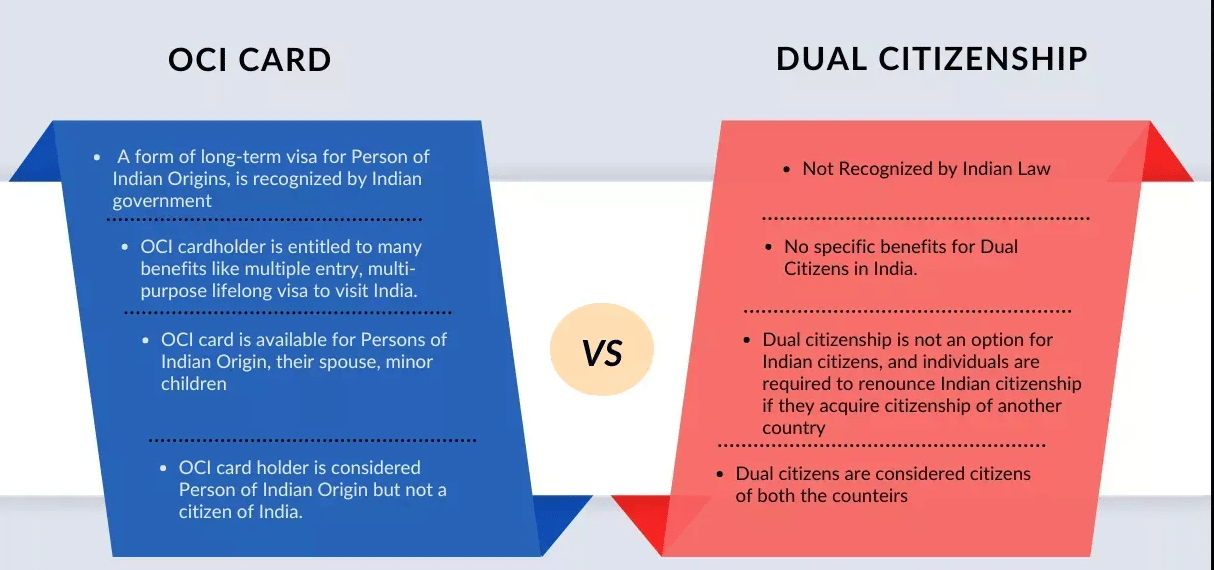
Dual citizenship refers to the possession of citizenship in two countries simultaneously, allowing individuals to enjoy rights and responsibilities in both nations.
Global Examples
Countries like the United States, Finland, Albania, Israel, and Pakistan allow dual citizenship.
India’s Stance on Dual Citizenship
- Prohibition: The Indian Constitution prohibits dual citizenship. Indian nationals must renounce their Indian citizenship upon acquiring foreign citizenship.
- Relevant Laws:
- Article 9: Bars Indian citizenship if a person voluntarily acquires citizenship of another country.
- Citizenship Act, 1955: Details the acquisition and termination of Indian citizenship.
- Reason for Restriction: Concerns over divided political loyalties and national security issues.
Overseas Citizenship of India (OCI)
Eligibility for OCI
- Foreign nationals of Indian origin who were eligible to become Indian citizens on January 26, 1950, or were Indian citizens after this date.
- Individuals from territories that joined India post-August 15, 1947.
- Exclusions: Former citizens of Pakistan and Bangladesh.
Benefits of OCI
- Visa-Free Travel: Lifetime, multiple-entry travel privileges.
- Economic Opportunities: Parity with Non-Resident Indians (NRIs) in economic and financial domains, excluding agricultural property.
- Exemption from Reporting: OCI holders are exempt from police registration irrespective of their stay duration.
- Pathway to Citizenship: OCI holders can apply for Indian citizenship after five years, provided they reside in India for at least one year
Person of Indian Origin (PIO)
Eligibility for PIO
- Individuals with Indian ancestry up to four generations (excluding Pakistan, Bangladesh, China, Iran, Bhutan, Sri Lanka, Afghanistan, and Nepal).
- Spouses of Indian citizens or PIOs.
Benefits of PIO
- Extended Visa Validity: 15 years of visa-free travel.
- Economic Privileges: Parity with NRIs for educational quotas and housing schemes.
- Simplified Procedures: Exemption from registering with FRRO/FRO for stays under 180 days.
- Transition to OCI: In 2015, PIO cards were replaced by OCI cards for enhanced benefits.
Non-Resident Indians (NRIs)
Eligibility for NRIs
- Indian citizens residing abroad for employment, education, or other purposes.
- Defined under the Income Tax Act as individuals staying outside India for 182+ days in a financial year.
Benefits of NRIs
- Political Rights: NRIs can vote in Indian elections.
- Economic Opportunities: Ownership of property (excluding agricultural land) and access to financial markets.
- Educational Access: Reserved seats in Indian institutions.
- Cultural Connectivity: Strong cultural and social ties with India.
Why Consider Dual Citizenship in India?
Benefits for India
- Strengthening Diaspora Ties: Encourages cultural and economic exchanges.
- Facilitating Mobility: Simplifies travel for diasporic Indians.
- Economic Contributions: Boosts investments and entrepreneurial ventures.
- Leveraging Expertise: Taps into global networks and skills.
Benefits for Individuals
- Cultural and Emotional Bonds: Helps maintain cultural identity and emotional ties.
- Ease of Travel: Eliminates visa requirements.
- Economic Opportunities: Encourages investments in India.
- Social and Educational Benefits: Easier access to healthcare and education
Criticism and Challenges
Criticism of Dual Citizenship
- Divided Loyalties: May lead to conflicting political and national allegiances.
- National Security Risks: Potential exploitation by individuals with conflicting interests.
- Political Influence: External interference in domestic governance.
- Economic Inequities: Benefits may favor wealthier diasporic Indians.
Challenges for Implementation
- Legal Barriers: Requires constitutional and legislative amendments.
- Political Sensitivities: Concerns over sovereignty and national integrity.
- Operational Hurdles: Need for robust administrative systems.
Global Lessons and Way Forward
- Careful Policy Framing: Explore tiered citizenship models offering limited privileges without political rights.
- Engagement with Diaspora: Strengthen OCI and other diaspora-focused initiatives.
- Learn from Other Nations: Study the dual citizenship frameworks of countries like the U.S., Canada, and Australia.
- Pilot Programs: Collaborate with select countries to test feasibility.
- Public Consultation: Involve stakeholders, including diaspora representatives, to create a balanced policy.
Case Study: Singapore
Singapore’s single citizenship policy maintains national cohesion while leveraging its diaspora’s economic potential.
Conclusion
India’s approach to dual citizenship requires balancing the benefits of stronger diaspora engagement with risks to national security and political integrity. A thoughtful policy, incorporating lessons from global examples, could maximize the advantages while addressing concerns effectively.
Download the PREPP App and attempt FREE IAS Exam Mock Tests and get complete study material!

Live Test : UPSC CSE Prelims CSAT (Paper-II) (Oct 08 - 11)
Full Test - 04: UPSC CSE Prelims CSAT (Paper-II)
Full Test - 03: UPSC CSE Prelims CSAT (Paper-II)
UPSC CSE Prelims 2026 GS Paper 1 Question Paper (24-May-2026)
UPSC CSE Prelims 2026 CSAT Paper 2 Question Paper (24-May-2026)

17 February 2025 | The Hindu Must Read Articles | Current Affairs

16 February 2026 | The Hindu Must Read Articles | Current Affairs

13 February 2026 | The Hindu Must Read Articles | Current Affairs









Comments