Undersea Cable: The Next Frontier in Global Connectivity
Why in the News?
Two groundbreaking submarine cable systems, the India Asia Xpress (IAX) and India Europe Xpress (IEX), are set to go live in just three months. These advanced systems promise to revolutionize connectivity between India, Europe, and Asia, significantly enhancing data transmission capabilities and resilience.
Key Highlights of the New Cables
- Ownership: The cables are owned by Reliance Jio, with strategic investment from China Mobile, bolstering India's ability to manage escalating data demands.
- Resilience and Security: These new cables are part of India’s strategy to improve undersea cable resilience, mitigating risks from cyberattacks and physical damages.
- Global Relevance: This initiative aligns with worldwide efforts to secure submarine communication networks, vital for uninterrupted international internet links.
Understanding Undersea Cables
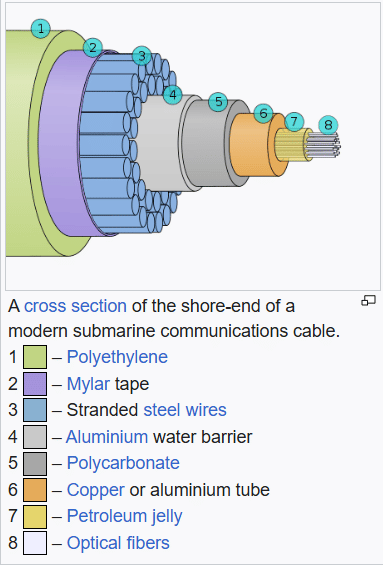
Submarine cables are critical infrastructure for global digital communication. They transmit data, including internet, phone, and private communications, across oceans with remarkable speed and reliability.
Key Features:
- Optical Fiber Technology: Modern submarine cables utilize optical fibers, which convert electrical signals into light, enabling massive data transmission with minimal signal loss.
- Specifications: These cables are approximately 25 mm in diameter and weigh around 1.4 tonnes per kilometer in deep-sea sections.
- Historical Evolution: The first undersea cables, laid in the 1850s, supported telegraphy. Today, they connect continents with advanced technology, facilitating global internet connectivity.
India’s Submarine Cable Network
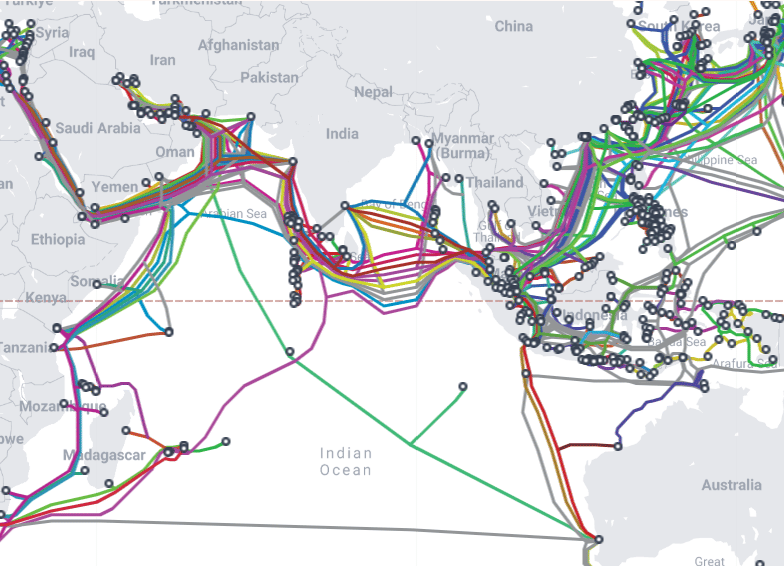
India plays a pivotal role in the global undersea cable landscape, with an extensive network ensuring seamless connectivity.
Existing Infrastructure:
- International Cables: India has 17 international subsea cables landing in cities such as Mumbai, Chennai, Cochin, Tuticorin, and Trivandrum, providing a total activated capacity of 111.111 Tbps.
- Key Operators: Prominent players include Tata Communications, Reliance Jio, Bharti Airtel, Sify Technologies, BSNL, Vodafone, and Lightstorm.
Recent and Upcoming Projects:
- Domestic Initiatives: The Chennai-Andaman and Nicobar Island Cable (CANI) and Kochi-Lakshadweep Island (KLI) cable enhance connectivity to remote islands.
- Future Projects: Major developments like MIST, 2Africa/EMIC-1, and SEA-ME-WE 6 reflect India's focus on strengthening digital connectivity.
Benefits of Undersea Cables
Undersea cables are the backbone of the global internet, offering numerous advantages that support India’s digital transformation.
Enhanced Connectivity
- Reliable and high-speed internet links are critical for sectors like IT, e-commerce, and cloud services, meeting India’s surging data demands.
Economic Growth
- Robust communication infrastructure attracts foreign investments, fosters trade, and facilitates global business expansion in India.
National Security
- Secure and resilient cables protect critical communication channels from cyberattacks and disruptions, ensuring national safety.
Disaster Recovery
- Redundant systems ensure uninterrupted connectivity during disruptions, minimizing impacts on businesses and essential services.
Future Outlook
India’s proactive approach to expanding its undersea cable network positions it as a leader in global digital connectivity.
Key Projections:
- Increased Investments: Enhanced infrastructure is expected to draw significant investments from global tech and telecom giants.
- Focus on Security: Efforts to safeguard cables against threats, such as bypassing vulnerable routes like the Malacca Strait, will intensify.
- Regional Leadership: India’s emergence as a maritime cable hub underscores its growing influence in Asia and the Indo-Pacific.
- Technological Advancements: Innovations in cable design and data transmission will boost capacity and efficiency, driving India’s digital ambitions.
Conclusion
The launch of the IAX and IEX cable systems marks a significant milestone in global connectivity. With its strategic investments and focus on resilience, India is poised to become a central player in the global digital ecosystem.
Download the PREPP App and attempt FREE IAS Exam Mock Tests and get complete study material!

Live Test : UPSC CSE Prelims CSAT (Paper-II) (Oct 08 - 11)
Full Test - 04: UPSC CSE Prelims CSAT (Paper-II)
Full Test - 03: UPSC CSE Prelims CSAT (Paper-II)
UPSC CSE Prelims 2026 GS Paper 1 Question Paper (24-May-2026)
UPSC CSE Prelims 2026 CSAT Paper 2 Question Paper (24-May-2026)

17 February 2025 | The Hindu Must Read Articles | Current Affairs

16 February 2026 | The Hindu Must Read Articles | Current Affairs

13 February 2026 | The Hindu Must Read Articles | Current Affairs









Comments