The Three-Language Formula in India: Linguistic Struggles, Current Restraints
Why in news?
- The Three-Language Debate: Balancing Education, Equality, and Opportunity for Students in India’s Public Schools Amidst Policy, Politics, and Practical Challenges.
Introduction
- The three-language formula in India has been a subject of intense debate, encompassing issues of education, linguistic identity, and national integration.
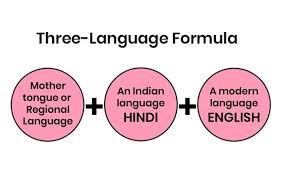
- Initially introduced as a policy to promote multilingual proficiency among students while ensuring equitable representation of regional, national, and global languages, it has often been mired in controversy.
Historical Context of the Three-Language Formula
The three-language formula was first proposed by the Central Advisory Board of Education (CABE) in 1956 and formally adopted in the National Policy on Education (NPE) in 1968. The formula aimed at:
- Teaching the regional or state language (mother tongue or first language).
- Teaching Hindi (for non-Hindi speaking states) or a modern Indian language (for Hindi-speaking states).
- Teaching English or a foreign language.
- This policy was intended to unify India’s diverse linguistic landscape while providing students with access to multiple languages for better communication and career prospects. However, its implementation has faced significant hurdles over the decades.
Linguistic Struggles in India
India is one of the most linguistically diverse countries in the world, with over 19,500 languages and dialects spoken across its regions. The major linguistic struggles include:
- Resistance to Hindi Imposition: In South Indian states like Tamil Nadu, the imposition of Hindi has been met with strong opposition, leading to anti-Hindi agitations in the 1960s and continued resistance to its enforcement in schools.
- Preservation of Regional Languages: Many states argue that the overemphasis on Hindi and English has led to the decline of indigenous languages, threatening their cultural heritage.
- English as a Language of Mobility: The preference for English medium schools over regional language schools highlights a socio-economic divide, where proficiency in English often determines access to better job opportunities.
Current Constraints in Implementing the Three-Language Formula
Despite being enshrined in national education policies, the three-language formula faces several practical constraints:
- Uneven Implementation: Some states strictly adhere to the policy, while others modify or reject it based on political and cultural considerations. Tamil Nadu, for instance, follows a two-language formula, opposing mandatory Hindi instruction.
- Quality of Language Education: Many public schools struggle with a shortage of qualified teachers for all three languages, resulting in ineffective learning outcomes.
- Parental Preferences: Parents often opt for English-medium schools, sidelining the importance of Hindi and regional languages, thus creating disparities in language proficiency.
- Policy Uncertainty: Changes in government policies frequently alter the focus on language instruction, causing inconsistencies in curriculum design and teacher training.
Advantages of the Three-Language Formula
- Linguistic Diversity and Cultural Unity: The policy promotes multilingualism, fostering an appreciation for India’s rich linguistic heritage while ensuring that students learn both a national and an international language.
- Enhanced Cognitive Abilities: Studies have shown that multilingual individuals exhibit better cognitive flexibility, problem-solving skills, and memory retention.
- Greater Employment Opportunities: Proficiency in multiple languages enhances job prospects, especially in global industries such as IT, tourism, and international trade.
- National Integration: By learning Hindi or another widely spoken Indian language, students from different regions can communicate better, strengthening national unity.
- Preservation of Regional Languages: The inclusion of a regional language in the curriculum helps sustain linguistic diversity and prevents language extinction.
Challenges in Implementing the Three-Language Formula
Despite its advantages, several challenges hinder its effective execution:
- Political Opposition and Regional Resistance: The formula has been perceived as an attempt to impose Hindi, particularly in southern and northeastern states, leading to political and social opposition.
- Lack of Qualified Teachers: Many schools, especially in rural areas, lack teachers proficient in all three languages, affecting the quality of instruction.
- Disparity Between Urban and Rural Schools: Urban schools often have better resources and faculty to implement the formula, whereas rural schools struggle with infrastructure and faculty shortages.
- Preference for English Over Indian Languages: English is often viewed as the key to socio-economic mobility, leading to a decline in interest in Hindi and regional languages.
- Curriculum Overload: Introducing three languages adds an extra academic burden on students, potentially affecting their performance in other subjects.
- Resistance from Private Schools: Many private institutions focus primarily on English-medium instruction, making the enforcement of a three-language curriculum difficult.
Way Forward: A Balanced Approach
To address the challenges and harness the benefits of multilingual education, the following steps can be taken:
- Flexible Language Policy: States should be allowed to tailor the three-language formula according to their cultural and linguistic context while ensuring students acquire functional proficiency in at least three languages.
- Strengthening Teacher Training: The government must invest in training language teachers and ensuring that every school has access to qualified faculty for all three languages.
- Encouraging Regional and Indigenous Languages: The curriculum should include local languages, incorporating them into mainstream education through modern teaching methods and digital tools.
- Using Technology for Language Learning: E-learning platforms, language apps, and interactive digital resources can supplement traditional teaching methods, making language learning more engaging and effective.
- Incentives for Multilingual Proficiency: Scholarships, special recognition, and career advantages can be offered to students excelling in multiple languages to encourage greater participation.
- Public Awareness and Parental Engagement: Educating parents about the benefits of multilingualism and encouraging them to support the three-language system can bridge socio-linguistic divides.
- Collaboration Between States and Centre: A cooperative federal approach is needed to ensure balanced policy implementation without imposing one language over another.
Conclusion
- The three-language formula, despite its challenges, remains a crucial tool for fostering linguistic diversity, cognitive development, and national integration.
- However, its implementation must be flexible, inclusive, and sensitive to regional linguistic identities.
- A well-executed language policy can strengthen India’s multilingual fabric, ensuring that future generations remain rooted in their linguistic heritage while being equipped for global opportunities.
- The key lies in balancing national unity with regional identity and academic excellence with linguistic inclusivity.
Download the PREPP App and attempt FREE IAS Exam Mock Tests and get complete study material!
Live Test : UPSC IAS : GS - Indian Geography - Subject Knowledge Test

Live Test : UPSC CSE Prelims CSAT (Paper-II) (Oct 08 - 11)
Full Test - 04: UPSC CSE Prelims CSAT (Paper-II)
Full Test - 03: UPSC CSE Prelims CSAT (Paper-II)
UPSC CSE Prelims 2026 GS Paper 1 Question Paper (24-May-2026)
UPSC CSE Prelims 2026 CSAT Paper 2 Question Paper (24-May-2026)

17 February 2025 | The Hindu Must Read Articles | Current Affairs

16 February 2026 | The Hindu Must Read Articles | Current Affairs

13 February 2026 | The Hindu Must Read Articles | Current Affairs









Comments