The Role of Consumption in India's Economic Growth: Challenges and Strategic Solutions
Why in the News?
Experts have warned that India's sluggish consumption-led growth signals an urgent need for structural reforms. Weak demand, low investment, and rising inequality pose significant risks to long-term economic stability.
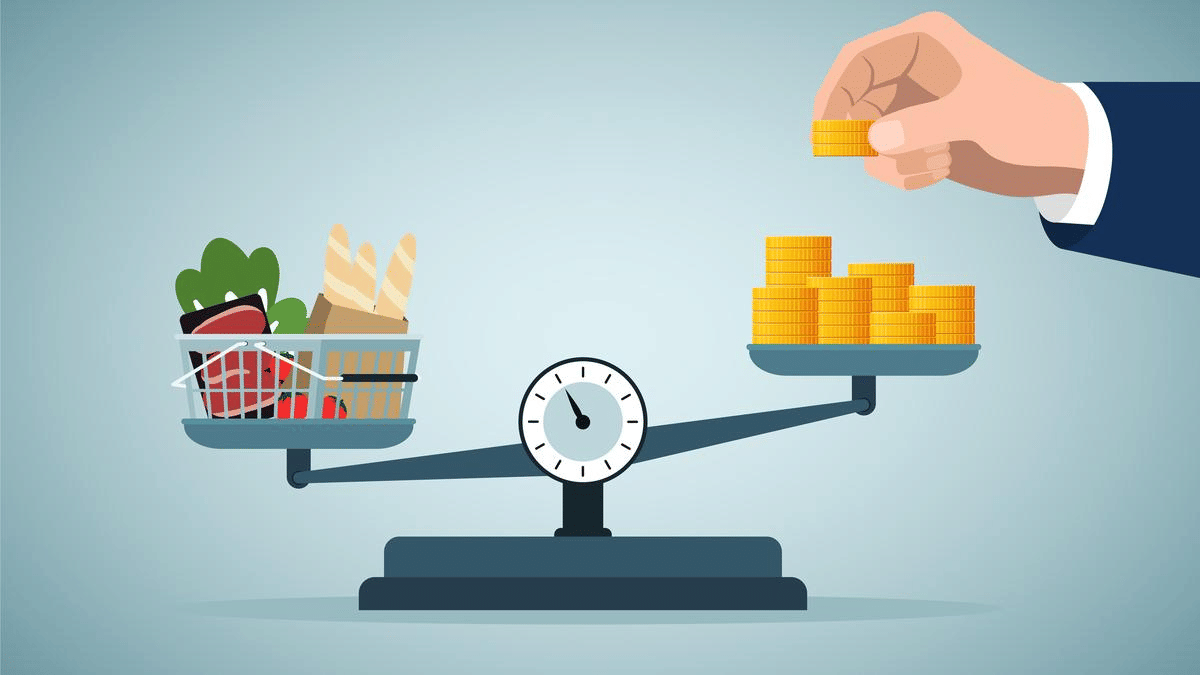
Understanding the Role of Consumption in India's GDP Growth
Largest Component of GDP
- Private consumption constitutes approximately 60% of India's GDP, making it the key driver of economic activity. A robust consumption sector fuels demand, boosting production and employment.
Influence on Production and Services
- Higher consumer spending stimulates industrial production and the services sector, leading to job creation and increased incomes, further reinforcing the consumption cycle.
Sectoral Contributions
- Key consumption-driven industries include retail, FMCG (Fast-Moving Consumer Goods), automobiles, and real estate, all of which play a crucial role in India's economic expansion.
Concerning Trends in Consumption Growth
Slow Consumption Growth
- Since 2020, India's Compound Annual Growth Rate (CAGR) in consumption has hovered around 4.8%, raising concerns about long-term sustainability.
Unequal Growth Distribution
- Urban and high-income groups primarily benefit from consumption-led growth, while rural demand lags behind, deepening income inequality.
Impact of Rising Inflation
- Persistent high inflation erodes disposable incomes, discouraging spending and suppressing overall demand.
Declining Wage Growth
- Stagnant wages, especially in the informal sector, limit consumers’ purchasing power, weakening economic resilience.
Key Consumption-Boosting Initiatives in Union Budget 2025-26
Income Tax Reductions
- New lower income tax rates aim to increase disposable income, thereby stimulating spending and demand.
Agricultural Reforms
- Programs like the Dhan-Dhanya Krishi Yojana are designed to boost rural incomes, indirectly supporting broader consumption demand.
Direct Benefit Transfers (DBT)
- Continued focus on DBT schemes ensures direct financial aid, enhancing purchasing power among lower-income groups.
MSME Support
- Initiatives such as credit cards for MSMEs and reclassification of thresholds seek to strengthen small businesses, fostering local consumption.
Investment vs. Consumption: Finding the Right Balance
The Multiplier Effect of Investment
- Investment in infrastructure and manufacturing offers a higher multiplier effect than consumption, leading to sustained economic growth.
Private Sector Hesitation
- Concerns over regulatory policies and risk aversion have slowed private investments, increasing reliance on consumption-driven growth.
Government’s Role in Boosting Investment
- Public sector investment in renewable energy, AI, and infrastructure can attract private capital, ensuring long-term economic benefits.
India vs. China: Contrasting Growth Models
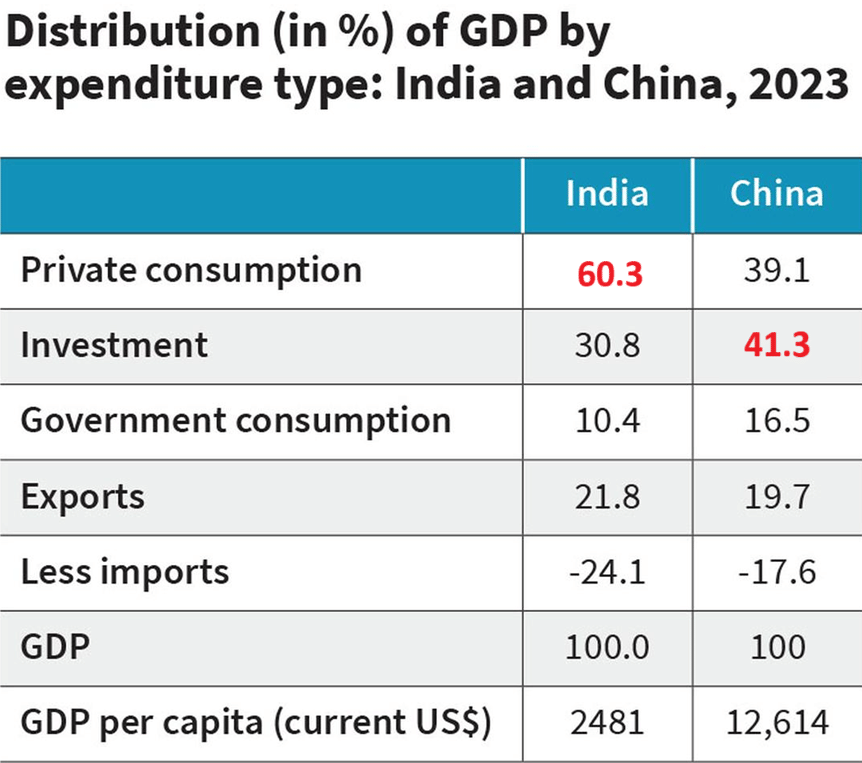
Diverging Economic Trajectories
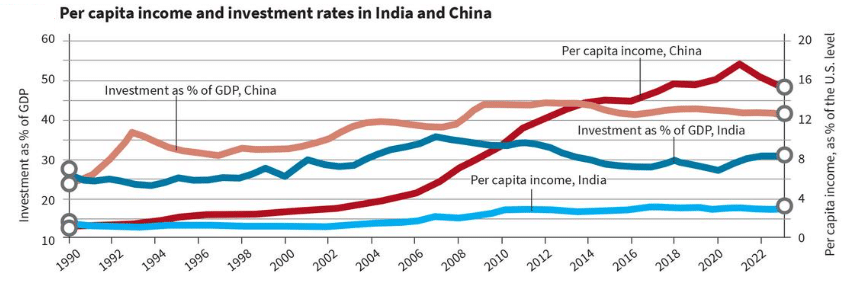
- India and China had similar per capita incomes in the 1990s, but by 2023, China's income was five times higher.
Investment-Led Growth in China
- China maintains investment rates above 40% of GDP, while India's investment rate is at 30.8%.
Post-2008 Financial Crisis Policies
- China expanded public investment post-2008, whereas India’s investment rate declined after 2012.
Consumption vs. Investment
- India's consumption share of GDP (60.3%) is much higher than China’s 39.1%, highlighting India's weaker investment base.
Economic Mobility Impact
- China's investment-driven model has significantly reduced poverty, whereas India's consumption-led model has left many behind.
Impacts of Consumption-Led Growth
Short-Term Economic Boost
- Increased consumption spurs immediate economic activity, benefiting businesses and retail sectors.
Employment Generation
- Consumption-driven demand supports job creation in manufacturing, retail, and services.
Tax Revenue Growth
- Higher spending leads to increased GST collections, strengthening government revenues.
Trade Deficit Risks
- Consumption-led growth increases import dependency, widening the trade deficit.
Challenges in Consumption-Led Growth
Stagnant Rural Demand
- Slow rural income growth limits economic participation, slowing overall consumption expansion.
High Unemployment Rates
- Limited employment opportunities restrict purchasing power, hindering demand growth.
Supply-Side Constraints
- India’s manufacturing limitations force reliance on imports, exacerbating trade imbalances.
Inequality in Consumption Growth
- The benefits of consumption-led growth favor urban and higher-income groups, deepening economic disparity.
Global Economic Uncertainties
- External factors such as geopolitical tensions, inflation, and commodity price fluctuations influence domestic consumption patterns.
- Example: The ongoing global semiconductor shortage has raised the cost of consumer electronics and automobiles, reducing demand.
Rising Household Debt
- Growing dependence on credit-based consumption (e.g., unsecured loans) raises concerns over financial stability.
The Way Forward: Sustainable Economic Growth Strategies
Balanced Growth Strategy
- A combination of investment and consumption-driven growth ensures long-term economic stability.
Strengthening Rural Demand
- Expanding direct income support schemes (e.g., MNREGA) and improving rural infrastructure can boost rural consumption.
Boosting Private Investment
- Providing targeted incentives for private sector investment in infrastructure, technology, and green energy is essential.
Example: Production-Linked Incentives (PLI)
- Extending PLI schemes to more sectors (e.g., semiconductor manufacturing, renewable energy) can drive long-term investment.
Enhancing Employment Opportunities
- Expanding skill development programs in AI, automation, and emerging technologies can raise income levels and stimulate consumption.
Strengthening Consumer Confidence
- Improving social security measures (e.g., universal basic income) can boost spending and ensure economic stability.
Conclusion
While consumption remains the backbone of India's GDP, its long-term sustainability depends on balanced investment and consumption strategies. By fostering private investment, boosting rural demand, and ensuring employment growth, India can transition to a more resilient and inclusive economy.
Download the PREPP App and attempt FREE IAS Exam Mock Tests and get complete study material!
*The article might have information for the previous academic years, please refer the official website of the exam.
How likely are you to recommend Prepp.in to a friend or a colleague?
Not so likely
Highly likely
UPSC CSE (IAS) 2027 Prelims Mock Test Series
Live Quizzes
Quizzes
Live Tests

• Live
Live Test : UPSC CSE Prelims CSAT (Paper-II) (Oct 08 - 11)
120 Minutes
80 Questions
200 Marks
English, Hindi
MEDIUM
Test will end in 14:10:14
Full Tests
Full Test - 04: UPSC CSE Prelims CSAT (Paper-II)
120 Minutes
80 Questions
200 Marks
English, Hindi
MEDIUM
Attempted by 18 aspirants in 12 hours
Full Test - 03: UPSC CSE Prelims CSAT (Paper-II)
120 Minutes
80 Questions
200 Marks
English, Hindi
MEDIUM
Attempted by 19 aspirants in 12 hours
Previous Year Papers
UPSC CSE Prelims 2026 GS Paper 1 Question Paper (24-May-2026)
120 Minutes
100 Questions
200 Marks
2,981 Attempted
English, Hindi
MEDIUM
Attempted by 12 aspirants in 12 hours
UPSC CSE Prelims 2026 CSAT Paper 2 Question Paper (24-May-2026)
120 Minutes
80 Questions
200 Marks
3,158 Attempted
English, Hindi
MEDIUM
Attempted by 13 aspirants in 12 hours
Videos

17 February 2025 | The Hindu Must Read Articles | Current Affairs
7,202 Views
•4
•7 months ago

16 February 2026 | The Hindu Must Read Articles | Current Affairs
6,962 Views
•4
•7 months ago

13 February 2026 | The Hindu Must Read Articles | Current Affairs
8,765 Views
•5
•7 months ago

12 February 2026 | The Hindu Must Read Articles | Current Affairs
5,788 Views
•4
•7 months ago






Also Check
IAS Exam Overview
IAS Exam Admit Card
IAS Exam Question Paper 2026
IAS Exam Mains Syllabus
IAS Exam Application Process
IAS Exam Eligibility
IAS Exam Result
IAS Exam Exam Pattern
IAS Exam CSAT Syllabus
IAS Exam Answer Key
IAS Exam Previous Year Paper
IAS Exam Current Affairs
IAS Exam Mains Question Paper
IAS Exam IAS Courses
IAS Exam UPSC Study Notes
IAS Exam Foundation Course 2024
IAS Exam Prelims Question Paper
IAS Exam Exam Center
IAS Exam Foundation Course 2025
IAS Exam Notification 2026
IAS Exam IAS Success Stories
IAS Exam Salary
IAS Exam Cutoff
IAS Exam Mock Tests
IAS Exam News


Comments