The Paris Agreement: Nine Years of Climate Action Progress and Challenges
Why in the News?
December 12, 2024, marks the 9th anniversary of the Paris Agreement, a pivotal international climate treaty designed to combat climate change and limit global warming.
Key Concerns in Climate Action Under the Paris Agreement
Despite the Paris Agreement’s ambitious targets, several challenges hinder progress:
- Failure to Meet Climate Targets: Many nations are falling short of their Nationally Determined Contributions (NDCs). The Climate Action Tracker forecasts a 2.7°C warming trajectory, far above the target of keeping global temperatures well below 2°C.
- Geopolitical Tensions: Conflicts such as the Russia-Ukraine war have diverted focus from climate goals to energy security, making it harder to achieve decarbonization targets.
- Finance Gaps: The promised $100 billion annually for developing nations remains unmet, impeding climate mitigation and adaptation.
- Withdrawal and Inconsistent Support: The U.S. withdrew from the agreement in 2017 and rejoined in 2021, creating uncertainty and undermining global trust.
Reasons for the Paris Agreement's Ineffectiveness
Several factors hinder the Paris Agreement's full potential:
- Insufficient Targets: Many countries' NDCs are not aligned with the 1.5°C target. Even with full implementation, pledges still result in 2.4°C to 2.7°C warming by 2100.
- Lack of Enforcement: There are no punitive measures for non-compliance, and countries only self-report progress, leading to minimal accountability.
- Inadequate Climate Finance: Less than $83 billion was mobilized in 2020, falling short of the commitment to fund mitigation and adaptation in developing countries.
- Over-reliance on Voluntary Contributions: The bottom-up approach allows countries to set their own goals, which often lack ambition.
Understanding the Paris Agreement: A Global Climate Framework
Adopted during COP21 in Paris on December 12, 2015, the Paris Agreement is a legally binding international treaty designed to limit global temperature rise and promote climate action.
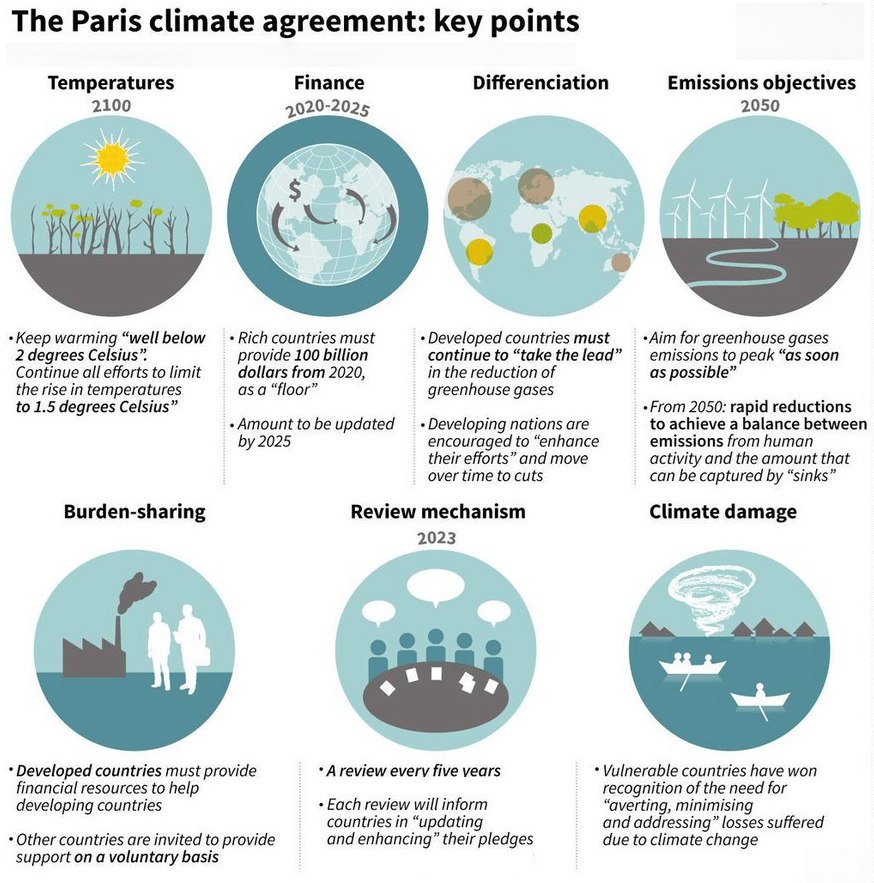
- Temperature Targets: The agreement aims to limit global warming to well below 2°C and pursue efforts to cap it at 1.5°C.
- Financial and Technological Support: The treaty encourages international cooperation, including financial and technological support for developing nations.
- Non-Punitive Framework: While the Paris Agreement emphasizes transparency and accountability, it does not enforce penalties for failing to meet targets.
The History Behind the Paris Agreement
The Paris Agreement builds upon earlier climate frameworks:
- UNFCCC (1992): Set the foundation for climate action.
- Kyoto Protocol (1997): Established binding emissions reduction targets for developed countries.
- Copenhagen Accord (2009): Introduced the bottom-up approach, paving the way for the Paris Agreement.
- Durban Platform (2011): Laid the groundwork for a post-2020 climate agreement.
Why the Paris Agreement is Crucial
The Paris Agreement addresses the urgent need for climate action:
- Rising Global Temperatures: 1.1°C of warming has already occurred, with devastating global impacts.
- Extreme Weather Events: Increasing hurricanes, floods, and droughts require immediate global action.
- Vulnerable Nations: Countries like small island states face existential threats from rising sea levels and food insecurity.
- Economic Impacts: Climate change poses significant economic risks, threatening jobs, livelihoods, and communities.
Key Provisions of the Paris Agreement
The Paris Agreement focuses on cooperation and flexibility:
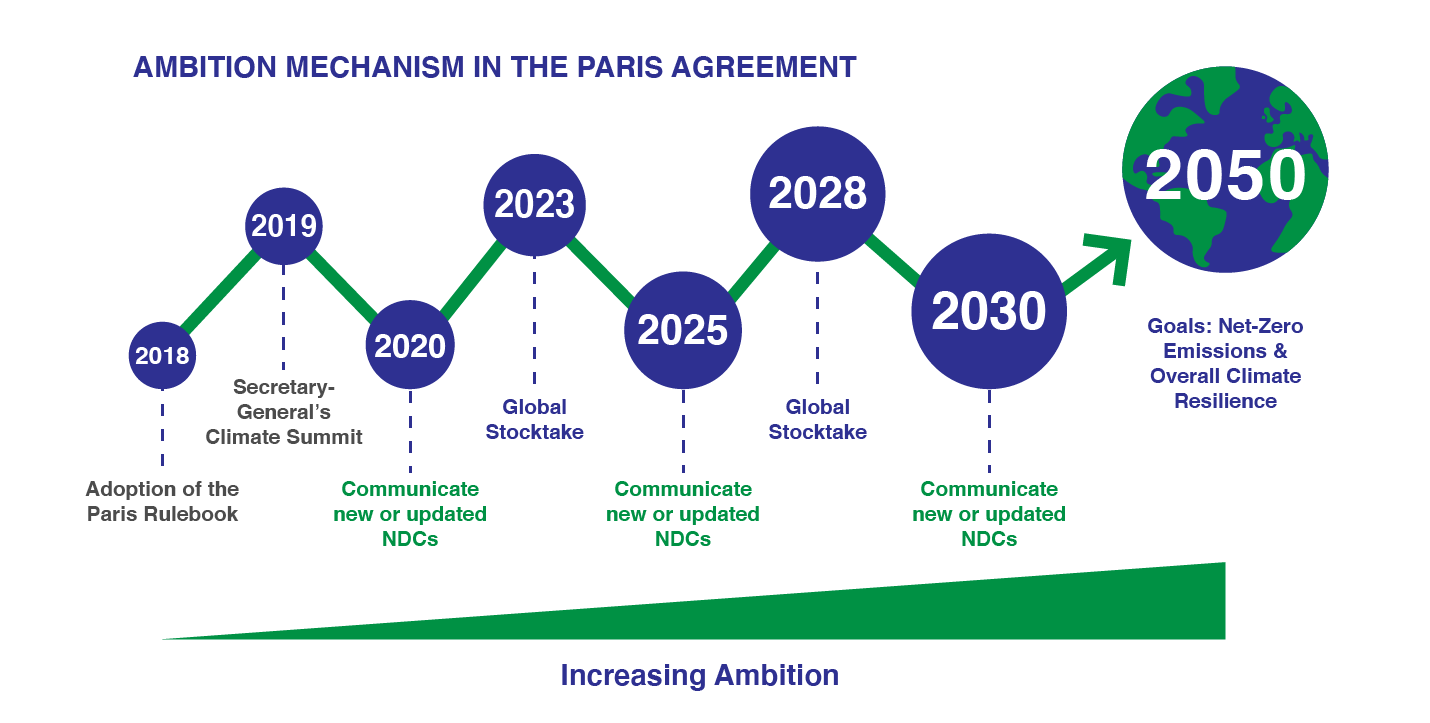
- Nationally Determined Contributions (NDCs): Countries submit self-determined climate targets and update them every five years, increasing ambition over time.
- Global Stocktake: Every five years, a stocktake assesses collective progress and adjusts global climate goals.
- Mitigation Provisions: Includes mechanisms for international carbon trading and emissions reductions, such as the Sustainable Development Mechanism (SDM) and International Transfer of Mitigation Outcomes (ITMOs).
- Adaptation Provisions: Countries must report on adaptation efforts, with special emphasis on vulnerable regions.
Key Differences Between the Paris Agreement and Kyoto Protocol
The Paris Agreement offers greater flexibility compared to the Kyoto Protocol:
- Universal Participation: Unlike the Kyoto Protocol, the Paris Agreement requires all countries to submit emissions reduction plans.
- Voluntary Targets: Countries voluntarily set their own targets, unlike the legally binding commitments in the Kyoto Protocol.
- Differentiated Responsibilities: The agreement recognizes differing capacities and responsibilities based on development levels.
Challenges Facing the Paris Agreement
Despite progress, challenges remain:
- Insufficient Ambition: Many countries’ NDCs do not align with the 1.5°C target.
- Climate Finance Deficit: Developing nations struggle due to insufficient funds for climate action.
- Technological Barriers: Some countries lack access to clean technology and renewable energy solutions.
- Geopolitical Divides: Tensions between developed and developing nations over responsibility and funding delay progress.
The Path Forward: Strengthening the Paris Agreement
To ensure the Paris Agreement achieves its goals:
- Enhance Climate Finance: Developed nations must meet their commitment to mobilize $100 billion annually for developing nations.
- Stronger Accountability: Implement stricter reporting guidelines and penalties for non-compliance.
- Increase Technology Transfer: Boost access to renewable technologies for developing nations.
- Focus on Adaptation: Increase funding for adaptation projects, such as flood-resistant infrastructure and drought-resistant agriculture.
- Global Cooperation on Energy Transition: Accelerate efforts to phase out fossil fuels and expand renewable energy investments.
Conclusion
The Paris Agreement remains a crucial step in global efforts to combat climate change. However, to meet its ambitious targets, nations must commit to greater climate finance, technology transfer, and accountability. Enhanced cooperation and an integrated approach to mitigation and adaptation will be key to ensuring that the world stays on track to limit global warming.
Download the PREPP App and attempt FREE IAS Exam Mock Tests and get complete study material!

Live Test : UPSC CSE Prelims CSAT (Paper-II) (Oct 08 - 11)
Full Test - 04: UPSC CSE Prelims CSAT (Paper-II)
Full Test - 03: UPSC CSE Prelims CSAT (Paper-II)
UPSC CSE Prelims 2026 GS Paper 1 Question Paper (24-May-2026)
UPSC CSE Prelims 2026 CSAT Paper 2 Question Paper (24-May-2026)

17 February 2025 | The Hindu Must Read Articles | Current Affairs

16 February 2026 | The Hindu Must Read Articles | Current Affairs

13 February 2026 | The Hindu Must Read Articles | Current Affairs









Comments