The Legacy of the 2004 Indian Ocean Tsunami: Lessons and Innovations
Why in the News?
December 26, 2024, marks the 20th year since the 2004 Indian Ocean earthquake and tsunami.
What is a Tsunami?
Definition:
A tsunami is a series of giant ocean waves caused by a sudden displacement of a large volume of water.
Causes:
- Earthquakes: The most common cause, especially those occurring beneath the ocean floor.
- Volcanic Eruptions: Underwater eruptions can displace vast amounts of water.
- Landslides: Large landslides into the ocean can trigger powerful waves.
- Meteorite Impacts: The impact of a large meteorite can generate a massive tsunami.
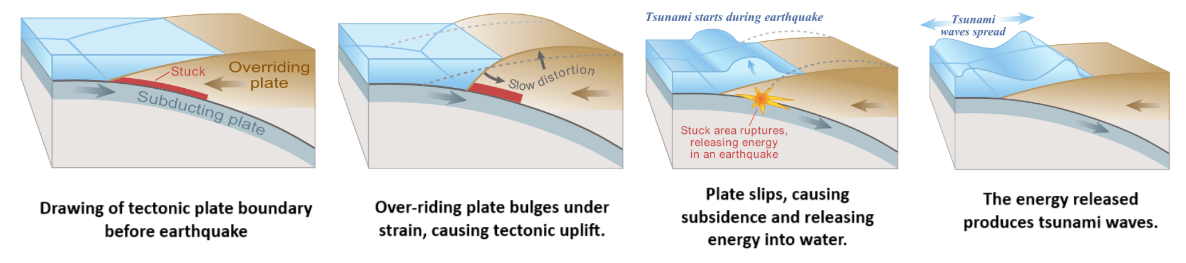
Characteristics:
- Long Wavelengths: Spanning hundreds of kilometers.
- High Speeds: Often exceeding 500 miles per hour across the ocean.
- Inconspicuous in Deep Water: Appear as small ripples in the open ocean.
- Devastating Impact on Coastlines: Energy concentrates in shallow waters, creating massive waves.
Impact:
- Loss of Life: Widespread devastation, including significant human casualties.
- Infrastructure Damage: Coastal communities and infrastructure are often severely impacted.
- Environmental Disruption: Coastal erosion and pollution can result from tsunamis.
The 2004 Indian Ocean Tsunami
Magnitude and Origin:
- Date: December 26, 2004
- Earthquake Magnitude: 9.1–9.3
- Location: Sunda Trench, off the west coast of Sumatra, Indonesia
- Source: 30 km below the ocean floor, where the Indo-Australian plate subducts beneath the Burma microplate.
Unprecedented Scale:
- Fault Rupture: Spanning 1,200–1,300 km, the longest ever recorded.
- Wave Heights: Reached up to 30 meters.
Widespread Impact:
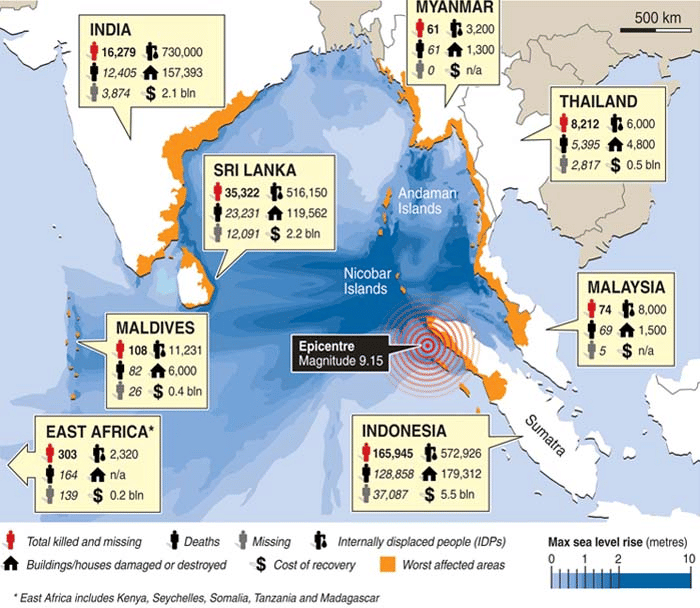
- Affected Countries: 14, including Indonesia, Sri Lanka, India, and Thailand.
- Fatalities: Over 227,000 lives lost.
- Displacement: 1.7 million people.
Economic and Social Consequences:
- Coastal economies faced catastrophic disruptions in fisheries, tourism, and trade.
- Entire communities were wiped out in regions like Aceh (Indonesia) and Khao Lak (Thailand).
Global Response:
- $14 billion in aid raised.
- Highlighted the need for improved disaster preparedness.
Impact on India
- Fatalities: Over 10,000, with Tamil Nadu, Andhra Pradesh, and the Andaman and Nicobar Islands being the worst affected.
- Economic Loss: Severe damage to fishing industries and coastal infrastructure.
- Displacement: Thousands rendered homeless, requiring large-scale rehabilitation efforts.
- Cultural Heritage Damage: Historical sites along the coastline were destroyed.
Advances in Tsunami Science
Early Warning Systems:
- Indian Tsunami Early Warning Centre (ITEWC): Established in 2007, featuring real-time monitoring using seismological stations, bottom pressure recorders, and tidal gauges.
Research and Technology:
- Tsunami Geology: Historical sediment analysis uncovered ancient tsunami evidence.
- Geodetic Innovations: GPS systems and improved earthquake instrumentation monitor tectonic shifts.
- Inundation Modelling: Advanced models predict tsunami propagation, enabling governments to plan evacuations.
- New Discoveries: Studies of the Andaman and Nicobar Islands revealed changes in land elevation and ancient tsunami imprints.
Significance of the Event
-
Increased Awareness:
- Highlighted the vulnerability of coastal regions to natural disasters.
-
Policy Changes:
- Governments integrated disaster risk reduction into urban planning and infrastructure development.
-
Technological Leaps:
- Enhanced seismic monitoring and tsunami detection systems.
-
Global Cooperation:
- Fostering collaboration among Indian Ocean nations for research and early warning protocols.
-
Scientific Insights:
- Provided invaluable data on megathrust earthquakes, fault dynamics, and tsunami generation.
Current Challenges
- Gaps in Monitoring: Regions like the Makran Coast remain under-monitored.
- Vulnerable Populations: Coastal communities in developing nations often lack resources and education.
- Infrastructure Risks: Critical infrastructure, such as nuclear power plants, remains at risk.
- Understudied Zones: Subduction zones like Great Nicobar and Car Nicobar need further research.
- Coordination Issues: Effective disaster response requires better international and local collaboration.
Future Directions
- Comprehensive Monitoring: Expand seismic and tsunami networks to cover underrepresented regions using AI-based analysis.
- Community Awareness: Regular drills, education campaigns, and capacity-building programs.
- Resilient Infrastructure: Build tsunami-resistant structures, including elevated shelters.
- Global Collaboration: Strengthen data sharing, technology exchange, and research partnerships.
- Research Investments: Allocate funding for studying seismic zones and historical tsunami records.
- Policy Reforms: Stricter zoning laws and integration of tsunami risk assessments into development plans.
Download the PREPP App and attempt FREE IAS Exam Mock Tests and get complete study material!
*The article might have information for the previous academic years, please refer the official website of the exam.
How likely are you to recommend Prepp.in to a friend or a colleague?
Not so likely
Highly likely
UPSC CSE (IAS) 2027 Prelims Mock Test Series
Live Quizzes
Quizzes
Live Tests
Free
• Live
Live Test : UPSC IAS : GS - Indian Geography - Subject Knowledge Test
35 Minutes
30 Questions
60 Marks
English, Hindi
Test will end in 03:24:22

• Live
Live Test : UPSC CSE Prelims CSAT (Paper-II) (Oct 08 - 11)
120 Minutes
80 Questions
200 Marks
English, Hindi
MEDIUM
Test will end on 11th Oct, 07:00 PM
Full Tests
Full Test - 04: UPSC CSE Prelims CSAT (Paper-II)
120 Minutes
80 Questions
200 Marks
English, Hindi
MEDIUM
Attempted by 19 aspirants in 12 hours
Full Test - 03: UPSC CSE Prelims CSAT (Paper-II)
120 Minutes
80 Questions
200 Marks
English, Hindi
MEDIUM
Attempted by 21 aspirants in 12 hours
Previous Year Papers
UPSC CSE Prelims 2026 GS Paper 1 Question Paper (24-May-2026)
120 Minutes
100 Questions
200 Marks
2,968 Attempted
English, Hindi
MEDIUM
Attempted by 13 aspirants in 12 hours
UPSC CSE Prelims 2026 CSAT Paper 2 Question Paper (24-May-2026)
120 Minutes
80 Questions
200 Marks
3,144 Attempted
English, Hindi
MEDIUM
Attempted by 13 aspirants in 12 hours
Videos

17 February 2025 | The Hindu Must Read Articles | Current Affairs
7,202 Views
•4
•7 months ago

16 February 2026 | The Hindu Must Read Articles | Current Affairs
6,962 Views
•4
•7 months ago

13 February 2026 | The Hindu Must Read Articles | Current Affairs
8,765 Views
•5
•7 months ago

12 February 2026 | The Hindu Must Read Articles | Current Affairs
5,788 Views
•4
•7 months ago






Also Check
IAS Exam Overview
IAS Exam Admit Card
IAS Exam Question Paper 2026
IAS Exam Mains Syllabus
IAS Exam Application Process
IAS Exam Eligibility
IAS Exam Result
IAS Exam Exam Pattern
IAS Exam CSAT Syllabus
IAS Exam Answer Key
IAS Exam Previous Year Paper
IAS Exam Current Affairs
IAS Exam Mains Question Paper
IAS Exam IAS Courses
IAS Exam UPSC Study Notes
IAS Exam Foundation Course 2024
IAS Exam Prelims Question Paper
IAS Exam Exam Center
IAS Exam Foundation Course 2025
IAS Exam Notification 2026
IAS Exam IAS Success Stories
IAS Exam Salary
IAS Exam Cutoff
IAS Exam Mock Tests
IAS Exam News


Comments