Spot-Billed Pelican: Habitat, Behavior, and Conservation Status
Why in the News?
In 2014, Cyclone Hudhud severely damaged the bird enclosure at Indira Gandhi Zoological Park, Visakhapatnam. As a result, painted storks and spot-billed pelicans started roaming freely within the zoo premises, adapting to their new environment.
About Spot-Billed Pelican
Scientific Name: Pelecanus philippensis
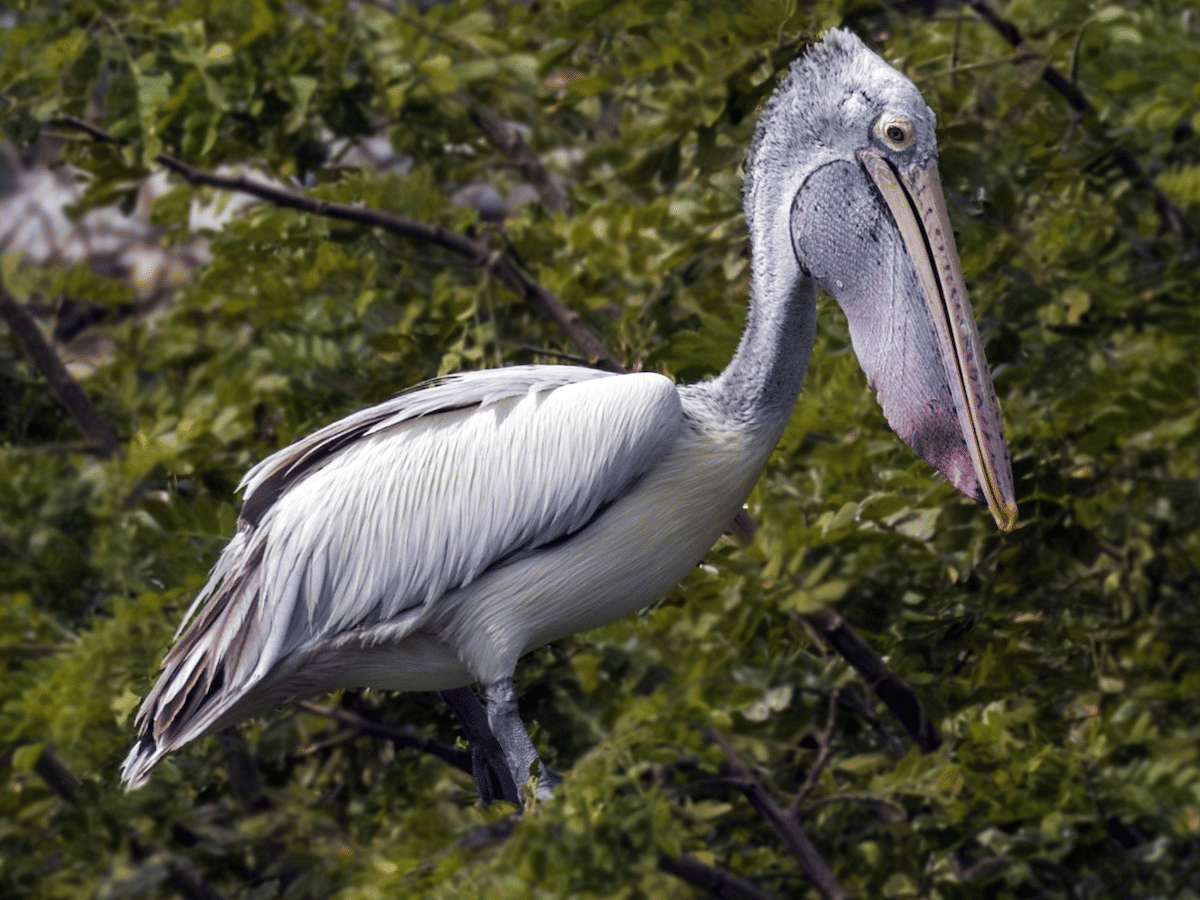
- The spot-billed pelican, also known as the gray pelican, is a large water bird native to southern Asia. It primarily inhabits large inland and coastal water bodies, especially shallow freshwater lakes.
Habitat and Distribution
- Habitat: Prefers shallow lowland freshwater wetlands.
- Geographical Distribution:
- Found mainly in Peninsular India, Sri Lanka, and Cambodia.
- Declining populations in Southeast Asia, with local extinctions in areas like the Philippines.
Characteristics and Behavior
- Size & Appearance:
- Medium-sized pelican with a wingspan of 213–250 cm.
- Predominantly white with a grey crest and brownish tail.
- Migration & Movement:
- Non-migratory, but exhibits local movements, especially during the non-breeding season.
- Breeding:
- Colonial breeder, often nesting alongside painted storks.
- Vocalization:
- Generally silent, but may grunt or hiss during the nesting period.
Threats to Spot-Billed Pelican
- Habitat destruction due to wetland degradation and human disturbance.
- Population decline in Southeast Asia, leading to local extinctions.
Conservation Status
- IUCN Status: Near Threatened
- Wildlife (Protection) Act, 1972: Schedule II
- CITES: Appendix II
Download the PREPP App and attempt FREE IAS Exam Mock Tests and get complete study material!
*The article might have information for the previous academic years, please refer the official website of the exam.
How likely are you to recommend Prepp.in to a friend or a colleague?
Not so likely
Highly likely
UPSC CSE (IAS) 2027 Prelims Mock Test Series
Live Quizzes
Quizzes
Live Tests
Free
• Live
Live Test : UPSC IAS : GS - Indian Geography - Subject Knowledge Test
35 Minutes
30 Questions
60 Marks
English, Hindi
Test will end in 04:09:45

• Live
Live Test : UPSC CSE Prelims CSAT (Paper-II) (Oct 08 - 11)
120 Minutes
80 Questions
200 Marks
English, Hindi
MEDIUM
Test will end on 11th Oct, 07:00 PM
Full Tests
Full Test - 04: UPSC CSE Prelims CSAT (Paper-II)
120 Minutes
80 Questions
200 Marks
English, Hindi
MEDIUM
Attempted by 19 aspirants in 12 hours
Full Test - 03: UPSC CSE Prelims CSAT (Paper-II)
120 Minutes
80 Questions
200 Marks
English, Hindi
MEDIUM
Attempted by 20 aspirants in 12 hours
Previous Year Papers
UPSC CSE Prelims 2026 GS Paper 1 Question Paper (24-May-2026)
120 Minutes
100 Questions
200 Marks
2,967 Attempted
English, Hindi
MEDIUM
Attempted by 13 aspirants in 12 hours
UPSC CSE Prelims 2026 CSAT Paper 2 Question Paper (24-May-2026)
120 Minutes
80 Questions
200 Marks
3,143 Attempted
English, Hindi
MEDIUM
Attempted by 13 aspirants in 12 hours
Videos

17 February 2025 | The Hindu Must Read Articles | Current Affairs
7,202 Views
•4
•7 months ago

16 February 2026 | The Hindu Must Read Articles | Current Affairs
6,962 Views
•4
•7 months ago

13 February 2026 | The Hindu Must Read Articles | Current Affairs
8,765 Views
•5
•7 months ago

12 February 2026 | The Hindu Must Read Articles | Current Affairs
5,788 Views
•4
•7 months ago






Also Check
IAS Exam Overview
IAS Exam Admit Card
IAS Exam Question Paper 2026
IAS Exam Mains Syllabus
IAS Exam Application Process
IAS Exam Eligibility
IAS Exam Result
IAS Exam Exam Pattern
IAS Exam CSAT Syllabus
IAS Exam Answer Key
IAS Exam Previous Year Paper
IAS Exam Current Affairs
IAS Exam Mains Question Paper
IAS Exam IAS Courses
IAS Exam UPSC Study Notes
IAS Exam Foundation Course 2024
IAS Exam Prelims Question Paper
IAS Exam Exam Center
IAS Exam Foundation Course 2025
IAS Exam Notification 2026
IAS Exam IAS Success Stories
IAS Exam Salary
IAS Exam Cutoff
IAS Exam Mock Tests
IAS Exam News


Comments