Solar Storm
Why in news
- ‘cataclysmic' solar storm hit Earth around 2687 years ago, ancient tree rings reveal.
About Solar Storm
- Definition: A solar storm is a violent eruption of energy, particles, magnetic fields, and materials released by the Sun into the solar system.
![solar storm specifications]()
- Cause: These storms are caused by the Sun’s twisted magnetic fields, where the equator rotates faster than the poles, leading to magnetic instabilities.
- Magnetic Reconnection: Solar storms occur when these magnetic fields snap and reconnect, releasing large amounts of energy.
- Components: Solar storms include solar flares (bright light bursts), radiation storms (solar particles), and coronal mass ejections (CMEs), which are vast clouds of charged particles.
- Effects on Earth: When solar storms strike Earth, they can cause geomagnetic storms, leading to disruptions such as radio blackouts, power outages, and stunning auroras.
- Protection: Earth’s magnetic field and atmosphere shield us from the worst impacts of solar storms.
- Plasma Eruptions: Solar storms release intense bursts of charged particles (protons and electrons) and electromagnetic radiation from the Sun's surface.
- Natural Cycle: Solar storms are part of the Sun's natural 11-year activity cycle, with more frequent storms during solar maximum.
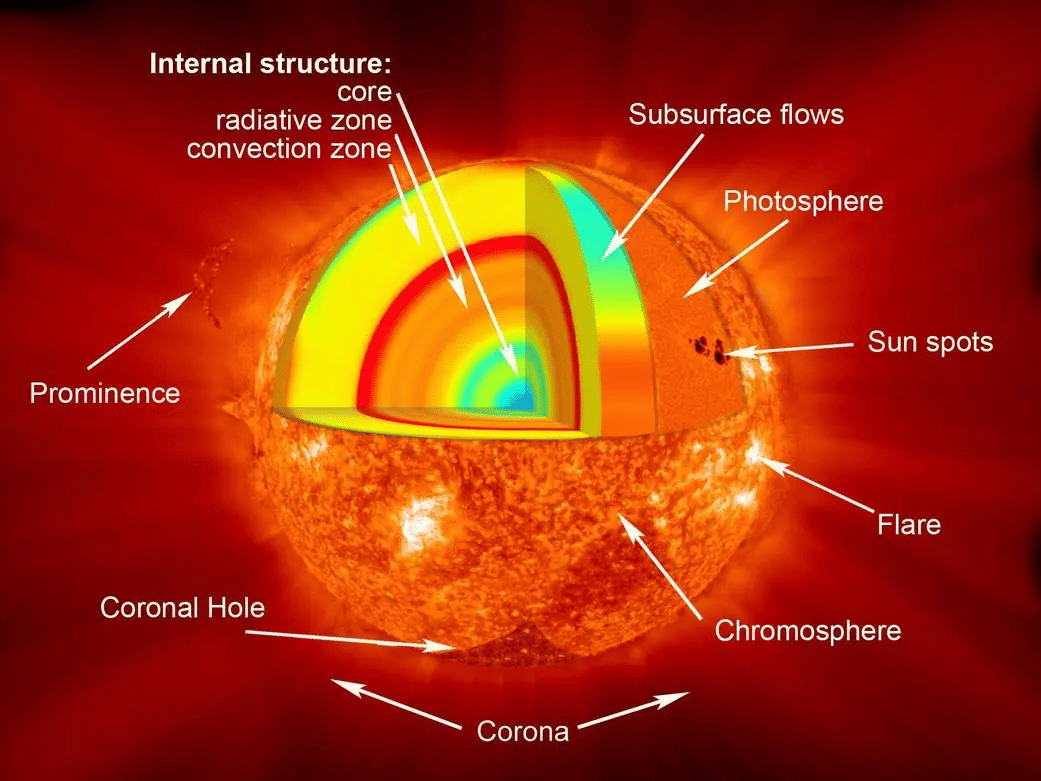
Sun's Atmosphere:
- Photosphere: The visible surface of the Sun, where sunspots are visible.
- Chromosphere: The layer above the photosphere, where solar flares originate.
- Corona: The Sun's outermost layer, where CMEs are formed and spread through space.
- Sun’s Magnetic Field: It plays a pivotal role in structuring the Sun’s atmosphere and driving solar storms.
Historical Evidence: Recent studies have revealed that a "cataclysmic" solar storm struck Earth approximately 2687 years ago, as indicated by ancient tree rings.
Download the PREPP App and attempt FREE IAS Exam Mock Tests and get complete study material!
*The article might have information for the previous academic years, please refer the official website of the exam.
How likely are you to recommend Prepp.in to a friend or a colleague?
Not so likely
Highly likely
UPSC CSE (IAS) 2027 Prelims Mock Test Series
Live Quizzes
Quizzes
Live Tests

• Live
Live Test : UPSC CSE Prelims CSAT (Paper-II) (Oct 08 - 11)
120 Minutes
80 Questions
200 Marks
English, Hindi
MEDIUM
Test will end in 05:31:38
Full Tests
Full Test - 04: UPSC CSE Prelims CSAT (Paper-II)
120 Minutes
80 Questions
200 Marks
English, Hindi
MEDIUM
Attempted by 19 aspirants in 12 hours
Full Test - 03: UPSC CSE Prelims CSAT (Paper-II)
120 Minutes
80 Questions
200 Marks
English, Hindi
MEDIUM
Attempted by 20 aspirants in 12 hours
Previous Year Papers
UPSC CSE Prelims 2026 GS Paper 1 Question Paper (24-May-2026)
120 Minutes
100 Questions
200 Marks
2,989 Attempted
English, Hindi
MEDIUM
Attempted by 12 aspirants in 12 hours
UPSC CSE Prelims 2026 CSAT Paper 2 Question Paper (24-May-2026)
120 Minutes
80 Questions
200 Marks
3,167 Attempted
English, Hindi
MEDIUM
Attempted by 13 aspirants in 12 hours
Videos

17 February 2025 | The Hindu Must Read Articles | Current Affairs
7,202 Views
•4
•7 months ago

16 February 2026 | The Hindu Must Read Articles | Current Affairs
6,962 Views
•4
•7 months ago

13 February 2026 | The Hindu Must Read Articles | Current Affairs
8,765 Views
•5
•7 months ago

12 February 2026 | The Hindu Must Read Articles | Current Affairs
5,788 Views
•4
•7 months ago






Also Check
IAS Exam Overview
IAS Exam Admit Card
IAS Exam Question Paper 2026
IAS Exam Mains Syllabus
IAS Exam Application Process
IAS Exam Eligibility
IAS Exam Result
IAS Exam Exam Pattern
IAS Exam CSAT Syllabus
IAS Exam Answer Key
IAS Exam Previous Year Paper
IAS Exam Current Affairs
IAS Exam Mains Question Paper
IAS Exam IAS Courses
IAS Exam UPSC Study Notes
IAS Exam Foundation Course 2024
IAS Exam Prelims Question Paper
IAS Exam Exam Center
IAS Exam Foundation Course 2025
IAS Exam Notification 2026
IAS Exam IAS Success Stories
IAS Exam Salary
IAS Exam Cutoff
IAS Exam Mock Tests
IAS Exam News


Comments