Smog: Impact on Republic Day Preparations at Kartavya Path
About Smog
- Smog is a dangerous form of air pollution that significantly reduces visibility and combines harmful elements like smoke, fog, dust, and pollutants.
- It primarily results from industrial activities, vehicular emissions, and the burning of fossil fuels.
- The term "smog" was first introduced in 1905 by Dr. Henry Antoine des Voeux to describe the combination of smoke and fog that affected London in the early 20th century.
- Smog is a serious environmental and public health hazard, contributing to a range of negative effects on both the ecosystem and human well-being.
Key Points on Smog
Composition and Sources:
- Smog contains pollutants such as nitrogen oxides (NOx), sulfur dioxide (SO2), volatile organic compounds (VOCs), particulate matter (PM), and ground-level ozone (O3).
- The main sources of smog are the burning of fossil fuels in industries, emissions from vehicles, and power plants, particularly coal combustion.
Types of Smog:
- Sulfurous Smog (London Smog): Characterized by high concentrations of sulfur oxides, typically from burning sulfur-rich coal. It occurs mainly in areas with heavy coal usage and damp conditions.
- Photochemical Smog (Los Angeles Smog): Caused when nitrogen oxides (NOx) and hydrocarbons (HCs) react with sunlight to form ground-level ozone (O3) and other harmful compounds. This type of smog is common in urban areas with high vehicular emissions.
Primary vs. Secondary Pollutants:
- Primary Pollutants: Directly released into the atmosphere, including carbon monoxide (CO), sulfur dioxide (SO2), and nitrogen oxides (NOx).
- Secondary Pollutants: Formed when primary pollutants undergo chemical reactions in the atmosphere, such as ozone (O3) and acid rain.
Formation of Smog:
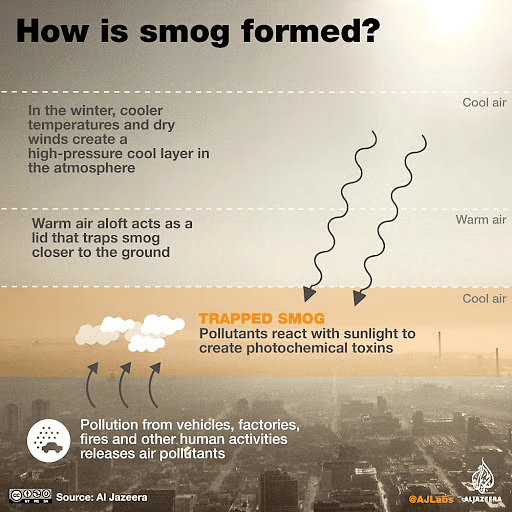
- Smog is formed when emissions from vehicles, industries, and power plants release pollutants into the air. These pollutants react with sunlight, creating secondary pollutants like ozone.
- Weather conditions such as temperature inversions can trap these pollutants close to the ground, exacerbating smog formation and reducing air quality.
Health Impacts of Smog:
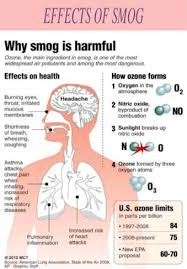
- Smog is a major public health threat, leading to respiratory diseases, eye irritation, and exacerbation of asthma and lung conditions.
- Prolonged exposure can cause chronic lung diseases, cardiovascular issues, and premature death.
Environmental Effects of Smog:
- Smog can damage plant life by inhibiting photosynthesis, negatively impacting agricultural yields.
- It contributes to global warming by emitting ozone, a potent greenhouse gas, into the atmosphere.
Haze and Visibility:
- Smog often results in haze, which diminishes visibility and leads to poor air quality. Haze is caused by suspended particulate matter from industrial, vehicular, and natural sources.
Urban Smog:
- Urban smog is common in large cities with dense populations and significant vehicular activity. It is further worsened by stagnant weather conditions and high temperatures.
Mitigation Measures:
- To combat smog, reducing emissions through cleaner technologies, better industrial regulations, and alternative energy solutions is crucial.
- Promoting urban planning, efficient public transport systems, and green spaces can help reduce smog levels in urban areas.
Conclusion:
- Smog remains a significant threat to both public health and the environment, particularly in urban settings with high levels of industrial activity and vehicular emissions.
- As seen in the case of Republic Day preparations at Kartavya Path, smog can disrupt important events and daily life.
- Addressing this issue requires comprehensive strategies to reduce pollution sources and improve air quality.
Download the PREPP App and attempt FREE IAS Exam Mock Tests and get complete study material!
*The article might have information for the previous academic years, please refer the official website of the exam.
How likely are you to recommend Prepp.in to a friend or a colleague?
Not so likely
Highly likely
UPSC CSE (IAS) 2027 Prelims Mock Test Series
Live Quizzes
Quizzes
Live Tests

• Live
Live Test : UPSC CSE Prelims CSAT (Paper-II) (Oct 08 - 11)
120 Minutes
80 Questions
200 Marks
English, Hindi
MEDIUM
Test will end in 05:30:35
Full Tests
Full Test - 04: UPSC CSE Prelims CSAT (Paper-II)
120 Minutes
80 Questions
200 Marks
English, Hindi
MEDIUM
Attempted by 19 aspirants in 12 hours
Full Test - 03: UPSC CSE Prelims CSAT (Paper-II)
120 Minutes
80 Questions
200 Marks
English, Hindi
MEDIUM
Attempted by 20 aspirants in 12 hours
Previous Year Papers
UPSC CSE Prelims 2026 GS Paper 1 Question Paper (24-May-2026)
120 Minutes
100 Questions
200 Marks
2,989 Attempted
English, Hindi
MEDIUM
Attempted by 12 aspirants in 12 hours
UPSC CSE Prelims 2026 CSAT Paper 2 Question Paper (24-May-2026)
120 Minutes
80 Questions
200 Marks
3,167 Attempted
English, Hindi
MEDIUM
Attempted by 13 aspirants in 12 hours
Videos

17 February 2025 | The Hindu Must Read Articles | Current Affairs
7,202 Views
•4
•7 months ago

16 February 2026 | The Hindu Must Read Articles | Current Affairs
6,962 Views
•4
•7 months ago

13 February 2026 | The Hindu Must Read Articles | Current Affairs
8,765 Views
•5
•7 months ago

12 February 2026 | The Hindu Must Read Articles | Current Affairs
5,788 Views
•4
•7 months ago






Also Check
IAS Exam Overview
IAS Exam Admit Card
IAS Exam Question Paper 2026
IAS Exam Mains Syllabus
IAS Exam Application Process
IAS Exam Eligibility
IAS Exam Result
IAS Exam Exam Pattern
IAS Exam CSAT Syllabus
IAS Exam Answer Key
IAS Exam Previous Year Paper
IAS Exam Current Affairs
IAS Exam Mains Question Paper
IAS Exam IAS Courses
IAS Exam UPSC Study Notes
IAS Exam Foundation Course 2024
IAS Exam Prelims Question Paper
IAS Exam Exam Center
IAS Exam Foundation Course 2025
IAS Exam Notification 2026
IAS Exam IAS Success Stories
IAS Exam Salary
IAS Exam Cutoff
IAS Exam Mock Tests
IAS Exam News


Comments