Siberian Demoiselle Crane Sets Migration Record
Why in the News?
A Siberian Demoiselle Crane, nicknamed Sukpak, has made headlines for setting a migration record by flying an astonishing 3,676 kilometers from Tyva, Siberia, to Khichan, Rajasthan, India.
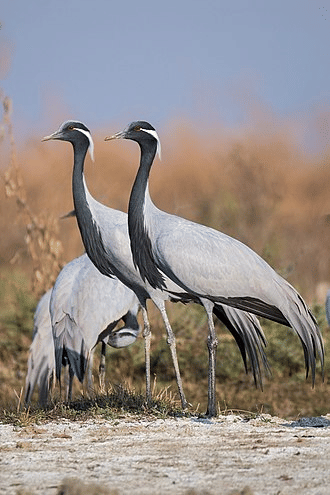
Record-Breaking Migration Journey
- Sukpak, identified by its distinct yellow-blue leg ring, was tagged in Tyva, Siberia.
- The crane's route was remarkable, traversing Russia, Kazakhstan, Turkmenistan, Afghanistan, and Pakistan, before entering India through Jaisalmer.
- The journey ended at Khichan, a well-known sanctuary for Demoiselle cranes in Rajasthan.
About the Siberian Demoiselle Crane
- Scientific Name: Grus virgo
- Smallest Crane Species: Known for its delicate size, the Demoiselle crane stands out as the smallest member of the crane family.
- Migratory Bird: Native to central Eurosiberia, these cranes are known to travel great distances for wintering.
Habitat and Distribution
- Native Range: Central Eurosiberia, from the Black Sea to Mongolia and Northeast China.
- Wintering Grounds: The Sahel region in Africa and the Indian subcontinent, with Khichan, Rajasthan, serving as a major roosting site.
- Khichan's Conservation Significance: Recently declared as India's first conservation reserve for Demoiselle cranes, highlighting the area’s vital role in the species' survival.
Unique Characteristics
- Physical Features:
- Length: 85–100 cm
- Wingspan: 155–180 cm
- Distinctive Traits: A long white neck stripe and a striking black chest plume.
- Behavior:
- Vocal: Produces high-pitched, trumpet-like calls.
- Dance Display: Engages in graceful, balletic dance movements, especially during courtship.
Cultural and Historical Connection with India
- The Demoiselle crane holds a special place in Indian literature and folklore.
- Sanskrit Legacy: Known as kraunch in Sanskrit, cranes are deeply associated with themes of love and longing, famously mentioned in the Ramayana as inspiration for the first-ever human-composed verse.
- Ancient Military Formations: Their synchronized migration patterns inspired infantry formations in the Mahabharata, reflecting their cultural significance.
Conservation Status
- IUCN Red List: Classified as Least Concern, indicating stable populations.
- Indian Wildlife Protection Act: Listed under Schedule IV, ensuring legal protection.
- CITES: Included in Appendix II, regulating international trade to prevent exploitation.
Why This Matters
The record-breaking journey of Sukpak underscores the resilience of migratory birds like the Demoiselle crane and the importance of global conservation efforts. With habitats like Khichan, India plays a crucial role in protecting these majestic travelers.
Download the PREPP App and attempt FREE IAS Exam Mock Tests and get complete study material!
*The article might have information for the previous academic years, please refer the official website of the exam.
How likely are you to recommend Prepp.in to a friend or a colleague?
Not so likely
Highly likely
UPSC CSE (IAS) 2027 Prelims Mock Test Series
Live Quizzes
Quizzes
Live Tests

• Live
Live Test : UPSC CSE Prelims CSAT (Paper-II) (Oct 08 - 11)
120 Minutes
80 Questions
200 Marks
English, Hindi
MEDIUM
Test will end in 08:52:35
Full Tests
Full Test - 04: UPSC CSE Prelims CSAT (Paper-II)
120 Minutes
80 Questions
200 Marks
English, Hindi
MEDIUM
Attempted by 19 aspirants in 12 hours
Full Test - 03: UPSC CSE Prelims CSAT (Paper-II)
120 Minutes
80 Questions
200 Marks
English, Hindi
MEDIUM
Attempted by 20 aspirants in 12 hours
Previous Year Papers
UPSC CSE Prelims 2026 GS Paper 1 Question Paper (24-May-2026)
120 Minutes
100 Questions
200 Marks
2,986 Attempted
English, Hindi
MEDIUM
Attempted by 12 aspirants in 12 hours
UPSC CSE Prelims 2026 CSAT Paper 2 Question Paper (24-May-2026)
120 Minutes
80 Questions
200 Marks
3,164 Attempted
English, Hindi
MEDIUM
Attempted by 13 aspirants in 12 hours
Videos

17 February 2025 | The Hindu Must Read Articles | Current Affairs
7,202 Views
•4
•7 months ago

16 February 2026 | The Hindu Must Read Articles | Current Affairs
6,962 Views
•4
•7 months ago

13 February 2026 | The Hindu Must Read Articles | Current Affairs
8,765 Views
•5
•7 months ago

12 February 2026 | The Hindu Must Read Articles | Current Affairs
5,788 Views
•4
•7 months ago






Also Check
IAS Exam Overview
IAS Exam Admit Card
IAS Exam Question Paper 2026
IAS Exam Mains Syllabus
IAS Exam Application Process
IAS Exam Eligibility
IAS Exam Result
IAS Exam Exam Pattern
IAS Exam CSAT Syllabus
IAS Exam Answer Key
IAS Exam Previous Year Paper
IAS Exam Current Affairs
IAS Exam Mains Question Paper
IAS Exam IAS Courses
IAS Exam UPSC Study Notes
IAS Exam Foundation Course 2024
IAS Exam Prelims Question Paper
IAS Exam Exam Center
IAS Exam Foundation Course 2025
IAS Exam Notification 2026
IAS Exam IAS Success Stories
IAS Exam Salary
IAS Exam Cutoff
IAS Exam Mock Tests
IAS Exam News


Comments