Should Voter ID Be Linked to Aadhaar?
Why in the News?
The recent allegations by the Aam Aadmi Party against the Bharatiya Janata Party regarding electoral roll manipulation have reignited the debate about linking Voter IDs with Aadhaar. Proponents argue it enhances transparency, while critics voice concerns over privacy and potential disenfranchisement.
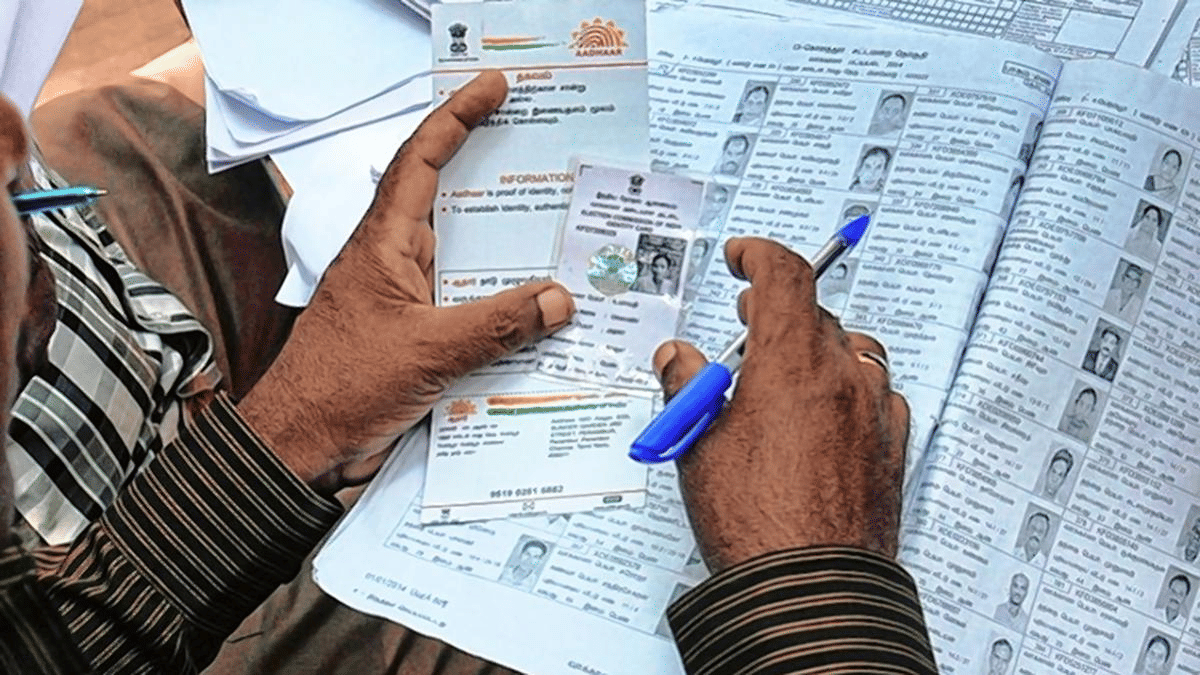
Legal Framework for Voter ID and Aadhaar Linking
- Representation of the People Act, 1950: Establishes guidelines for voter registration and electoral rolls, with recent amendments proposed to clarify Aadhaar's optional status.
- Election Laws (Amendment) Act, 2021: Permits the Election Commission (EC) to voluntarily collect Aadhaar numbers for deduplication.
- Rule 26-B of the Registration of Electors Rules, 2022: Allows voters to provide Aadhaar numbers voluntarily for authentication.
- Supreme Court Directives: Past rulings limit Aadhaar's mandatory use to welfare schemes, raising questions about its applicability to elections.
A Timeline of Aadhaar-Voter ID Linking
- Initial Proposal (2015): Initiated under Chief Election Commissioner H.S. Brahma to address bogus entries.
- Pause After SC Ruling (2015): Linking was suspended following the Supreme Court's judgment restricting Aadhaar's usage.
- Resumption (2021): The government allowed Aadhaar linking again, citing voluntary participation.
- Implementation (2022): Form 6B introduced to collect Aadhaar details or alternative identification voluntarily.
Key Supreme Court Judgments
- 2018 Ruling: Aadhaar’s mandatory use is limited to welfare schemes and taxation, reinforcing the right to privacy.
- G. Niranjan Petition (2022): Challenged the coercive nature of Aadhaar linking; the SC directed the EC to ensure clarity in voter forms.
The Election Commission's Stand
- Advocates for linking to eliminate duplicates while emphasizing its voluntary nature.
- Proposed amendments to enrollment forms to clearly indicate Aadhaar’s non-mandatory status.
- Faces challenges, including misinformation and reports of coercion.
Benefits of Linking Voter ID with Aadhaar
- Elimination of Duplicate Entries: Reduces bogus registrations for cleaner electoral rolls.
- Enhanced Electoral Transparency: Increases public trust by mitigating impersonation risks.
- Cost Efficiency: Automates deduplication, lowering administrative costs.
- Groundwork for Future Innovations: Facilitates remote and e-voting possibilities.
- Improved Voter Confidence: A transparent system fosters greater participation.
Drawbacks of Aadhaar-Voter ID Linking
- Privacy Concerns: Risks of data breaches and voter profiling.
- Disenfranchisement Risks: Errors in linking may lead to voter exclusion.
- Coercion and Miscommunication: Instances of voters being misled into believing Aadhaar linking is mandatory.
- Technical Limitations: Lack of biometric verification undermines reliability.
- Marginalized Communities: Vulnerable groups may face greater barriers to participation.
Global Best Practices
- Estonia: Utilizes digital IDs for secure and transparent e-voting.
- South Africa: Employs biometric voter registration to ensure accuracy.
The Way Forward
- Policy Revisions: Amend forms and laws to emphasize Aadhaar’s optional nature unequivocally.
- Public Awareness Campaigns: Educate voters on voluntary Aadhaar linking and available alternatives.
- Safeguarding Privacy: Implement robust data protection measures.
- Localized Solutions: Tailor verification mechanisms to address regional challenges.
- Pilot Programs: Test processes regionally to identify and address potential issues.
- Stakeholder Collaboration: Engage civil society, political representatives, and technologists to design inclusive policies.
- Legal Safeguards: Establish laws to prevent voter data misuse and ensure accountability.
- Incentivized Participation: Offer non-coercive incentives for voluntary Aadhaar linking.
Conclusion
While linking Voter IDs with Aadhaar has the potential to streamline electoral processes and enhance transparency, it is critical to address concerns about privacy, misinformation, and disenfranchisement. A balanced, inclusive, and transparent approach is essential to ensure the integrity of India's electoral system.
Download the PREPP App and attempt FREE IAS Exam Mock Tests and get complete study material!
*The article might have information for the previous academic years, please refer the official website of the exam.
How likely are you to recommend Prepp.in to a friend or a colleague?
Not so likely
Highly likely
UPSC CSE (IAS) 2027 Prelims Mock Test Series
Live Quizzes
Quizzes
Live Tests

• Live
Live Test : UPSC CSE Prelims CSAT (Paper-II) (Oct 08 - 11)
120 Minutes
80 Questions
200 Marks
English, Hindi
MEDIUM
Test will end in 07:07:17
Full Tests
Full Test - 04: UPSC CSE Prelims CSAT (Paper-II)
120 Minutes
80 Questions
200 Marks
English, Hindi
MEDIUM
Attempted by 19 aspirants in 12 hours
Full Test - 03: UPSC CSE Prelims CSAT (Paper-II)
120 Minutes
80 Questions
200 Marks
English, Hindi
MEDIUM
Attempted by 20 aspirants in 12 hours
Previous Year Papers
UPSC CSE Prelims 2026 GS Paper 1 Question Paper (24-May-2026)
120 Minutes
100 Questions
200 Marks
2,988 Attempted
English, Hindi
MEDIUM
Attempted by 12 aspirants in 12 hours
UPSC CSE Prelims 2026 CSAT Paper 2 Question Paper (24-May-2026)
120 Minutes
80 Questions
200 Marks
3,166 Attempted
English, Hindi
MEDIUM
Attempted by 13 aspirants in 12 hours
Videos

17 February 2025 | The Hindu Must Read Articles | Current Affairs
7,202 Views
•4
•7 months ago

16 February 2026 | The Hindu Must Read Articles | Current Affairs
6,962 Views
•4
•7 months ago

13 February 2026 | The Hindu Must Read Articles | Current Affairs
8,765 Views
•5
•7 months ago

12 February 2026 | The Hindu Must Read Articles | Current Affairs
5,788 Views
•4
•7 months ago






Also Check
IAS Exam Overview
IAS Exam Admit Card
IAS Exam Question Paper 2026
IAS Exam Mains Syllabus
IAS Exam Application Process
IAS Exam Eligibility
IAS Exam Result
IAS Exam Exam Pattern
IAS Exam CSAT Syllabus
IAS Exam Answer Key
IAS Exam Previous Year Paper
IAS Exam Current Affairs
IAS Exam Mains Question Paper
IAS Exam IAS Courses
IAS Exam UPSC Study Notes
IAS Exam Foundation Course 2024
IAS Exam Prelims Question Paper
IAS Exam Exam Center
IAS Exam Foundation Course 2025
IAS Exam Notification 2026
IAS Exam IAS Success Stories
IAS Exam Salary
IAS Exam Cutoff
IAS Exam Mock Tests
IAS Exam News


Comments