Sarin: The chemical agent
Why in news?
Survivors Of 2013 Syria Chemical Attack Seek Justice.
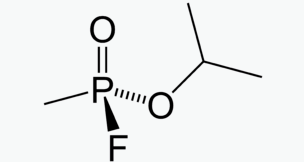
About Sarin
- Sarin is a highly toxic chemical warfare agent classified as a nerve agent, colorless, and odorless.
- Chemical Properties of Sarin: Sarin is a volatile organophosphorus compound that evaporates rapidly into a toxic gas, affecting the nervous system.
- Mechanism of Action: Sarin inhibits acetylcholinesterase, an enzyme responsible for breaking down acetylcholine, leading to overstimulation of muscles and nerves.
- Health Effects of Sarin Exposure: Sarin poisoning causes symptoms like muscle spasms, paralysis, respiratory failure, and potentially death if untreated.
- Routes of Exposure: Sarin can enter the body through skin contact, inhalation, or ingestion, making it highly lethal in a chemical attack.
- History and Synthesis: First synthesized in 1938 by German scientists, Sarin was originally developed as a pesticide before being weaponized for chemical warfare.
- International Legal Status: Sarin is a banned substance under the Chemical Weapons Convention (CWC), as it is considered a weapon of mass destruction.
- Sarin and Chemical Warfare: Despite its ban, Sarin has been used in chemical attacks in conflict zones like Syria, highlighting concerns over chemical weapons proliferation.
- Treatment for Sarin Poisoning: Timely treatment with antidotes such as atropine and pralidoxime is critical for reversing the effects of Sarin exposure.
Download the PREPP App and attempt FREE IAS Exam Mock Tests and get complete study material!
*The article might have information for the previous academic years, please refer the official website of the exam.
How likely are you to recommend Prepp.in to a friend or a colleague?
Not so likely
Highly likely
UPSC CSE (IAS) 2027 Prelims Mock Test Series
Live Quizzes
Quizzes
Live Tests

• Live
Live Test : UPSC CSE Prelims CSAT (Paper-II) (Oct 08 - 11)
120 Minutes
80 Questions
200 Marks
English, Hindi
MEDIUM
Test will end in 05:31:03
Full Tests
Full Test - 04: UPSC CSE Prelims CSAT (Paper-II)
120 Minutes
80 Questions
200 Marks
English, Hindi
MEDIUM
Attempted by 19 aspirants in 12 hours
Full Test - 03: UPSC CSE Prelims CSAT (Paper-II)
120 Minutes
80 Questions
200 Marks
English, Hindi
MEDIUM
Attempted by 20 aspirants in 12 hours
Previous Year Papers
UPSC CSE Prelims 2026 GS Paper 1 Question Paper (24-May-2026)
120 Minutes
100 Questions
200 Marks
2,989 Attempted
English, Hindi
MEDIUM
Attempted by 12 aspirants in 12 hours
UPSC CSE Prelims 2026 CSAT Paper 2 Question Paper (24-May-2026)
120 Minutes
80 Questions
200 Marks
3,167 Attempted
English, Hindi
MEDIUM
Attempted by 13 aspirants in 12 hours
Videos

17 February 2025 | The Hindu Must Read Articles | Current Affairs
7,202 Views
•4
•7 months ago

16 February 2026 | The Hindu Must Read Articles | Current Affairs
6,962 Views
•4
•7 months ago

13 February 2026 | The Hindu Must Read Articles | Current Affairs
8,765 Views
•5
•7 months ago

12 February 2026 | The Hindu Must Read Articles | Current Affairs
5,788 Views
•4
•7 months ago






Also Check
IAS Exam Overview
IAS Exam Admit Card
IAS Exam Question Paper 2026
IAS Exam Mains Syllabus
IAS Exam Application Process
IAS Exam Eligibility
IAS Exam Result
IAS Exam Exam Pattern
IAS Exam CSAT Syllabus
IAS Exam Answer Key
IAS Exam Previous Year Paper
IAS Exam Current Affairs
IAS Exam Mains Question Paper
IAS Exam IAS Courses
IAS Exam UPSC Study Notes
IAS Exam Foundation Course 2024
IAS Exam Prelims Question Paper
IAS Exam Exam Center
IAS Exam Foundation Course 2025
IAS Exam Notification 2026
IAS Exam IAS Success Stories
IAS Exam Salary
IAS Exam Cutoff
IAS Exam Mock Tests
IAS Exam News


Comments