Risk-Weighted Assets (RWAs): RBI Reduces Risk Weights on Bank Loans to NBFCs
Why in the News?
The Reserve Bank of India (RBI) has announced a significant reduction in risk weights on bank loans to Non-Banking Financial Companies (NBFCs) by 25 percentage points, based on external credit ratings. This move is aimed at improving credit flow and ensuring financial stability in the banking sector.

Key Highlights
Background
- In November 2023, the RBI increased risk weights on bank exposures to NBFCs, leading to tighter credit conditions and slowing down bank lending.
- The central bank has now reversed this decision after evaluating its impact on credit availability and liquidity.
Reasons for Reduction
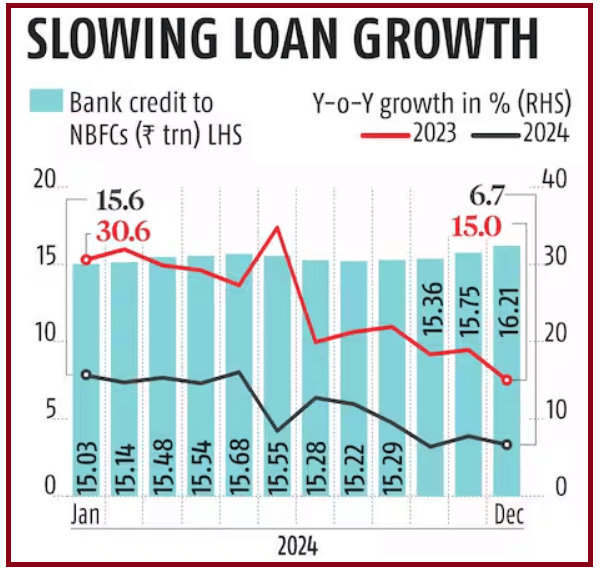
- Sluggish Bank Credit to NBFCs: The previous increase in risk weights had constrained bank lending to NBFCs.
- Liquidity Tightening: Prevailing liquidity challenges required intervention to ease credit flow.
- Economic Stability: Ensuring a balanced credit supply is critical for financial and economic stability.
Objective
- This reduction aims to enhance credit flow to NBFCs, thereby improving credit availability for retail borrowers and small businesses.
Impact on Microfinance Loans
- The RBI has also reduced risk weights on microfinance loans under regulatory retail to 75% from 125%.
Understanding Risk-Weighted Assets (RWAs)
Risk-Weighted Assets (RWAs) refer to a bank’s total assets, adjusted by a risk factor, to determine the capital required to mitigate potential losses.
How Are RWAs Calculated?
- Each loan or asset is assigned a risk weight based on its risk level.
- Higher-risk assets require banks to allocate more capital as a safeguard against potential defaults.
Regulatory Requirement
- Banks must maintain a Capital Adequacy Ratio (CAR) to ensure they have sufficient capital to absorb risks.
Implications of RBI’s Decision
1. Impact on Banks
- Lower Capital Requirement: Reduced risk weights mean banks need to hold less capital against loans to NBFCs.
- Enhanced Credit Growth: Encourages banks to lend more, boosting overall economic activity.
2. Impact on NBFCs
- Easier Access to Bank Credit: Lower risk weights increase banks’ willingness to extend loans.
- Lower Borrowing Costs: Reduced capital requirements translate into lower interest rates for NBFCs.
- Business Expansion: Greater liquidity enables NBFCs to lend more to retail borrowers and underserved markets.
3. Impact on the Economy
- Boost to Retail Credit: Increased NBFC lending supports consumer spending and small business growth.
- Financial Stability: A steady credit flow prevents liquidity crunches and economic slowdowns.
Key Terms Explained
Non-Banking Financial Companies (NBFCs)
- Financial institutions that provide banking-like services without holding a banking license.
- They specialize in lending, asset financing, microfinance, and wealth management.
- NBFCs play a critical role in providing credit to retail customers, small businesses, and underserved communities.
Capital Adequacy Ratio (CAR)
- A crucial measure of a bank’s financial strength.
- Ensures that banks have sufficient capital reserves to absorb potential losses.
- Banks must maintain a minimum CAR as per Basel norms.
Conclusion
The RBI’s decision to reduce risk weights on bank loans to NBFCs is a strategic move to improve liquidity, support financial stability, and accelerate economic growth. By lowering capital requirements for banks, this measure encourages higher lending, reduces borrowing costs, and strengthens the role of NBFCs in retail financing.
Download the PREPP App and attempt FREE IAS Exam Mock Tests and get complete study material!

Live Test : UPSC CSE Prelims CSAT (Paper-II) (Oct 08 - 11)
Full Test - 04: UPSC CSE Prelims CSAT (Paper-II)
Full Test - 03: UPSC CSE Prelims CSAT (Paper-II)
UPSC CSE Prelims 2026 GS Paper 1 Question Paper (24-May-2026)
UPSC CSE Prelims 2026 CSAT Paper 2 Question Paper (24-May-2026)

17 February 2025 | The Hindu Must Read Articles | Current Affairs

16 February 2026 | The Hindu Must Read Articles | Current Affairs

13 February 2026 | The Hindu Must Read Articles | Current Affairs









Comments