Revitalizing SAARC: Nepal's Call for Regional Cooperation
Why in the News?
Nepalese Prime Minister K P Sharma Oli has recently called for the revitalization of the South Asian Association for Regional Cooperation (SAARC) to foster shared interests and prosperity within the region. This call was made during the celebration of the 40th Charter Day of SAARC.
Challenges Addressed by Prime Minister Oli
In his address, Prime Minister Oli highlighted the urgent need to tackle pressing challenges such as climate change, socioeconomic disparities, and environmental issues. These challenges, according to Oli, require a collective effort from SAARC members for effective solutions. However, since its peak in the early 2010s, SAARC has faced significant setbacks, primarily due to geopolitical tensions among member states, hindering the organization’s progress.
The Stagnation of SAARC: A History of Inactivity
SAARC has been largely inactive since 2016. The 19th summit, scheduled to be held in Pakistan, was canceled after key member states, including India, Bangladesh, Bhutan, and Afghanistan, boycotted the event following a terrorist attack on an Indian military base in Uri. No summits have been held since 2014, and progress on key initiatives has been stalled, further highlighting the need for reforms within the organization.
What is SAARC? Understanding the South Asian Association for Regional Cooperation
SAARC's Formation and Objectives
The South Asian Association for Regional Cooperation (SAARC) was established in 1985 in Dhaka, Bangladesh, to foster regional cooperation and development. The organization aims to promote economic growth, regional integration, and self-reliance among its member states. SAARC's member countries include Afghanistan, Bangladesh, Bhutan, India, Maldives, Nepal, Pakistan, and Sri Lanka.
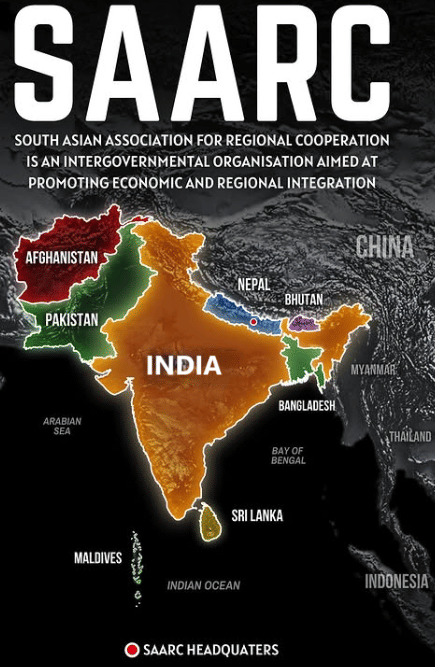
Key Statistics About SAARC's Global Significance
- Geography: SAARC countries represent 3% of the world’s land area.
- Population: Home to 21% of the global population.
- Economy: Contributing 5.21% to the world economy.
SAARC also maintains close relations with global organizations such as the United Nations (UN) and the European Union (EU), with its headquarters located in Kathmandu, Nepal.
SAFTA: The South Asian Free Trade Area
Purpose and Goals of SAFTA
The South Asian Free Trade Area (SAFTA), created in 2004 and implemented in 2006, aimed to reduce trade barriers and facilitate free trade among SAARC countries. However, its impact has been limited, with intra-SAARC trade accounting for only 5% of the region’s GDP, primarily due to political tensions and trade barriers among member states.
SAFTA vs ASEAN: A Comparative Analysis
In comparison, the Association of Southeast Asian Nations (ASEAN), which also promotes free trade, sees intra-regional trade accounting for around 10% of GDP, highlighting the relative underperformance of SAFTA in fostering regional economic integration.
Specialized Bodies of SAARC
SAARC also includes several specialized bodies, each playing a crucial role in regional development:
- SAARC Arbitration Council (SARCO): Based in Islamabad, Pakistan, SARCO handles dispute resolution within the region.
- SAARC Development Fund (SDF): Located in Thimphu, Bhutan, SDF finances regional projects aimed at promoting socio-economic development.
- South Asian University (SAU): Situated in New Delhi, India, SAU supports academic collaboration across SAARC nations.
- South Asian Regional Standards Organization (SARSO): Based in Dhaka, Bangladesh, SARSO works on standardizing regional products and services.
Current Status of SAARC: A Look at the Challenges
Inactive Status and Stagnation
Since the cancellation of its 2016 summit, SAARC has faced significant challenges that have led to its stagnation. The lack of progress and commitment from member countries has prevented the effective implementation of agreements and initiatives aimed at regional cooperation.
Key Challenges Facing SAARC
- Geopolitical Conflicts: Tensions, particularly between India and Pakistan, continue to disrupt SAARC's potential for collaboration.
- Economic Disparities: Differing levels of development among member states hinder uniform progress.
- Trust Deficit: Historical mistrust between nations hampers effective decision-making.
- Infrastructure Gaps: Inadequate transportation and trade routes slow regional connectivity.
- Financial Constraints: Limited funding has undermined the effectiveness of SAARC’s initiatives.
Future Outlook for SAARC: Revitalization and Regional Cooperation
Proposals for Reform and Revitalization
Prime Minister K P Sharma Oli has emphasized the need for reforms within SAARC to revitalize the organization as a platform for regional problem-solving and cooperation. He proposed enhancing trade agreements, improving infrastructure, and leveraging technology to strengthen economic integration.
Focus Areas for Future Cooperation
- Strengthening Regional Trade: Improving trade agreements and infrastructure could foster deeper economic ties among SAARC nations.
- Climate Action: Joint initiatives to tackle climate change could serve as a unifying cause for the region.
- Digital Connectivity: Investment in digital technology and education can help drive sustainable growth across South Asia.
Shifting Dynamics: The Rise of Alternatives
Due to SAARC's stagnation, alternative forums such as BIMSTEC (Bay of Bengal Initiative for Multi-Sectoral Technical and Economic Cooperation) are gaining prominence as platforms for regional collaboration.
Conclusion: Can SAARC Overcome its Challenges?
While SAARC faces significant geopolitical and economic challenges, there remains potential for its revitalization. If the organization can address its internal divisions and focus on collective solutions to regional issues, it could once again become a strong platform for promoting peace, prosperity, and sustainable development across South Asia.
Download the PREPP App and attempt FREE IAS Exam Mock Tests and get complete study material!

Live Test : UPSC CSE Prelims CSAT (Paper-II) (Oct 08 - 11)
Full Test - 04: UPSC CSE Prelims CSAT (Paper-II)
Full Test - 03: UPSC CSE Prelims CSAT (Paper-II)
UPSC CSE Prelims 2026 GS Paper 1 Question Paper (24-May-2026)
UPSC CSE Prelims 2026 CSAT Paper 2 Question Paper (24-May-2026)

17 February 2025 | The Hindu Must Read Articles | Current Affairs

16 February 2026 | The Hindu Must Read Articles | Current Affairs

13 February 2026 | The Hindu Must Read Articles | Current Affairs









Comments