Retail and Wholesale Inflation in India: February 2025 Update
Why in the News?
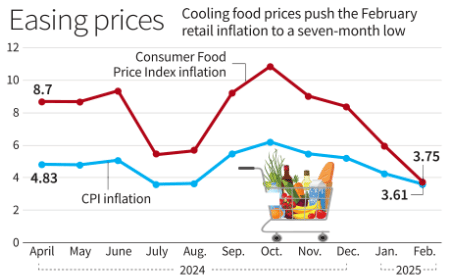
India's retail inflation dropped to 3.6% in February 2025, marking its lowest level in seven months. The decline was primarily driven by falling food prices, bringing relief to consumers and policymakers.
Key Highlights
- Food Price Slowdown: Prices of essential food items such as vegetables, pulses, and eggs declined, contributing to a significant drop in the Consumer Food Price Index (CFPI).
- CPI Inflation Trend: The Consumer Price Index (CPI) has been on a downward trajectory for four consecutive months, now falling below the Reserve Bank of India’s (RBI) 4% target.
- Repo Rate Expectations: With softer inflation, there is an increased probability of a 0.25% repo rate cut in the upcoming Monetary Policy Committee (MPC) meeting.
- Boost in Purchasing Power: Lower inflation enhances consumers’ purchasing power, stimulating demand for goods and services in the economy.
Understanding Retail Inflation
Retail inflation represents the rise in prices of goods and services at the consumer level, measured using the Consumer Price Index (CPI).
CPI Key Components
- The CPI is composed of various categories, including:
- Food and Beverages
- Clothing and Footwear
- Housing
- Fuel and Light
- Miscellaneous Items
Urban vs. Rural Inflation in February 2025
- Urban retail inflation: 3.3%
- Rural retail inflation: 3.8%
- Since food and beverages account for 45.86% of the CPI, their price movement significantly influences overall retail inflation.
Inflation Control Measures
- The RBI primarily uses interest rate policies to regulate inflation and maintain price stability, ensuring balanced economic growth.
Wholesale Inflation: A Broader Perspective
Definition and Measurement
- Wholesale inflation measures price changes at the wholesale level, tracked through the Wholesale Price Index (WPI).
WPI Categories
- The WPI consists of three major groups:
- Primary Articles (food and non-food items)
- Fuel and Power
- Manufactured Goods
Impact on Retail Prices
- Changes in wholesale inflation eventually influence retail prices with a time lag as businesses adjust their pricing strategies.
Inflation Trends
- While wholesale and retail inflation trends often differ, WPI movements provide crucial insights into future retail price fluctuations.
WPI vs. CPI: Key Differences
| Feature | CPI (Retail Inflation) | WPI (Wholesale Inflation) |
|---|---|---|
| Measurement | Consumer-level price changes | Business-to-business price changes |
| Includes Services? | Yes | No |
| Main Components | Food, housing, fuel, etc. | Primary articles, fuel & power, manufactured goods |
Conclusion
India’s declining inflation provides a positive outlook for consumers and businesses alike. As the RBI considers a potential repo rate cut, the evolving inflation trends will continue to shape economic policy and market dynamics.
Download the PREPP App and attempt FREE IAS Exam Mock Tests and get complete study material!
*The article might have information for the previous academic years, please refer the official website of the exam.
How likely are you to recommend Prepp.in to a friend or a colleague?
Not so likely
Highly likely
UPSC CSE (IAS) 2027 Prelims Mock Test Series
Live Quizzes
Quizzes
Live Tests

• Live
Live Test : UPSC CSE Prelims CSAT (Paper-II) (Oct 08 - 11)
120 Minutes
80 Questions
200 Marks
English, Hindi
MEDIUM
Test will end in 05:29:27
Full Tests
Full Test - 04: UPSC CSE Prelims CSAT (Paper-II)
120 Minutes
80 Questions
200 Marks
English, Hindi
MEDIUM
Attempted by 19 aspirants in 12 hours
Full Test - 03: UPSC CSE Prelims CSAT (Paper-II)
120 Minutes
80 Questions
200 Marks
English, Hindi
MEDIUM
Attempted by 20 aspirants in 12 hours
Previous Year Papers
UPSC CSE Prelims 2026 GS Paper 1 Question Paper (24-May-2026)
120 Minutes
100 Questions
200 Marks
2,989 Attempted
English, Hindi
MEDIUM
Attempted by 12 aspirants in 12 hours
UPSC CSE Prelims 2026 CSAT Paper 2 Question Paper (24-May-2026)
120 Minutes
80 Questions
200 Marks
3,167 Attempted
English, Hindi
MEDIUM
Attempted by 13 aspirants in 12 hours
Videos

17 February 2025 | The Hindu Must Read Articles | Current Affairs
7,202 Views
•4
•7 months ago

16 February 2026 | The Hindu Must Read Articles | Current Affairs
6,962 Views
•4
•7 months ago

13 February 2026 | The Hindu Must Read Articles | Current Affairs
8,765 Views
•5
•7 months ago

12 February 2026 | The Hindu Must Read Articles | Current Affairs
5,788 Views
•4
•7 months ago






Also Check
IAS Exam Overview
IAS Exam Admit Card
IAS Exam Question Paper 2026
IAS Exam Mains Syllabus
IAS Exam Application Process
IAS Exam Eligibility
IAS Exam Result
IAS Exam Exam Pattern
IAS Exam CSAT Syllabus
IAS Exam Answer Key
IAS Exam Previous Year Paper
IAS Exam Current Affairs
IAS Exam Mains Question Paper
IAS Exam IAS Courses
IAS Exam UPSC Study Notes
IAS Exam Foundation Course 2024
IAS Exam Prelims Question Paper
IAS Exam Exam Center
IAS Exam Foundation Course 2025
IAS Exam Notification 2026
IAS Exam IAS Success Stories
IAS Exam Salary
IAS Exam Cutoff
IAS Exam Mock Tests
IAS Exam News


Comments