Remittance and Money Laundering: Enforcement Directorate Recovers ₹13.58 Crore
Why in the News?
The Enforcement Directorate (ED) has successfully facilitated the restitution of assets worth ₹13.58 crore to victims of money laundering and rightful claimants. This action is part of a broader investigation into a high-profile fake imports case involving an illegal overseas remittance of approximately ₹3,200 crore.
Fake Imports Case: Key Details
The ED investigation stems from a First Information Report (FIR) filed by the Bank of Baroda. Key findings include:
- Large sums of money were remitted to companies based in Hong Kong, China, and Dubai under the pretext of advance import remittances and software imports.
- No actual imports took place, and fake documents were submitted to the bank to justify the transactions.
- The illicit funds were channeled through multiple shell entities to evade scrutiny and bypass financial regulations.
Understanding Remittance: Definition and Importance
Remittance refers to a non-commercial transfer of money by a foreign worker, diaspora member, or citizen with familial ties abroad to their home country. It plays a vital role in global financial stability, especially in developing economies.
Why Are Remittances Important for Developing Countries?
- Serve as a major financial inflow, often exceeding foreign aid.
- Contribute significantly to household income, improving access to food, healthcare, and education.
- Strengthen the foreign exchange reserves of recipient nations.
Types of Remittances
- Workers' Remittances – Money sent by migrant workers to their families.
- Business Remittances – Transfers related to international trade and investments.
- Informal Remittances – Transfers through unofficial channels such as hawala networks.
Global Remittance Trends and Key Statistics![]()

Top Remittance-Receiving Countries (2022 Data):
- India: $100+ billion (Highest globally)
- Mexico: $61.1 billion
- Philippines: $38 billion
Major Source Regions for Remittances
- 40% of international migrants originate from Asia.
- India and China have the largest number of migrants abroad.
- The largest migration corridor is from India to the UAE, with approximately 3.5 million Indians residing there.

India’s Top Remittance Sources
- United States: 23.4%
- United Arab Emirates (UAE): 18%
- United Kingdom (UK): 6.8%
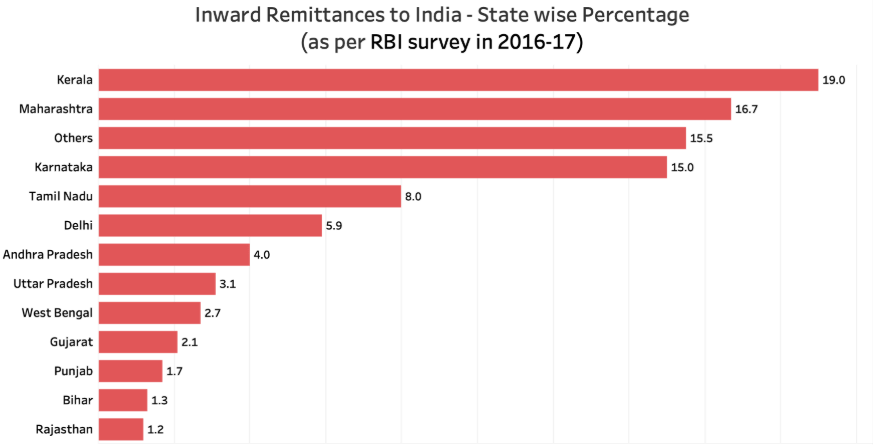
State-wise Distribution of Remittances in India
- 58.7% of remittances go to four states: Kerala, Maharashtra, Karnataka, and Tamil Nadu.
- Other states such as Assam, Chhattisgarh, Himachal Pradesh, Uttarakhand, Jammu & Kashmir, and Jharkhand together account for only 1% of total remittance inflows.
Conclusion
The ED’s recent crackdown on illegal remittances highlights the critical need for financial transparency and stringent anti-money laundering measures. Meanwhile, legal remittances continue to be a lifeline for millions of families, playing a crucial role in the economies of many developing nations, including India.
Download the PREPP App and attempt FREE IAS Exam Mock Tests and get complete study material!

Live Test : UPSC CSE Prelims CSAT (Paper-II) (Oct 08 - 11)
Full Test - 04: UPSC CSE Prelims CSAT (Paper-II)
Full Test - 03: UPSC CSE Prelims CSAT (Paper-II)
UPSC CSE Prelims 2026 GS Paper 1 Question Paper (24-May-2026)
UPSC CSE Prelims 2026 CSAT Paper 2 Question Paper (24-May-2026)

17 February 2025 | The Hindu Must Read Articles | Current Affairs

16 February 2026 | The Hindu Must Read Articles | Current Affairs

13 February 2026 | The Hindu Must Read Articles | Current Affairs









Comments