Regional Rapid Transit System (RRTS): Key Features and Advantages for NCR
Regional Rapid Transit System (RRTS): Key Features and Advantages for NCR
Why in news?
- Prime Minister Narendra Modi on January 5, 2025 inaugurated a 13-km-long section of the Rapid Rail Transit System (RRTS) between New Ashok Nagar in Delhi and Sahibabad in Uttar Pradesh. The estimated project cost is ₹4,600 crore.
Introduction to Regional Rapid Transit System (RRTS):
- What is RRTS?: The Regional Rapid Transit System (RRTS) is a high-speed, rail-based commuter transit network designed for the National Capital Region (NCR). It connects key cities and towns in NCR, with the Delhi-Meerut corridor being the first operational one.
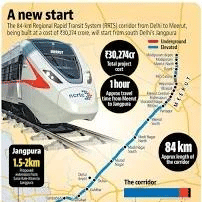
- Delhi-Meerut Corridor: The Delhi-Meerut RRTS spans 82 km with 22 stations, offering semi-high-speed connectivity between Delhi, Ghaziabad, and Meerut.
RRTS Development and Background:
- Origins: The concept of RRTS was developed following a 1998-99 study by Indian Railways, later reviewed in 2006, and officially recommended in the NCR Planning Board's Functional Plan (2032).
- Objectives: RRTS aims to enhance regional connectivity, reduce road congestion, and promote the use of public transportation in NCR.
Design, Features, and Structure:
- High-Speed Rail: RRTS trains can reach speeds of 160 km/h, with a maximum speed of 180 km/h.
- Dedicated RRTS Corridors: RRTS operates on elevated tracks, ensuring smooth, congestion-free travel.
- Environmental Sustainability: The project incorporates rainwater harvesting systems and eco-friendly design elements to ensure environmental sustainability.
Advantages of Regional Rapid Transit System:
- Speed and Efficiency: RRTS trains offer faster transit compared to metros, reducing commute times.
- Reduced Congestion: With dedicated corridors, RRTS alleviates road congestion, contributing to a cleaner environment and less pollution.
- Boost to Economic Growth: RRTS improves connectivity, encouraging balanced economic development and new commercial opportunities across NCR.
- Sustainability: RRTS promotes green transport solutions, encouraging less reliance on private vehicles and reducing overall emissions.
Geographical Theories and RRTS Impact:
- Central Place Theory: RRTS improves access between central cities and surrounding areas, offering residents better job, education, and service opportunities.
- Gravity Model: RRTS increases interaction and trade potential between cities, enhancing regional economic growth.
- Diffusion Theory: RRTS catalyzes urban growth along its corridors, creating new commercial hubs and fostering urban development.
Comparison with Metro and Rail Systems:
- Speed and Comfort: RRTS trains are faster than metro services and more comfortable than Indian Railways for shorter-distance travel.
- Frequency and Accessibility: The RRTS operates with high-frequency trains, offering more flexibility for commuters.
Namo Bharat Trains:
- India’s First RRTS Train: The “Namo Bharat” train is the first RRTS service connecting Delhi and Meerut, marking a significant milestone for regional transit.
Impact of RRTS on NCR:
- Improved Productivity: Shorter travel times will increase economic productivity across the NCR region.
- Job Creation and Economic Growth: RRTS will create new employment opportunities and open commercial hubs in connected towns, reducing dependency on Delhi as a central economic hub.
Conclusion: Transforming NCR's Transport Landscape:
- The Regional Rapid Transit System (RRTS) is a transformative project that aims to improve regional connectivity, ease traffic congestion, and foster sustainable urban growth in the National Capital Region (NCR). By improving access to transportation, it will drive economic development and enhance the quality of life for commuters.
Download the PREPP App and attempt FREE IAS Exam Mock Tests and get complete study material!
*The article might have information for the previous academic years, please refer the official website of the exam.
How likely are you to recommend Prepp.in to a friend or a colleague?
Not so likely
Highly likely
UPSC CSE (IAS) 2027 Prelims Mock Test Series
Live Quizzes
Quizzes
Live Tests

• Live
Live Test : UPSC CSE Prelims CSAT (Paper-II) (Oct 08 - 11)
120 Minutes
80 Questions
200 Marks
English, Hindi
MEDIUM
Test will end in 05:30:43
Full Tests
Full Test - 04: UPSC CSE Prelims CSAT (Paper-II)
120 Minutes
80 Questions
200 Marks
English, Hindi
MEDIUM
Attempted by 19 aspirants in 12 hours
Full Test - 03: UPSC CSE Prelims CSAT (Paper-II)
120 Minutes
80 Questions
200 Marks
English, Hindi
MEDIUM
Attempted by 20 aspirants in 12 hours
Previous Year Papers
UPSC CSE Prelims 2026 GS Paper 1 Question Paper (24-May-2026)
120 Minutes
100 Questions
200 Marks
2,989 Attempted
English, Hindi
MEDIUM
Attempted by 12 aspirants in 12 hours
UPSC CSE Prelims 2026 CSAT Paper 2 Question Paper (24-May-2026)
120 Minutes
80 Questions
200 Marks
3,167 Attempted
English, Hindi
MEDIUM
Attempted by 13 aspirants in 12 hours
Videos

17 February 2025 | The Hindu Must Read Articles | Current Affairs
7,202 Views
•4
•7 months ago

16 February 2026 | The Hindu Must Read Articles | Current Affairs
6,962 Views
•4
•7 months ago

13 February 2026 | The Hindu Must Read Articles | Current Affairs
8,765 Views
•5
•7 months ago

12 February 2026 | The Hindu Must Read Articles | Current Affairs
5,788 Views
•4
•7 months ago






Also Check
IAS Exam Overview
IAS Exam Admit Card
IAS Exam Question Paper 2026
IAS Exam Mains Syllabus
IAS Exam Application Process
IAS Exam Eligibility
IAS Exam Result
IAS Exam Exam Pattern
IAS Exam CSAT Syllabus
IAS Exam Answer Key
IAS Exam Previous Year Paper
IAS Exam Current Affairs
IAS Exam Mains Question Paper
IAS Exam IAS Courses
IAS Exam UPSC Study Notes
IAS Exam Foundation Course 2024
IAS Exam Prelims Question Paper
IAS Exam Exam Center
IAS Exam Foundation Course 2025
IAS Exam Notification 2026
IAS Exam IAS Success Stories
IAS Exam Salary
IAS Exam Cutoff
IAS Exam Mock Tests
IAS Exam News


Comments