RBI Keeps Repo Rate Unchanged at 6.5% for Eleventh Consecutive Review
Why in the News?
The Reserve Bank of India’s (RBI) Monetary Policy Committee (MPC) has decided to maintain the repo rate at 6.5%, marking the eleventh consecutive bi-monthly review without changes. This decision reflects the central bank's continued focus on inflation control amid slowing economic growth.
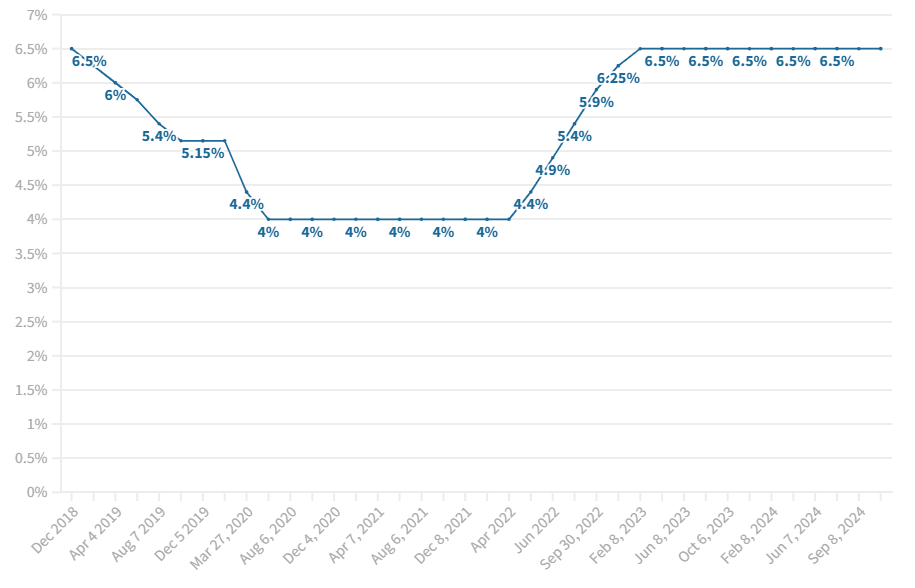
Key Highlights of the RBI’s Repo Rate Decision
Reasons for Keeping the Repo Rate Unchanged
- Inflation Control:
- The RBI aims to align inflation with its medium-term target of 4%.
- Retail inflation rose to 6.2% in October, breaching the upper tolerance limit.
- Economic Growth Monitoring:
- While growth has decelerated, the MPC finds the economic outlook resilient, favoring caution over immediate intervention.
- Global Uncertainties:
- Geopolitical risks, adverse weather events, and financial market volatility necessitate a balanced approach.
Impact of an Unchanged Repo Rate
- Stable Borrowing Costs:
Businesses and consumers benefit from consistent borrowing costs, reducing financial uncertainty.
- Inflation Management:
By not cutting rates, the RBI prevents excess liquidity that could further fuel inflation.
- Liquidity Measures:
The RBI addressed tight liquidity by reducing the Cash Reserve Ratio (CRR) by 50 basis points, injecting ₹1.16 lakh crore into the banking system.
Understanding the Repo Rate
- Definition: The repo rate is the interest rate at which the RBI lends money to commercial banks against collateral.
- Purpose: It helps control liquidity, inflation, and overall economic activity.
- Mechanism: Banks borrow from the RBI during liquidity shortages, agreeing to repurchase the collateral securities at a predetermined price.
Significance of the Repo Rate
- Inflation Control: Higher repo rates discourage bank borrowing, reducing liquidity and curbing inflation.
- Economic Stability: Repo rate adjustments stabilize the economy during recessions or overheating.
- Impact on Loans: Changes in repo rates influence loan and deposit interest rates, directly affecting businesses and consumers.
Related Monetary Policy Terms
- Reverse Repo Rate: The rate at which the RBI borrows funds from banks, encouraging banks to park excess liquidity.
- Bank Rate: Long-term lending rate from the RBI to banks, usually higher than the repo rate.
- Cash Reserve Ratio (CRR): The percentage of bank deposits that must be maintained with the RBI.
- Statutory Liquidity Ratio (SLR): The percentage of net demand and time liabilities to be kept as liquid assets like cash, gold, or government securities.
About the Monetary Policy Committee (MPC)
The MPC sets the benchmark interest rate to maintain price stability while supporting economic growth.
- Formation: Established under the RBI Act, 1934, operational since 2016.
- Objective: Maintain inflation at 4% (+/- 2%) and foster growth.
- Structure:
- Six members: Three from the RBI, three external experts nominated by the government.
- The RBI Governor serves as the ex-officio chairperson.
- Decisions are made by majority vote.
- Functions:
- Sets the policy repo rate.
- Monitors inflation, growth, and liquidity.
- Publishes monetary policy statements with rationale for decisions.
Conclusion
The RBI's decision to keep the repo rate unchanged at 6.5% reflects its dual focus on controlling inflation and monitoring economic stability. With global uncertainties and inflationary pressures, the cautious approach highlights the central bank’s commitment to long-term financial and economic stability.
Download the PREPP App and attempt FREE IAS Exam Mock Tests and get complete study material!

Live Test : UPSC CSE Prelims CSAT (Paper-II) (Oct 08 - 11)
Full Test - 04: UPSC CSE Prelims CSAT (Paper-II)
Full Test - 03: UPSC CSE Prelims CSAT (Paper-II)
UPSC CSE Prelims 2026 GS Paper 1 Question Paper (24-May-2026)
UPSC CSE Prelims 2026 CSAT Paper 2 Question Paper (24-May-2026)

17 February 2025 | The Hindu Must Read Articles | Current Affairs

16 February 2026 | The Hindu Must Read Articles | Current Affairs

13 February 2026 | The Hindu Must Read Articles | Current Affairs









Comments