Ramsar Sites: Wetlands of International Importance
| Two bird sanctuaries in Tamil Nadu’s Ramanathapuram district — Sakkarakottai and Therthangal — have been designated as Ramsar sites |
|---|
Tamil Nadu’s New Ramsar Sites
- Two bird sanctuaries in Tamil Nadu’s Ramanathapuram district, Sakkarakottai And Arthangal, have been designated as Ramsar Sites, further enhancing India's wetland conservation efforts.
What Are Ramsar Sites?
- Ramsar Sites are wetlands recognized under the Ramsar Convention, an international treaty signed in 1971 in Ramsar, Iran.
- These wetlands hold ecological, biodiversity, or cultural significance and play a crucial role in sustaining the environment.
Criteria for Ramsar Site Designation
To qualify as a Ramsar Site, a wetland must meet one or more of nine criteria established by the convention. These criteria emphasize:
- Supporting endangered species
- Preserving unique ecosystems
- Providing habitat for migratory birds and waterfowl
Importance of Ramsar Sites
Ramsar Sites contribute significantly to environmental sustainability by:
- Maintaining biodiversity: Providing shelter for migratory birds, fish, and invertebrates
- Ecosystem services: Purifying water, controlling floods, and sequestering carbon
- Promoting ecotourism: Encouraging conservation based tourism, education, and sustainable livelihoods
The Montreux Record: A Conservation Priority
- The Montreux Record Is a register of wetlands facing ecological threats due to human activities, pollution, or development.
- It helps prioritize conservation efforts at national and international levels.
- India’s Montreux Record Sites Include:
- Keoladeo National Park (Rajasthan)
- Loktak Lake (Manipur)
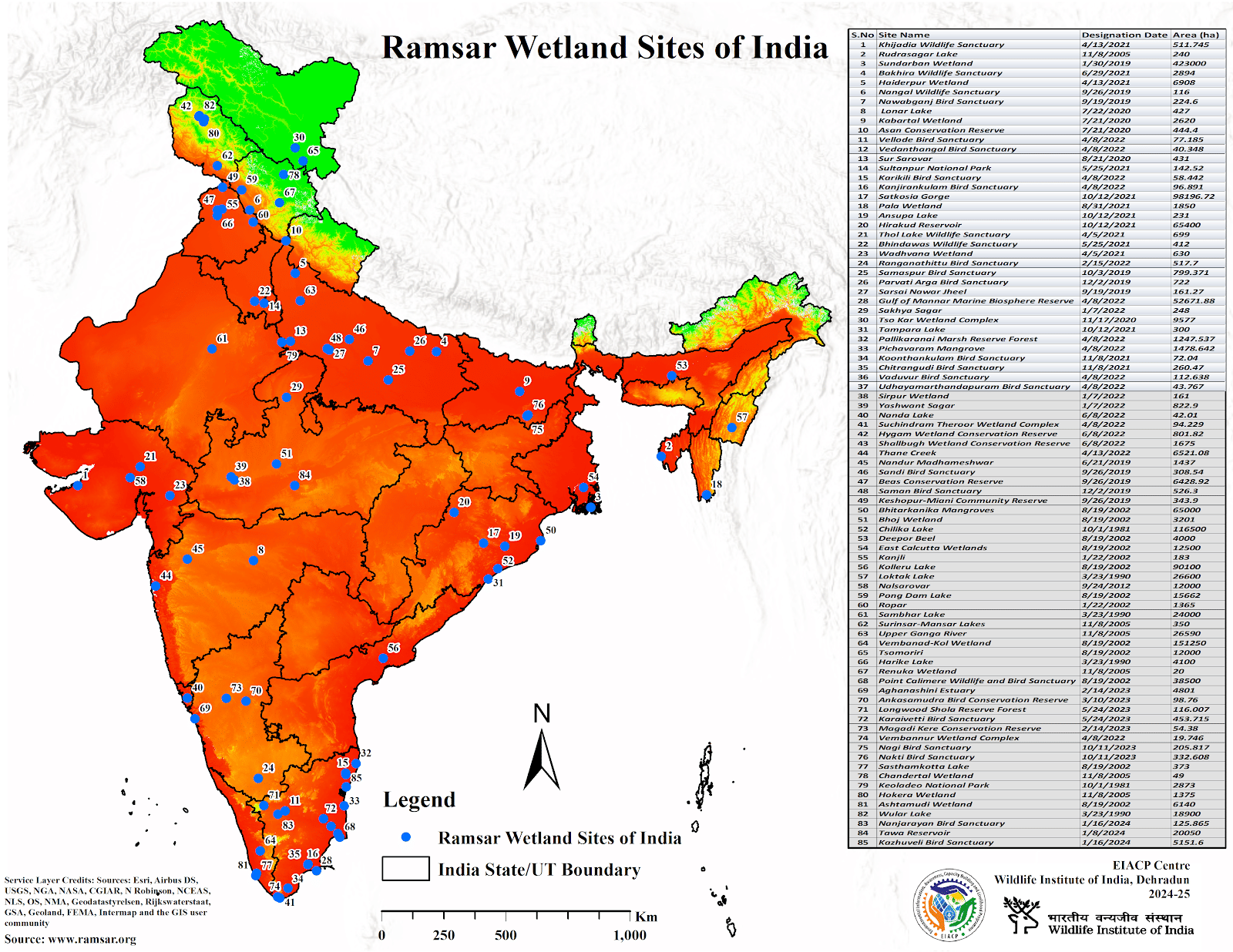
Ramsar Sites in India
India now boasts 89 Ramsar Sites, reinforcing its commitment to wetland conservation and biodiversity preservation.
Download the PREPP App and attempt FREE IAS Exam Mock Tests and get complete study material!
*The article might have information for the previous academic years, please refer the official website of the exam.
How likely are you to recommend Prepp.in to a friend or a colleague?
Not so likely
Highly likely
UPSC CSE (IAS) 2027 Prelims Mock Test Series
Live Quizzes
Quizzes
Live Tests

• Live
Live Test : UPSC CSE Prelims CSAT (Paper-II) (Oct 08 - 11)
120 Minutes
80 Questions
200 Marks
English, Hindi
MEDIUM
Test will end in 10:01:22
Full Tests
Full Test - 04: UPSC CSE Prelims CSAT (Paper-II)
120 Minutes
80 Questions
200 Marks
English, Hindi
MEDIUM
Attempted by 18 aspirants in 12 hours
Full Test - 03: UPSC CSE Prelims CSAT (Paper-II)
120 Minutes
80 Questions
200 Marks
English, Hindi
MEDIUM
Attempted by 20 aspirants in 12 hours
Previous Year Papers
UPSC CSE Prelims 2026 GS Paper 1 Question Paper (24-May-2026)
120 Minutes
100 Questions
200 Marks
2,985 Attempted
English, Hindi
MEDIUM
Attempted by 12 aspirants in 12 hours
UPSC CSE Prelims 2026 CSAT Paper 2 Question Paper (24-May-2026)
120 Minutes
80 Questions
200 Marks
3,163 Attempted
English, Hindi
MEDIUM
Attempted by 13 aspirants in 12 hours
Videos

17 February 2025 | The Hindu Must Read Articles | Current Affairs
7,202 Views
•4
•7 months ago

16 February 2026 | The Hindu Must Read Articles | Current Affairs
6,962 Views
•4
•7 months ago

13 February 2026 | The Hindu Must Read Articles | Current Affairs
8,765 Views
•5
•7 months ago

12 February 2026 | The Hindu Must Read Articles | Current Affairs
5,788 Views
•4
•7 months ago






Also Check
IAS Exam Overview
IAS Exam Admit Card
IAS Exam Question Paper 2026
IAS Exam Mains Syllabus
IAS Exam Application Process
IAS Exam Eligibility
IAS Exam Result
IAS Exam Exam Pattern
IAS Exam CSAT Syllabus
IAS Exam Answer Key
IAS Exam Previous Year Paper
IAS Exam Current Affairs
IAS Exam Mains Question Paper
IAS Exam IAS Courses
IAS Exam UPSC Study Notes
IAS Exam Foundation Course 2024
IAS Exam Prelims Question Paper
IAS Exam Exam Center
IAS Exam Foundation Course 2025
IAS Exam Notification 2026
IAS Exam IAS Success Stories
IAS Exam Salary
IAS Exam Cutoff
IAS Exam Mock Tests
IAS Exam News


Comments