Public-Private Partnership (PPP) Model: Strengthening Veterinary Services through PPPs
Introduction
Public-Private Partnership (PPP) is a strategic collaboration between the government and the private sector to finance, develop, and operate infrastructure projects and public services. This model aims to leverage private sector efficiency and innovation while ensuring public welfare.
Features of PPP
- Long-Term Contract: Involves long-term agreements between public and private entities.
- Risk Sharing: Risks are distributed between the government and private sector.
- Revenue Generation: Private entities earn returns through user fees or government payments.
- Innovation & Efficiency: Encourages private sector expertise for enhanced service delivery.
Types of PPP Models
- Build-Operate-Transfer (BOT): The private party builds, operates, and transfers the project to the government.
- Build-Own-Operate-Transfer (BOOT): Similar to BOT but allows private ownership before transfer.
- Design-Build-Finance-Operate (DBFO): The private sector handles design, construction, financing, and operation.
- Hybrid Annuity Model (HAM): The government and private sector share financial responsibility.
![public private partnership pros and cons]()
- Operate-Maintain-Transfer (OMT): The government builds the project, and the private entity operates and maintains it.
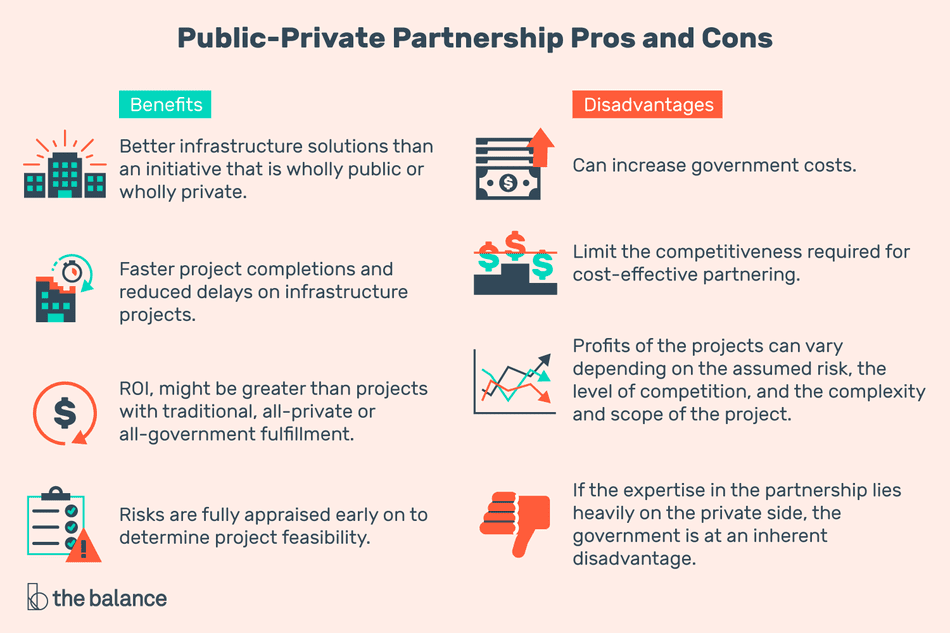
Advantages of PPP
- Reduced Government Burden: Eases fiscal stress by attracting private investment.
- Accelerated Infrastructure Development: Ensures timely completion of projects.
- Enhanced Service Quality: Utilizes private sector efficiency and innovation.
- Employment Generation: Creates jobs across multiple industries.
- Risk Mitigation: Distributes risks between public and private stakeholders.
Challenges of PPP
- Project Delays: Bureaucratic approvals can slow down implementation.
- Financial Risks: Revenue uncertainties impact private investment.
- Contractual Disputes: Misalignment of interests may lead to conflicts.
- Lack of Transparency: Risk of corruption and mismanagement.
PPP in Veterinary Services
- The Indian government is strengthening veterinary services through PPPs to enhance animal healthcare infrastructure.
- Private sector involvement can improve disease control, livestock health, and rural veterinary access.
- PPPs in veterinary services can lead to better technology adoption, modernized diagnostic facilities, and increased vaccination coverage.
Examples of PPP in India
- Delhi Metro Rail Corporation (DMRC) – Successful urban transport model.
- Mumbai-Pune Expressway – India's first six-lane tolled expressway.
- Hyderabad Metro Rail Project – A major urban transport initiative.
- Ganga Expressway – Enhancing road connectivity in North India.
Conclusion
- The PPP model plays a vital role in infrastructure growth and economic development. Effective implementation, regulatory stability, and transparency are essential to maximize its benefits.
- In sectors like veterinary services, PPPs can revolutionize healthcare accessibility, improve animal welfare, and support rural livelihoods.
- By fostering a strong public-private collaboration, India can achieve sustainable development while ensuring quality service delivery across various sectors.
Download the PREPP App and attempt FREE IAS Exam Mock Tests and get complete study material!
*The article might have information for the previous academic years, please refer the official website of the exam.
How likely are you to recommend Prepp.in to a friend or a colleague?
Not so likely
Highly likely
UPSC CSE (IAS) 2027 Prelims Mock Test Series
Live Quizzes
Quizzes
Live Tests

• Live
Live Test : UPSC CSE Prelims CSAT (Paper-II) (Oct 08 - 11)
120 Minutes
80 Questions
200 Marks
English, Hindi
MEDIUM
Test will end in 05:30:45
Full Tests
Full Test - 04: UPSC CSE Prelims CSAT (Paper-II)
120 Minutes
80 Questions
200 Marks
English, Hindi
MEDIUM
Attempted by 19 aspirants in 12 hours
Full Test - 03: UPSC CSE Prelims CSAT (Paper-II)
120 Minutes
80 Questions
200 Marks
English, Hindi
MEDIUM
Attempted by 20 aspirants in 12 hours
Previous Year Papers
UPSC CSE Prelims 2026 GS Paper 1 Question Paper (24-May-2026)
120 Minutes
100 Questions
200 Marks
2,989 Attempted
English, Hindi
MEDIUM
Attempted by 12 aspirants in 12 hours
UPSC CSE Prelims 2026 CSAT Paper 2 Question Paper (24-May-2026)
120 Minutes
80 Questions
200 Marks
3,167 Attempted
English, Hindi
MEDIUM
Attempted by 13 aspirants in 12 hours
Videos

17 February 2025 | The Hindu Must Read Articles | Current Affairs
7,202 Views
•4
•7 months ago

16 February 2026 | The Hindu Must Read Articles | Current Affairs
6,962 Views
•4
•7 months ago

13 February 2026 | The Hindu Must Read Articles | Current Affairs
8,765 Views
•5
•7 months ago

12 February 2026 | The Hindu Must Read Articles | Current Affairs
5,788 Views
•4
•7 months ago






Also Check
IAS Exam Overview
IAS Exam Admit Card
IAS Exam Question Paper 2026
IAS Exam Mains Syllabus
IAS Exam Application Process
IAS Exam Eligibility
IAS Exam Result
IAS Exam Exam Pattern
IAS Exam CSAT Syllabus
IAS Exam Answer Key
IAS Exam Previous Year Paper
IAS Exam Current Affairs
IAS Exam Mains Question Paper
IAS Exam IAS Courses
IAS Exam UPSC Study Notes
IAS Exam Foundation Course 2024
IAS Exam Prelims Question Paper
IAS Exam Exam Center
IAS Exam Foundation Course 2025
IAS Exam Notification 2026
IAS Exam IAS Success Stories
IAS Exam Salary
IAS Exam Cutoff
IAS Exam Mock Tests
IAS Exam News


Comments