Privatization of Defense Production in India: A Strategic Shift
Why in the News?
The Indian Air Chief Marshal has underscored the crucial role of private sector participation in bridging the production gap in fighter jets. With India’s growing defense needs, privatization is emerging as a key driver of modernization and self-reliance in defense manufacturing.

Current Status of India’s Defense Production
Record-Breaking Growth
- India’s defense production reached an all-time high of ₹1.27 lakh crore in FY 2023-24, marking a 174% increase from 2014-15.
- Domestic Manufacturing: Around 65% of India’s defense equipment is now produced domestically, reducing reliance on imports.
- Government Policies: Policies like the Defence Acquisition Procedure (DAP)-2020 and Positive Indigenization Lists have boosted indigenous production.
Major Indigenous Platforms
- India has successfully developed state-of-the-art defense systems, including:
- LCA Tejas – India’s indigenously developed fighter jet.
- Dhanush Artillery Gun – An advanced artillery system.
- ATAGS – Advanced Towed Artillery Gun System.
- INS Vikrant – India’s first indigenous aircraft carrier.
Growing Role of the Private Sector
- TATA Aircraft Complex: The launch of TASL’s aircraft facility in Gujarat is a milestone in private defense production.
- Increased Private Participation: Private firms contribute 21% of India’s total defense production with over 430 licensed companies and 16,000 MSMEs engaged in the sector.
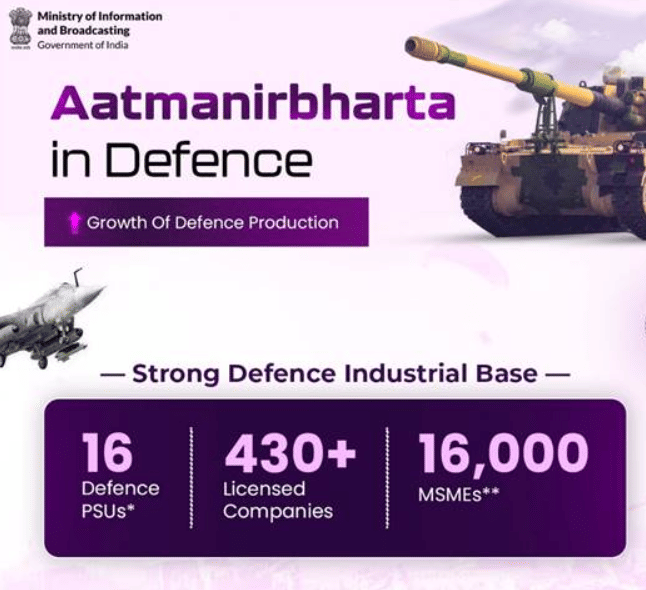
The Growing Trend of Privatization
Key Policy Reforms
- Liberalized FDI Policy: The Foreign Direct Investment (FDI) limit was raised to 74% via the automatic route and 100% via government approval.
- Industrial Licensing Simplification: The licensing process has been streamlined to attract private investments.
- Defense Industrial Corridors: Special corridors in Uttar Pradesh and Tamil Nadu are fostering private sector participation in defense manufacturing.
Boost in Defense Exports
- Record Growth: India’s defense exports skyrocketed from ₹686 crore in FY 2013-14 to ₹21,083 crore in FY 2023-24.
- Key Export Destinations: The USA, France, and Armenia are among India’s top buyers.
- Future Goals: India aims to achieve ₹50,000 crore in defense exports by 2029.
Significance of Privatization in Defense Production
1. Addressing Shortages and Delays
- Meeting Fighter Jet Demand: Private firms can help fulfill the Indian Air Force’s requirement of 35-40 fighter jets annually.
- Faster Deliveries: Streamlined private sector operations can minimize delays in defense equipment production.
2. Reducing Import Dependency
- Cost Savings: Indigenous manufacturing significantly reduces costs associated with acquiring advanced weapon systems.
- Strategic Independence: Strengthening domestic production reduces reliance on foreign suppliers, enhancing national security.
3. Enhancing Innovation and Technology
- SAMAR Certification: DRDO’s SAMAR certification program evaluates and enhances private sector manufacturing capabilities.
- R&D Investments: Private firms bring cutting-edge technology, global expertise, and innovation into India’s defense industry.
Conclusion
Privatization is playing a pivotal role in transforming India’s defense production landscape. By leveraging private sector efficiency, fostering innovation, and reducing import dependency, India is well on its way to becoming a global defense manufacturing hub. With ambitious export targets and continued policy support, the future of India’s defense industry looks promising.
Download the PREPP App and attempt FREE IAS Exam Mock Tests and get complete study material!

Live Test : UPSC CSE Prelims CSAT (Paper-II) (Oct 08 - 11)
Full Test - 04: UPSC CSE Prelims CSAT (Paper-II)
Full Test - 03: UPSC CSE Prelims CSAT (Paper-II)
UPSC CSE Prelims 2026 GS Paper 1 Question Paper (24-May-2026)
UPSC CSE Prelims 2026 CSAT Paper 2 Question Paper (24-May-2026)

17 February 2025 | The Hindu Must Read Articles | Current Affairs

16 February 2026 | The Hindu Must Read Articles | Current Affairs

13 February 2026 | The Hindu Must Read Articles | Current Affairs









Comments