Private Sector Research and Development Corpus: A Game Changer for India's Innovation Landscape
Why in the News?
The Indian government is set to launch a massive ₹1 lakh crore Private Sector Research and Development Corpus to boost private sector investment in research and development (R&D). This initiative aims to drive innovation, enhance global competitiveness, and close India's commercialization gap in scientific research.

Key Highlights
- Low-Interest Loans: The fund will provide long-term, low-interest loans to private firms to develop novel products and intellectual property.
- PLI Scheme Parallels: This initiative is similar to the Production Linked Incentive (PLI) scheme, but specifically designed for R&D.
- Administration: The Anusandhan National Research Foundation (ANRF) will likely oversee fund allocation, with proposals evaluated by an expert panel.
- Budget Announcement: Finance Minister Nirmala Sitharaman introduced this plan in the Interim Budget 2024, with a detailed implementation framework under preparation.
Why India Needs This Fund
Low R&D Investment
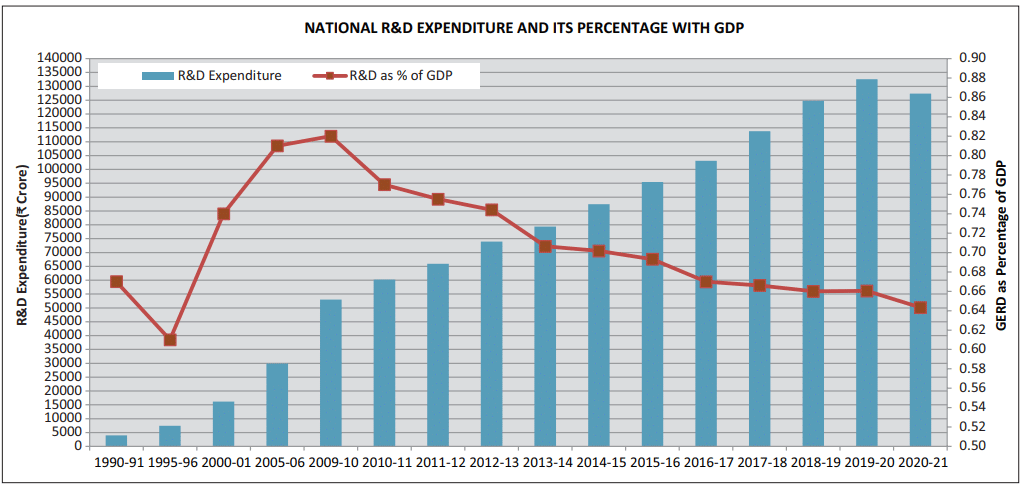
- India's Gross Expenditure on R&D (GERD) is just 0.65% of GDP, significantly lower than the 1.5%-3% seen in advanced economies.
Weak Private Sector Participation
- Private sector R&D contribution in India is only 30%-36%, whereas in the USA and China, it stands at 75% and 77%, respectively.
Global Competitiveness & Commercialization Gaps
- Increased private R&D funding will enhance India’s global innovation ranking and ensure commercialization of research outputs.
About the ₹1 Lakh Crore Private Sector R&D Corpus
Fund Structure & Loan Mechanism
- Corpus Size: ₹1 lakh crore fund exclusively for private companies.
- Loan Terms: Loans at near 0% interest to companies with strong commercialization potential.
- Focus Sectors: Covers space, pharmaceuticals, energy, and auto, excluding IT and service industries.
- Implementation Body: Managed by ANRF, modeled after the U.S. National Science Foundation.
ANRF's Role in R&D Growth
- ANRF aims to mobilize ₹50,000 crore, with ₹36,000 crore from private and international sources.
- Encourages academia-industry collaboration for cutting-edge research.
Current State of R&D in India
GERD Growth & Government Dominance
- GERD grew from ₹60,197 crore (2010–11) to ₹127,381 crore (2020–21).
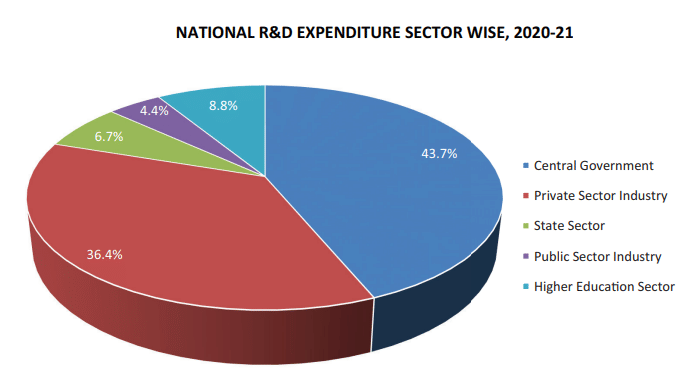
- 59% of GERD comes from the government, while the private sector accounts for 36.4%.
- Leading government R&D investors: DRDO, ISRO, ICAR, and DAE, which contribute 72% of national R&D spending.
India vs. Global R&D Leaders
- Private sector GERD participation: China (70%), USA (77%), Japan & South Korea (70%+), India (36.4%).
- Scientific Output Growth: India ranks 7th in resident patent filings globally (WIPO 2022 Report) but needs greater private sector engagement.
Benefits of Private Sector R&D Investment
1. Economic Growth & Global Innovation Ranking
- Enhances efficiency and commercialization of R&D.
- Strengthens India’s position in global innovation rankings.
2. Stronger Academia-Industry Partnerships
- Encourages collaborative research between universities and private firms.
- Bridges technology transfer gaps.
3. Diversification & Resilience in Research
- Reduces dependence on government research labs.
- Expands the research ecosystem across multiple industries.
Challenges in Private R&D Investment
1. Low GERD & Resource Constraints
- India’s GERD at 0.65% of GDP is below the global average of 2%-3%.
2. Bureaucratic & Commercialization Issues
- Complex approval processes delay funding.
- Many firms struggle to convert research into viable commercial products.
3. Accountability & Knowledge Gaps
- Over-reliance on elite institutions (e.g., ISRO, IITs) limits knowledge dissemination.
- Need for greater transparency in fund allocation.
Government Initiatives Supporting R&D
1. DST & SERB Programs
- FIST & STARS Programs: Boost private university R&D.
- SERB-FIRE & SERB-SURE: Fund industry-academia collaborations.
2. DBT-BIRAC for Biotech R&D
- Provides grants to biotech startups and companies.
Way Forward: Strengthening India's R&D Ecosystem
1. Increase GERD to 2% of GDP
- Enhanced public and private R&D investments.
- Strengthened state & private university research programs.
2. Strengthen Public-Private Partnerships
- Transparent PPP models for R&D funding.
- Better accountability frameworks to track commercialization success.
3. Foster Global Collaborations
- Establish Centers of Excellence (CoEs) in AI, quantum computing, and biotech.
- Expand global R&D partnerships.
4. Support Startups & Incubators
- Increase deep-tech startup funding in space, AI, and energy.
- Expand university incubators & accelerators.
5. Tax Incentives & Diversified Research Focus
- Offer tax breaks for R&D investments.
- Broaden research focus beyond traditional sectors.
Conclusion
The ₹1 lakh crore Private Sector R&D Corpus is a landmark initiative to catalyze India’s research ecosystem, bridge commercialization gaps, and strengthen innovation-driven economic growth. With increased private sector participation, transparent policy frameworks, and strong global partnerships, India can position itself as a global leader in research and innovation.
Download the PREPP App and attempt FREE IAS Exam Mock Tests and get complete study material!

Live Test : UPSC CSE Prelims CSAT (Paper-II) (Oct 08 - 11)
Full Test - 04: UPSC CSE Prelims CSAT (Paper-II)
Full Test - 03: UPSC CSE Prelims CSAT (Paper-II)
UPSC CSE Prelims 2026 GS Paper 1 Question Paper (24-May-2026)
UPSC CSE Prelims 2026 CSAT Paper 2 Question Paper (24-May-2026)

17 February 2025 | The Hindu Must Read Articles | Current Affairs

16 February 2026 | The Hindu Must Read Articles | Current Affairs

13 February 2026 | The Hindu Must Read Articles | Current Affairs









Comments