Private Member’s Bill in India
Why in news?
- NCP (SP) MP Fauzia Khan introduced a Private Member’s Bill in Rajya Sabha to establish an authority to regulate coaching centres in India.
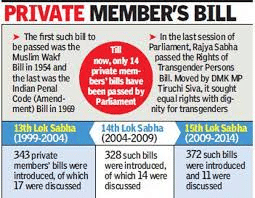
What is a Private Member’s Bill?
- A Private Member’s Bill is a legislative proposal introduced in the Indian Parliament by any Member of Parliament (MP) who is not a minister.
- It is distinct from a government bill and provides a way for individual MPs to propose new laws.
Key Features of a Private Member’s Bill
- Introduction & Admissibility
- Can be introduced in either Lok Sabha or Rajya Sabha.
- Requires one month’s notice and examination for constitutional validity.
- The Chairman of Rajya Sabha or Speaker of Lok Sabha decides its admissibility.
- Legislative Process
- Discussed on alternate Fridays during Parliamentary sessions.
- A ballot system determines which bills are selected for discussion due to time constraints.
- The passage or rejection of a Private Member’s Bill does not affect the government’s stability.
Historical Context & Success Rate
- Colonial Legacy: The system was inherited from the British parliamentary system.
- Post-Independence Continuation: It was retained as a democratic practice after 1947.
- Rare Success Rate:
- Since 1952, only 14 Private Members' Bills have been passed.
- The last successful bill was the Enlargement of Criminal Appellate Jurisdiction Bill in 1970.
Significance of Private Member’s Bills
✅ Policy Gaps: Addresses areas where government legislation is inadequate.
✅ Regional Representation: Helps MPs raise state-specific and constituency-level concerns.
✅ Public Debate: Encourages discussions on social, economic, and political issues.
Challenges in Passing Private Member’s Bills
❌ Low Passage Rate: Only 14 out of thousands of bills introduced have passed.
❌ Government Dominance: The ruling party’s majority often rejects opposition-sponsored bills.
❌ Time Constraints: Limited discussion time (2:30 PM to 6:00 PM on alternate Fridays) restricts debate.
Conclusion
While Private Member’s Bills rarely become laws, they play a crucial role in highlighting policy gaps and bringing regional issues into national discourse. Strengthening the system could lead to a more inclusive and democratic legislative process.
Download the PREPP App and attempt FREE IAS Exam Mock Tests and get complete study material!

Live Test : UPSC CSE Prelims CSAT (Paper-II) (Oct 08 - 11)
Full Test - 04: UPSC CSE Prelims CSAT (Paper-II)
Full Test - 03: UPSC CSE Prelims CSAT (Paper-II)
UPSC CSE Prelims 2026 GS Paper 1 Question Paper (24-May-2026)
UPSC CSE Prelims 2026 CSAT Paper 2 Question Paper (24-May-2026)

17 February 2025 | The Hindu Must Read Articles | Current Affairs

16 February 2026 | The Hindu Must Read Articles | Current Affairs

13 February 2026 | The Hindu Must Read Articles | Current Affairs









Comments