President's Rule Imposed in Violence-Hit Manipur: Key Provisions and Implications
President's Rule Imposed in Violence-Hit Manipur: Key Provisions and Implications
Why in news?
- The Indian government has imposed President's Rule in Manipur, following days of unrest and the resignation of Chief Minister N. Biren Singh.
- This constitutional provision enables the central government to take control of a state when its governance fails.
What is President's Rule?
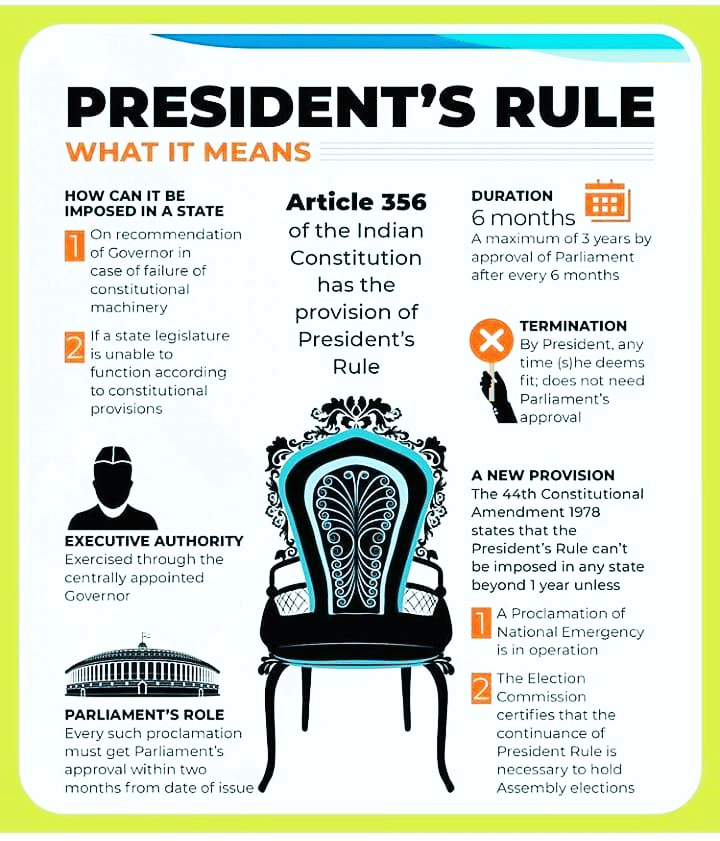
- President's Rule, under Article 356 of the Indian Constitution, allows the Union government to take direct control of a state's administration when it fails to function as per constitutional norms.
![president rule]()
- This is also known as a Constitutional Emergency and temporarily suspends the state's autonomy.
- The President acts on the Governor’s report or other relevant circumstances.
Constitutional Provisions
- Article 355: The Union's duty to protect states from external aggression and internal disturbances.
- Article 356: Allows the President to impose President’s Rule if the state's constitutional machinery fails.
- Article 357: Grants legislative powers to the President under President’s Rule.
- Article 365: Enables the President to intervene if the state government fails to comply with Union directives.
Grounds for Imposition of President's Rule
Failure of Constitutional Machinery (Article 356)
- If the President is convinced that the state government cannot function per constitutional provisions, he can impose President's Rule.
- This decision can be based on a Governor’s report or other considerations.
Non-compliance with Union Directions (Article 365)
- If a state refuses to adhere to the directives of the Union Government, the President can intervene.
Parliamentary Approval & Duration
- President’s Rule must be approved by both Houses of Parliament within two months.
- If the Lok Sabha is dissolved, the rule remains effective for 30 days from the first sitting of the newly elected Lok Sabha (provided Rajya Sabha has approved it).
- 44th Amendment (1978) restricts President’s Rule extensions beyond one year unless:
- A National Emergency is in force, or
- The Election Commission certifies that elections cannot be conducted.
- Initially imposed for six months, it can be extended up to three years with periodic approval.
Consequences of President’s Rule
- State Executive: The Chief Minister and Council of Ministers are dismissed. The Governor governs on behalf of the President.
- State Legislature: May be suspended or dissolved; Parliament assumes legislative powers over the state. The President can promulgate ordinances in the state.
- State Judiciary: The High Court continues to function unaffected.
Judicial Review & Key Cases
- 38th Amendment (1975): Initially barred courts from reviewing President’s Rule.
- 44th Amendment (1978): Reinstated judicial review, allowing courts to examine its validity.
- S.R. Bommai vs. Union of India (1994):
- The Supreme Court ruled that President’s Rule cannot be used arbitrarily.
- There must be objective material evidence to justify its imposition.
- Parliament and the judiciary can review the decision.
- Rameshwar Prasad vs. Union of India (2006): The Court held that President’s Rule must not be politically motivated and should be based on a valid constitutional rationale.
Reforms & Recommendations
- Sarkaria Commission (1988): Suggested President’s Rule should be the last resort and only be imposed after exploring all alternatives.
- Punchhi Commission (2010): Recommended limiting its duration to three months and avoiding excessive centralization.
- NCRWC (2002): Proposed stricter guidelines, including prior warnings and a chance for the state to explain itself.
Conclusion
- President’s Rule is a constitutional safeguard to ensure governance continuity during political instability or administrative failure.
- However, it must be used sparingly to uphold the spirit of federalism and state autonomy. The imposition in Manipur highlights the need for effective crisis management and governance reforms.
Download the PREPP App and attempt FREE IAS Exam Mock Tests and get complete study material!
*The article might have information for the previous academic years, please refer the official website of the exam.
How likely are you to recommend Prepp.in to a friend or a colleague?
Not so likely
Highly likely
UPSC CSE (IAS) 2027 Prelims Mock Test Series
Live Quizzes
Quizzes
Live Tests

• Live
Live Test : UPSC CSE Prelims CSAT (Paper-II) (Oct 08 - 11)
120 Minutes
80 Questions
200 Marks
English, Hindi
MEDIUM
Test will end in 05:29:52
Full Tests
Full Test - 04: UPSC CSE Prelims CSAT (Paper-II)
120 Minutes
80 Questions
200 Marks
English, Hindi
MEDIUM
Attempted by 19 aspirants in 12 hours
Full Test - 03: UPSC CSE Prelims CSAT (Paper-II)
120 Minutes
80 Questions
200 Marks
English, Hindi
MEDIUM
Attempted by 20 aspirants in 12 hours
Previous Year Papers
UPSC CSE Prelims 2026 GS Paper 1 Question Paper (24-May-2026)
120 Minutes
100 Questions
200 Marks
2,989 Attempted
English, Hindi
MEDIUM
Attempted by 12 aspirants in 12 hours
UPSC CSE Prelims 2026 CSAT Paper 2 Question Paper (24-May-2026)
120 Minutes
80 Questions
200 Marks
3,167 Attempted
English, Hindi
MEDIUM
Attempted by 13 aspirants in 12 hours
Videos

17 February 2025 | The Hindu Must Read Articles | Current Affairs
7,202 Views
•4
•7 months ago

16 February 2026 | The Hindu Must Read Articles | Current Affairs
6,962 Views
•4
•7 months ago

13 February 2026 | The Hindu Must Read Articles | Current Affairs
8,765 Views
•5
•7 months ago

12 February 2026 | The Hindu Must Read Articles | Current Affairs
5,788 Views
•4
•7 months ago






Also Check
IAS Exam Overview
IAS Exam Admit Card
IAS Exam Question Paper 2026
IAS Exam Mains Syllabus
IAS Exam Application Process
IAS Exam Eligibility
IAS Exam Result
IAS Exam Exam Pattern
IAS Exam CSAT Syllabus
IAS Exam Answer Key
IAS Exam Previous Year Paper
IAS Exam Current Affairs
IAS Exam Mains Question Paper
IAS Exam IAS Courses
IAS Exam UPSC Study Notes
IAS Exam Foundation Course 2024
IAS Exam Prelims Question Paper
IAS Exam Exam Center
IAS Exam Foundation Course 2025
IAS Exam Notification 2026
IAS Exam IAS Success Stories
IAS Exam Salary
IAS Exam Cutoff
IAS Exam Mock Tests
IAS Exam News


Comments