Places of Worship Act 1991: Supreme Court's Latest Directives and Implications
Why in the News?
The Supreme Court of India has temporarily barred civil courts nationwide from registering fresh suits related to the ownership or title of any place of worship, pending further orders. Surveys of disputed religious sites have also been prohibited.
Supreme Court Orders: Key Details
- Next Hearing Date: The Court has scheduled the next hearing for February 17, 2025. Until then, no interim or final orders will be passed in related cases.
- Directive to the Centre: The Union government has been instructed to present its official stance on the Places of Worship Act, 1991, within four weeks.
- Impacted Cases: This order affects ongoing cases involving the Gyanvapi mosque in Varanasi, the Shahi Idgah in Mathura, and the Jama Masjid in Sambhal, among others.
Supreme Court’s Rationale
- Stalling Proceedings: Lower courts have been directed to halt new cases and refrain from issuing orders in existing cases tied to the Act until the apex court resolves the matter.
- Judicial Consistency: Chief Justice Sanjiv Khanna emphasized the importance of uniform judicial rulings, referencing principles laid out in the Ayodhya verdict.
- Scope of Review: The Supreme Court clarified that it is assessing the constitutional validity, scope, and ambit of the Places of Worship Act, not the merits of individual disputes.
About the Places of Worship Act 1991
- Introduction: Enacted during the Ram Temple movement, the Act aims to maintain the religious character of places of worship as they existed on August 15, 1947.
- Exemption of Ayodhya: The Act excludes the Ram Janmabhoomi-Babri Masjid site, allowing its separate legal resolution.
- Contentious Suits: Critics argue that the Act prevents certain communities from reclaiming religious sites, sparking legal challenges.
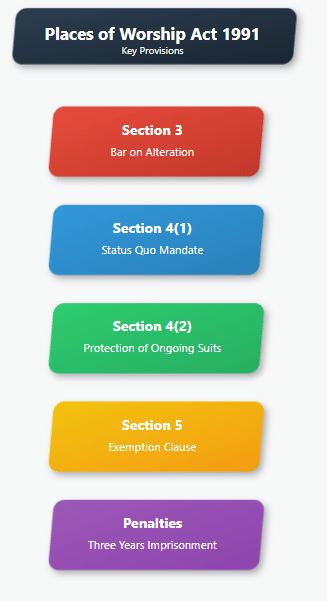
Key Provisions of the Act
- Section 3: Bar on Alteration Prohibits the conversion of a place of worship from one religious denomination to another.
- Section 4(1): Status Quo Mandate Declares the religious character of places of worship as fixed on August 15, 1947.
- Section 4(2): Protection of Ongoing Suits Excludes ongoing disputes, such as the Ayodhya case, from its purview.
- Section 5: Exemption Clause Exempts the Ayodhya dispute, allowing its separate legal proceedings.
- Penalties for Violation: Violators face imprisonment up to three years and fines.
Criticism of the Places of Worship Act
- Perceived Bias: Critics highlight the selective application of the Act, particularly the exemption of the Ayodhya dispute.
- Right to Religion: Some argue it infringes upon the right to freely practice and propagate religion.
- Historical Injustices: Certain groups claim the Act prevents them from reclaiming sites allegedly altered during invasions.
- Hindrance to Resolution: By preserving the status quo, the Act may discourage genuine dialogue and compromise.
Challenges to the Act
- Communal Polarization: The Act’s provisions are often exploited in political rhetoric, increasing communal tensions.
- Historical Ambiguities: Legal disputes often rely on unverifiable historical claims, complicating resolutions.
- Judicial Pendency: High-profile cases, like the Gyanvapi mosque dispute, highlight the difficulty of reconciling conflicting claims.
- Global Repercussions: Religious tensions influence India’s international image and relations.
- Political Manipulation: Political parties frequently use the Act to mobilize voter bases.
Way Forward
- Judicial Clarity: The Supreme Court should expedite its review to resolve constitutional ambiguities.
- Interfaith Dialogue: Structured discussions among religious leaders can foster understanding.
- Historical Research: Commissioning impartial studies could provide factual clarity on disputed sites.
- Strengthening Secularism: The government must reaffirm its commitment to secularism by countering divisive narratives.
- Learning from Global Practices: Examples like Turkey’s Hagia Sophia or Spain’s Cordoba Mosque-Cathedral offer insights for balancing heritage and harmony.
- Community-Led Solutions: Encouraging grassroots collaboration to preserve religious sites may reduce external interference.
Download the PREPP App and attempt FREE IAS Exam Mock Tests and get complete study material!
*The article might have information for the previous academic years, please refer the official website of the exam.
How likely are you to recommend Prepp.in to a friend or a colleague?
Not so likely
Highly likely
UPSC CSE (IAS) 2027 Prelims Mock Test Series
Live Quizzes
Quizzes
Live Tests

• Live
Live Test : UPSC CSE Prelims CSAT (Paper-II) (Oct 08 - 11)
120 Minutes
80 Questions
200 Marks
English, Hindi
MEDIUM
Test will end in 05:29:21
Full Tests
Full Test - 04: UPSC CSE Prelims CSAT (Paper-II)
120 Minutes
80 Questions
200 Marks
English, Hindi
MEDIUM
Attempted by 19 aspirants in 12 hours
Full Test - 03: UPSC CSE Prelims CSAT (Paper-II)
120 Minutes
80 Questions
200 Marks
English, Hindi
MEDIUM
Attempted by 20 aspirants in 12 hours
Previous Year Papers
UPSC CSE Prelims 2026 GS Paper 1 Question Paper (24-May-2026)
120 Minutes
100 Questions
200 Marks
2,989 Attempted
English, Hindi
MEDIUM
Attempted by 12 aspirants in 12 hours
UPSC CSE Prelims 2026 CSAT Paper 2 Question Paper (24-May-2026)
120 Minutes
80 Questions
200 Marks
3,167 Attempted
English, Hindi
MEDIUM
Attempted by 13 aspirants in 12 hours
Videos

17 February 2025 | The Hindu Must Read Articles | Current Affairs
7,202 Views
•4
•7 months ago

16 February 2026 | The Hindu Must Read Articles | Current Affairs
6,962 Views
•4
•7 months ago

13 February 2026 | The Hindu Must Read Articles | Current Affairs
8,765 Views
•5
•7 months ago

12 February 2026 | The Hindu Must Read Articles | Current Affairs
5,788 Views
•4
•7 months ago






Also Check
IAS Exam Overview
IAS Exam Admit Card
IAS Exam Question Paper 2026
IAS Exam Mains Syllabus
IAS Exam Application Process
IAS Exam Eligibility
IAS Exam Result
IAS Exam Exam Pattern
IAS Exam CSAT Syllabus
IAS Exam Answer Key
IAS Exam Previous Year Paper
IAS Exam Current Affairs
IAS Exam Mains Question Paper
IAS Exam IAS Courses
IAS Exam UPSC Study Notes
IAS Exam Foundation Course 2024
IAS Exam Prelims Question Paper
IAS Exam Exam Center
IAS Exam Foundation Course 2025
IAS Exam Notification 2026
IAS Exam IAS Success Stories
IAS Exam Salary
IAS Exam Cutoff
IAS Exam Mock Tests
IAS Exam News


Comments