Panama Canal: Key Facts, History, and Strategic Importance
Why in news?
US President-elect Donald Trump has hinted that his administration might attempt to regain control of the Panama Canal, describing its transfer to Panama as a “foolish” decision by the United States.
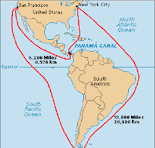
About Panama Canal
-
Overview of the Panama Canal:
- The Panama Canal is a 82 km long artificial waterway connecting the Atlantic and Pacific Oceans across the Isthmus of Panama, which separates North America and South America.
- As one of the world's most important artificial waterways, it plays a vital role in global maritime trade, alongside the Suez Canal.
-
Function and Operation:
- The Panama Canal allows ships to avoid the long and treacherous journey around Cape Horn at the southern tip of South America.
- Ships transit through a series of locks, which raise and lower vessels to and from Gatun Lake, situated 26 meters above sea level.
-
Historical Background:
- The idea for constructing the Panama Canal was initially proposed by the French in the late 19th century, but their efforts were unsuccessful.
- The United States took over the construction in 1904, completing the canal in 1914, with its official opening on August 15, 1914.
- From 1914 to 1999, the U.S. controlled the canal. However, Panama took full control of the canal in 1999, and it is now managed by the Panama Canal Authority.
-
Strategic Importance:
- The Panama Canal connects nearly 2,000 ports in 170 countries, making it a critical global trade route.
- The canal reduces travel time for ships between the Atlantic and Pacific Oceans, boosting international commerce and enhancing maritime efficiency.
-
Ownership and Current Management:
- The Panama Canal is owned by Panama and managed by the Panama Canal Authority, which oversees its operations since the U.S. relinquished control in 1999.
-
Geopolitical Significance:
- The strategic location of the Panama Canal makes it essential for global shipping, offering a shortcut for vessels traveling between the East Coast of the U.S. and Asia.
- The canal also holds significant geopolitical importance in international trade, impacting the economies of countries across the globe.
Conclusion
- The Panama Canal is a crucial infrastructure asset in international trade and global maritime operations.
- The canal’s historical shift from U.S. control to Panama's ownership in 1999 marks a significant moment in both Panama’s sovereignty and global trade dynamics.
Download the PREPP App and attempt FREE IAS Exam Mock Tests and get complete study material!
*The article might have information for the previous academic years, please refer the official website of the exam.
How likely are you to recommend Prepp.in to a friend or a colleague?
Not so likely
Highly likely
UPSC CSE (IAS) 2027 Prelims Mock Test Series
Live Quizzes
Quizzes
Live Tests

• Live
Live Test : UPSC CSE Prelims CSAT (Paper-II) (Oct 08 - 11)
120 Minutes
80 Questions
200 Marks
English, Hindi
MEDIUM
Test will end in 21:18:38
Full Tests
Full Test - 04: UPSC CSE Prelims CSAT (Paper-II)
120 Minutes
80 Questions
200 Marks
English, Hindi
MEDIUM
Attempted by 20 aspirants in 12 hours
Full Test - 03: UPSC CSE Prelims CSAT (Paper-II)
120 Minutes
80 Questions
200 Marks
English, Hindi
MEDIUM
Attempted by 21 aspirants in 12 hours
Previous Year Papers
UPSC CSE Prelims 2026 GS Paper 1 Question Paper (24-May-2026)
120 Minutes
100 Questions
200 Marks
2,974 Attempted
English, Hindi
MEDIUM
Attempted by 13 aspirants in 12 hours
UPSC CSE Prelims 2026 CSAT Paper 2 Question Paper (24-May-2026)
120 Minutes
80 Questions
200 Marks
3,151 Attempted
English, Hindi
MEDIUM
Attempted by 14 aspirants in 12 hours
Videos

17 February 2025 | The Hindu Must Read Articles | Current Affairs
7,202 Views
•4
•7 months ago

16 February 2026 | The Hindu Must Read Articles | Current Affairs
6,962 Views
•4
•7 months ago

13 February 2026 | The Hindu Must Read Articles | Current Affairs
8,765 Views
•5
•7 months ago

12 February 2026 | The Hindu Must Read Articles | Current Affairs
5,788 Views
•4
•7 months ago






Also Check
IAS Exam Overview
IAS Exam Admit Card
IAS Exam Question Paper 2026
IAS Exam Mains Syllabus
IAS Exam Application Process
IAS Exam Eligibility
IAS Exam Result
IAS Exam Exam Pattern
IAS Exam CSAT Syllabus
IAS Exam Answer Key
IAS Exam Previous Year Paper
IAS Exam Current Affairs
IAS Exam Mains Question Paper
IAS Exam IAS Courses
IAS Exam UPSC Study Notes
IAS Exam Foundation Course 2024
IAS Exam Prelims Question Paper
IAS Exam Exam Center
IAS Exam Foundation Course 2025
IAS Exam Notification 2026
IAS Exam IAS Success Stories
IAS Exam Salary
IAS Exam Cutoff
IAS Exam Mock Tests
IAS Exam News


Comments