Overview of the Four Labour Codes in India
Why in news
- Setting the stage for the possible implementation of the four Labour Codes from April 1, a meeting of the officials and Ministers of the Union Labour Ministry and State Labour Ministries has reviewed the progress in drafting of rules under the Codes by the States.
About the labour codes
- India's landmark labour law reforms have consolidated 29 existing laws into four major labour codes, designed to streamline and modernize the nation's labour regulations. These reforms aim to simplify the legal framework, improve working conditions, enhance worker benefits, and facilitate a business-friendly environment. The four labour codes are:
- Code on Wages, 2019
- Industrial Relations Code, 2020
- Code on Social Security, 2020
- Occupational Safety, Health, and Working Conditions Code, 2020
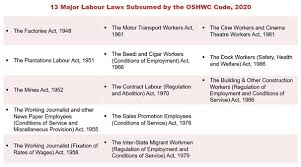
Code on Wages, 2019
- The Code on Wages, 2019 standardizes wage and bonus payments, ensuring equitable remuneration for all workers in both the formal and informal sectors.
- Uniform Definition of Wages: Introduces consistency in defining wages across the country, covering basic pay, allowances, and dearness allowances.
- Timely Settlement: Requires employers to settle all dues within two days of an employee's departure, reducing the current delay (ranging from 15 to 90 days).
- Minimum Wage Regulation: The central government will determine a national minimum wage, ensuring wage fairness, with states revising wages every five years.
- Impact on Employee Take-Home Pay: The new wage structure may impact allowances, thus affecting employees' take-home pay while also boosting provident fund and retirement savings.
Significance:
- Fairer Payment System: Aims to ensure timely, fair payment to workers.
- Boost to Retirement Savings: The new wage definition increases provident fund contributions, securing workers' financial future.
Industrial Relations Code, 2020
- The Industrial Relations Code, 2020 consolidates laws related to trade unions, disputes, and layoffs, focusing on improving industrial harmony.
- Four-Day Workweek: Employees may work for 12 hours a day over four days, ensuring work-life balance while meeting the 48-hour weekly work requirement.
- Flexibility in Hiring/Firing: Firms with more than 300 workers can hire and lay off workers without government approval (previously limited to firms with 100 workers).
- Grievance Redressal: Companies with over 20 employees must establish grievance committees for quick dispute resolution.
- Fixed-Term Contracts: Provides employers with greater flexibility in hiring workers on fixed-term contracts.
Significance:
- Flexibility for Employers: Streamlines hiring and firing procedures for businesses.
- Improved Dispute Resolution: Faster resolution of industrial disputes fosters a positive relationship between employers and employees.
Code on Social Security, 2020
-
The Code on Social Security, 2020 broadens the social security net to include gig workers and those in the informal sector, ensuring they have access to benefits like health insurance, pensions, and maternity leave.
- Inclusion of Gig Workers: Gig economy workers, such as app-based drivers and delivery personnel, are now included under the social security system.
- Provident Fund Contributions: Employers will contribute to the Provident Fund (PF) based on both basic wages and dearness allowance.
- National Minimum Floor Wage: The central government sets a national minimum wage, and states must follow it to ensure equitable wage standards.
- Maternity Benefits: Women workers continue to receive 26 weeks of paid maternity leave, along with employer-funded crèche facilities.
Significance:
- Extension of Social Security: Expands coverage to gig workers and informal sector employees.
- Enhanced Worker Benefits: Increases access to health, pension, and maternity benefits.
Occupational Safety, Health, and Working Conditions Code, 2020
- The Occupational Safety, Health, and Working Conditions Code, 2020 aims to ensure safe working environments for employees, focusing on workplace safety and health standards.
- Women in Hazardous Jobs: Women workers can now work in all sectors, including hazardous environments, but employers must ensure adequate safety measures.
- Employer Responsibilities: Employers must provide proper working conditions, including ventilation, lighting, and cleanliness.
- Regulation of Working Hours: The code ensures that employees' working hours and rest periods are well-regulated, preventing overwork.
- Industrial Hygiene: The code mandates access to clean drinking water, sanitation facilities, and first-aid kits.
Significance:
- Worker Safety and Well-being: Strengthens workplace safety standards and improves working conditions for employees.
- Gender Equality: The inclusion of women in all types of work fosters gender equality in the workplace.
Merits of the Labour Codes
- Simplification of Laws: Consolidates 29 laws into 4 comprehensive codes, reducing compliance complexity for businesses.
- Increased Social Security: Extends social security benefits to gig and informal sector workers.
- Hiring and Firing Flexibility: Increases business flexibility by allowing easier hiring and firing procedures for larger firms.
- Enhanced Worker Safety: Ensures stricter safety norms, promoting healthier working environments.
- Increased Minimum Wage Protection: The introduction of a national floor wage ensures workers are paid fair wages based on their living standards.
Concerns with the Labour Codes
- State-Level Implementation: Since labour is a concurrent subject, there might be differences in how states implement the codes, leading to lack of uniformity.
- Concerns about Gig Workers: Although the Code on Social Security includes gig workers, questions remain about effective enforcement and implementation of their entitlements.
- Impact on Trade Unions: The requirement that 75% of workers vote for a strike may undermine the effectiveness of trade unions and collective bargaining.
- Job Security: The increased threshold for layoffs (from 100 to 300 workers) could reduce job security for employees.
- Delegated Legislation: Some provisions allow the government to create rules without parliamentary consultation, which could lead to unilateral decisions.
Way Forward
- States and UTs must finalize and notify the corresponding rules.
- The Labour Market Information System (LMIS) can be used to identify skill gaps and provide necessary training.
- The Centre must oversee uniform implementation across states to prevent discrepancies in worker benefits and rights.
Conclusion
- The four labour codes are a transformative step toward improving India’s labour laws, promoting worker protection, and enhancing the ease of doing business.
- While the reforms promise better safety, social security, and wage standards, challenges related to implementation, state variations, and worker rights must be addressed.
- By aligning the states' efforts and focusing on seamless enforcement, these reforms can significantly improve India's labour market, fostering a fairer and more efficient work environment.
Download the PREPP App and attempt FREE IAS Exam Mock Tests and get complete study material!
*The article might have information for the previous academic years, please refer the official website of the exam.
How likely are you to recommend Prepp.in to a friend or a colleague?
Not so likely
Highly likely
UPSC CSE (IAS) 2027 Prelims Mock Test Series
Live Quizzes
Quizzes
Live Tests

• Live
Live Test : UPSC CSE Prelims CSAT (Paper-II) (Oct 08 - 11)
120 Minutes
80 Questions
200 Marks
English, Hindi
MEDIUM
Test will end in 05:30:33
Full Tests
Full Test - 04: UPSC CSE Prelims CSAT (Paper-II)
120 Minutes
80 Questions
200 Marks
English, Hindi
MEDIUM
Attempted by 19 aspirants in 12 hours
Full Test - 03: UPSC CSE Prelims CSAT (Paper-II)
120 Minutes
80 Questions
200 Marks
English, Hindi
MEDIUM
Attempted by 20 aspirants in 12 hours
Previous Year Papers
UPSC CSE Prelims 2026 GS Paper 1 Question Paper (24-May-2026)
120 Minutes
100 Questions
200 Marks
2,989 Attempted
English, Hindi
MEDIUM
Attempted by 12 aspirants in 12 hours
UPSC CSE Prelims 2026 CSAT Paper 2 Question Paper (24-May-2026)
120 Minutes
80 Questions
200 Marks
3,167 Attempted
English, Hindi
MEDIUM
Attempted by 13 aspirants in 12 hours
Videos

17 February 2025 | The Hindu Must Read Articles | Current Affairs
7,202 Views
•4
•7 months ago

16 February 2026 | The Hindu Must Read Articles | Current Affairs
6,962 Views
•4
•7 months ago

13 February 2026 | The Hindu Must Read Articles | Current Affairs
8,765 Views
•5
•7 months ago

12 February 2026 | The Hindu Must Read Articles | Current Affairs
5,788 Views
•4
•7 months ago






Also Check
IAS Exam Overview
IAS Exam Admit Card
IAS Exam Question Paper 2026
IAS Exam Mains Syllabus
IAS Exam Application Process
IAS Exam Eligibility
IAS Exam Result
IAS Exam Exam Pattern
IAS Exam CSAT Syllabus
IAS Exam Answer Key
IAS Exam Previous Year Paper
IAS Exam Current Affairs
IAS Exam Mains Question Paper
IAS Exam IAS Courses
IAS Exam UPSC Study Notes
IAS Exam Foundation Course 2024
IAS Exam Prelims Question Paper
IAS Exam Exam Center
IAS Exam Foundation Course 2025
IAS Exam Notification 2026
IAS Exam IAS Success Stories
IAS Exam Salary
IAS Exam Cutoff
IAS Exam Mock Tests
IAS Exam News


Comments