National Policy to Increase Female Workforce Participation in India
Why in the News?
The Government of India is developing a comprehensive National Policy on Female Labour Force Participation (FLFP) to boost women’s participation in the workforce and create a supportive environment.
Highlights of the Upcoming Policy
Policy Announcement
- The Indian government has announced the preparation of a policy to address FLFP, with a focus on enhancing opportunities for women in the workforce.
Inter-Ministerial Collaboration
- Key ministries like Skill Development, Labour, Rural Development, and Women & Child Development are collaborating to ensure the policy’s holistic development.
Focus on Care Economy
- The policy emphasizes developing infrastructure for caregiving, a critical factor in increasing female workforce participation.
Response to Global Reports
- This initiative follows a World Bank report highlighting a 12% drop in female employment rates post-marriage in India, stressing the need for targeted interventions.
Expected Provisions in the Policy
- Care-Giving Infrastructure
- Expansion of child care facilities under schemes like NREGS for informal sector workers.
- Skill Development
- Introduction of professional skilling packages for caregivers to formalize the care sector.
- Flexible Work Models
- Provisions for remote, part-time, and flexible working arrangements.
- Gender Sensitivity Training
- Workplace programs to combat biases and promote gender equity.
Understanding the Care Economy in India
What is the Care Economy?
The care economy includes activities related to providing paid and unpaid care, such as childcare, healthcare, and education services.
Challenges in India
- Undervalued Care Work: Limited recognition in formal economic frameworks.
- Lack of Infrastructure: Inadequate childcare facilities and absence of paid leave policies.
- Global Comparison: Countries like Japan and Sweden have achieved better gender workforce parity by investing in care economies.
Trends in Female Labour Force Participation (FLFP)
FLFP Rate in India
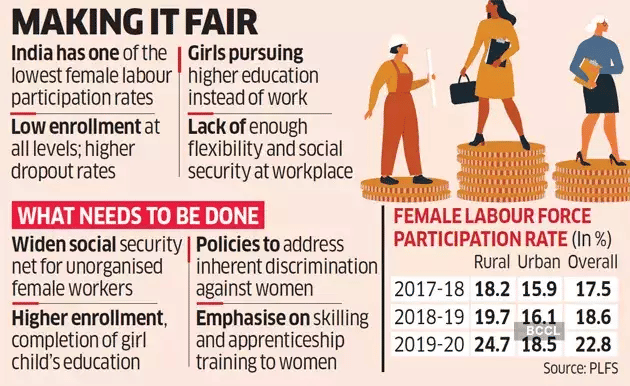
- Improved from 23% in 2017-18 to 37% in 2022-23.
- Rural women (36.6%) show higher participation than urban women (23.8%).
Global Comparison
Despite recent progress, India’s FLFP rate lags behind global averages, emphasizing the need for further action.
The estimated Female Labour Force Participation Rate (LFPR) and Worker Population Ratio (WPR)
| Years | LFPR (in %) | WPR (in %) |
|---|---|---|
| 2020-21 | 32.5 | 31.4 |
| 2021-22 | 32.8 | 31.7 |
| 2022-23 | 37 | 35.9 |
Why is a FLFP Policy Crucial for India?
Economic Growth Potential
- Equal female workforce participation could boost India’s GDP by 27%, according to the IMF.
Burden of Unpaid Care Work
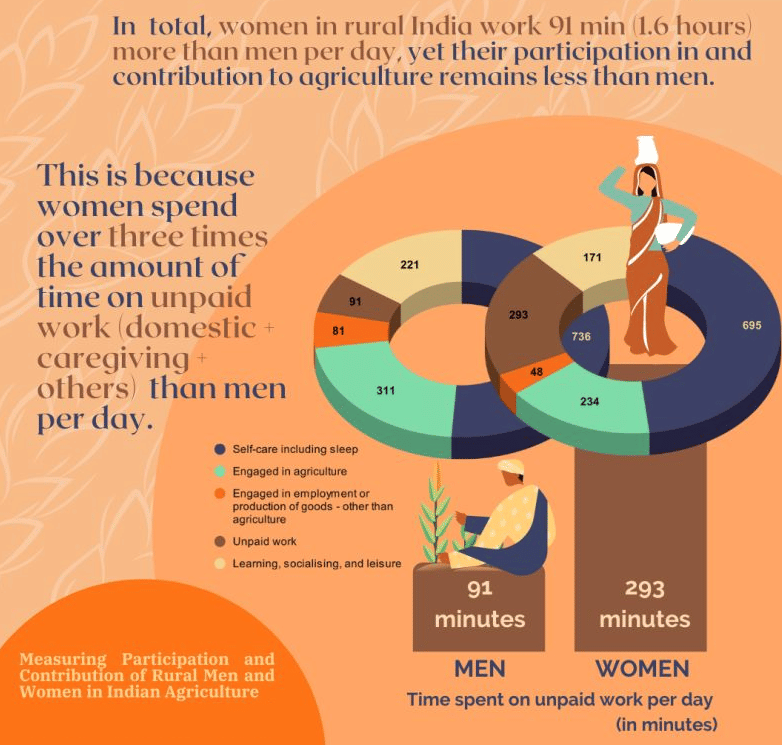
- Women in India disproportionately shoulder unpaid care responsibilities, limiting their economic opportunities.
Cultural and Educational Barriers
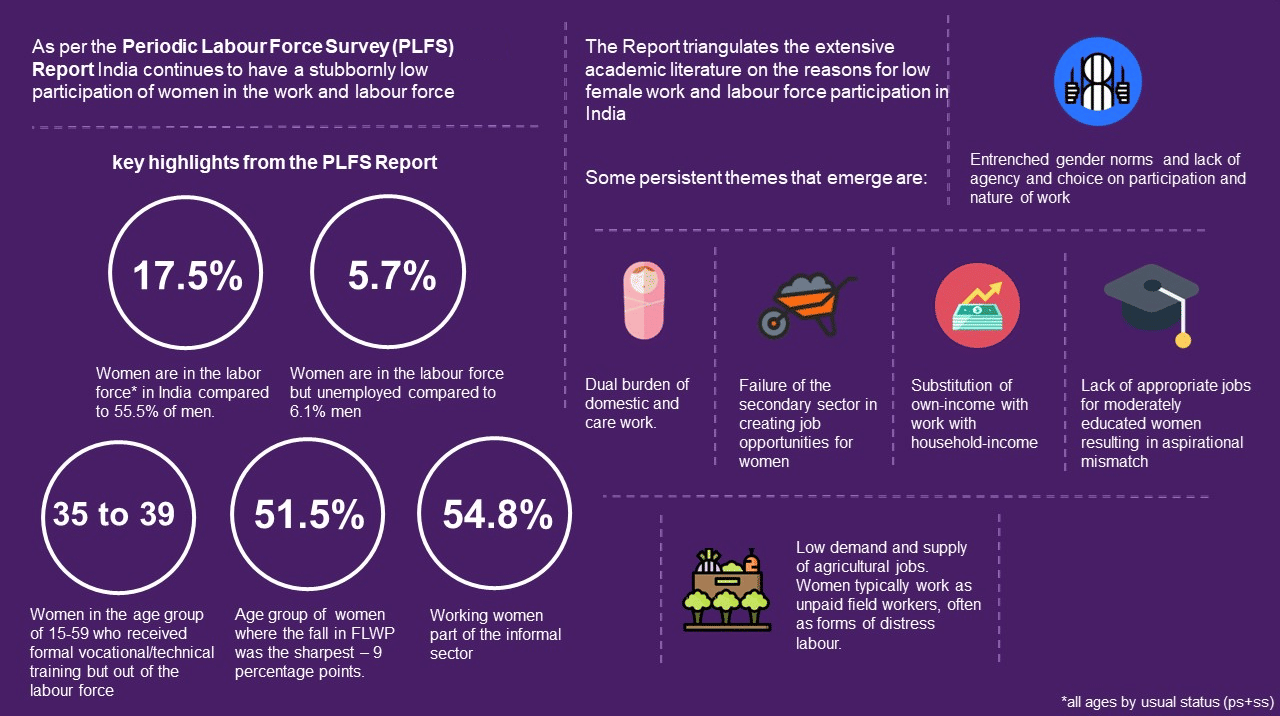
- Traditional gender roles and limited access to education hinder women’s workforce participation.
Benefits of Increasing FLFP
- Economic Growth: Higher participation leads to increased GDP and household income.
- Reduction in Gender Inequality: Bridges gaps in wages and opportunities.
- Women’s Empowerment: Enhances agency and decision-making.
- Social Progress: Drives inclusive development and equality.
Challenges Hindering FLFP
- Cultural Barriers: Deep-rooted societal norms restrict women to domestic roles.
- Safety Concerns: Lack of safe commuting and workplace environments.
- Wage Disparity: Persistent gender wage gaps.
- Childcare Deficit: Limited availability of crèche and daycare facilities.
- Representation in High-Skilled Jobs: Gender gaps in sectors like technology and finance.
Government Initiatives to Address FLFP Issues
- Maternity Benefit (Amendment) Act, 2017: Extended maternity leave to 26 weeks.
- Palna Scheme: Day-care facilities for working parents.
- Skill Development Programs: Initiatives like PMKVY and Women ITIs to improve employability.
- Stand-Up India Scheme: Loans for women entrepreneurs.
- Digital India Campaign: Digital literacy for women.
Recommendations and Way Forward
Urban Employment Schemes
- Implement urban-specific programs with free public transport and childcare facilities.
Flexible Work Models
- Incorporate part-time and remote work arrangements, inspired by successful global models like the Netherlands.
Investment in Care Economy
- Expand crèche facilities and professionalize caregiving roles, following Japan’s womenomics reforms.
Sector-Specific Training
- Launch programs like Girls Who Code to prepare women for high-skilled jobs.
Enhanced Safety Infrastructure
- Develop safer public spaces and transport systems to support women’s workforce participation.
Conclusion
Increasing female labour force participation in India is critical for economic growth, gender equality, and societal development. The upcoming policy provides a promising step toward addressing existing barriers and creating an enabling environment for women in the workforce.
Download the PREPP App and attempt FREE IAS Exam Mock Tests and get complete study material!

Live Test : UPSC CSE Prelims CSAT (Paper-II) (Oct 08 - 11)
Full Test - 04: UPSC CSE Prelims CSAT (Paper-II)
Full Test - 03: UPSC CSE Prelims CSAT (Paper-II)
UPSC CSE Prelims 2026 GS Paper 1 Question Paper (24-May-2026)
UPSC CSE Prelims 2026 CSAT Paper 2 Question Paper (24-May-2026)

17 February 2025 | The Hindu Must Read Articles | Current Affairs

16 February 2026 | The Hindu Must Read Articles | Current Affairs

13 February 2026 | The Hindu Must Read Articles | Current Affairs









Comments