Myrmecia Pyriformis: The Bull Ant That Navigates Using Polarised Moonlight
Why in the News?
Researchers at Macquarie University, Sydney, have made a groundbreaking discovery about Myrmecia pyriformis, commonly known as the Bull Ant. This species is one of the few known animals that use polarised moonlight to navigate during the night.
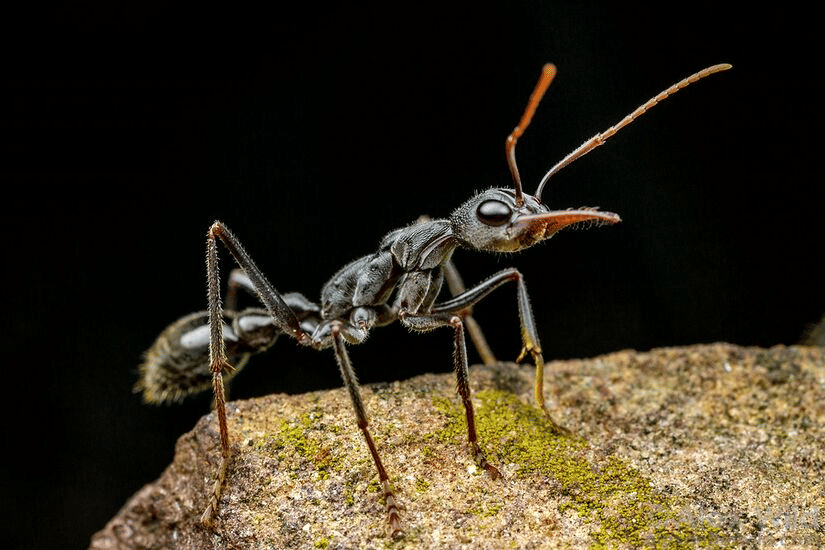
New Findings on Ant Navigation
- The study revealed that Myrmecia pyriformis can detect and utilise polarised moonlight, even during a crescent moon, when the light intensity is extremely low.
- Scientists observed that when a polarisation filter was rotated, the ants changed direction accordingly, proving their reliance on this type of light for nocturnal navigation.
- This discovery marks only the second known instance of an animal using polarised moonlight for orientation, the first being the dung beetle.
About Myrmecia Pyriformis (Bull Ant)
Scientific Classification
- Scientific Name: Myrmecia pyriformis
- Common Name: Bull Ant
- First Described: By Frederick Smith in 1858 in the Catalogue of Hymenopterous Insects in the British Museum.
Habitat and Distribution
- Found across Australia, particularly in major cities and eastern states.
- Prefers woodlands, forests, and urban areas, often nesting in soil or under logs.
Physical Characteristics and Behavior
- Size: Worker ants range from 14–23 mm, while queens grow up to 26 mm.
- Coloration: Dark red mandibles with a blackish-brown thorax.
- Colony Structure: Can survive without a queen, as female workers can reproduce.
- Navigation: Uses polarised sunlight during the day and polarised moonlight at night for movement and orientation.
- Aggression: Highly territorial and capable of delivering extremely painful stings.
Why This Discovery Matters
This research provides new insights into insect navigation and expands our understanding of how animals interact with natural light sources. It also raises further questions about evolutionary adaptations in nocturnal insects.
Download the PREPP App and attempt FREE IAS Exam Mock Tests and get complete study material!
*The article might have information for the previous academic years, please refer the official website of the exam.
How likely are you to recommend Prepp.in to a friend or a colleague?
Not so likely
Highly likely
UPSC CSE (IAS) 2027 Prelims Mock Test Series
Live Quizzes
Quizzes
Live Tests

• Live
Live Test : UPSC CSE Prelims CSAT (Paper-II) (Oct 08 - 11)
120 Minutes
80 Questions
200 Marks
English, Hindi
MEDIUM
Test will end in 11:22:52
Full Tests
Full Test - 04: UPSC CSE Prelims CSAT (Paper-II)
120 Minutes
80 Questions
200 Marks
English, Hindi
MEDIUM
Attempted by 18 aspirants in 12 hours
Full Test - 03: UPSC CSE Prelims CSAT (Paper-II)
120 Minutes
80 Questions
200 Marks
English, Hindi
MEDIUM
Attempted by 20 aspirants in 12 hours
Previous Year Papers
UPSC CSE Prelims 2026 GS Paper 1 Question Paper (24-May-2026)
120 Minutes
100 Questions
200 Marks
2,984 Attempted
English, Hindi
MEDIUM
Attempted by 12 aspirants in 12 hours
UPSC CSE Prelims 2026 CSAT Paper 2 Question Paper (24-May-2026)
120 Minutes
80 Questions
200 Marks
3,161 Attempted
English, Hindi
MEDIUM
Attempted by 13 aspirants in 12 hours
Videos

17 February 2025 | The Hindu Must Read Articles | Current Affairs
7,202 Views
•4
•7 months ago

16 February 2026 | The Hindu Must Read Articles | Current Affairs
6,962 Views
•4
•7 months ago

13 February 2026 | The Hindu Must Read Articles | Current Affairs
8,765 Views
•5
•7 months ago

12 February 2026 | The Hindu Must Read Articles | Current Affairs
5,788 Views
•4
•7 months ago






Also Check
IAS Exam Overview
IAS Exam Admit Card
IAS Exam Question Paper 2026
IAS Exam Mains Syllabus
IAS Exam Application Process
IAS Exam Eligibility
IAS Exam Result
IAS Exam Exam Pattern
IAS Exam CSAT Syllabus
IAS Exam Answer Key
IAS Exam Previous Year Paper
IAS Exam Current Affairs
IAS Exam Mains Question Paper
IAS Exam IAS Courses
IAS Exam UPSC Study Notes
IAS Exam Foundation Course 2024
IAS Exam Prelims Question Paper
IAS Exam Exam Center
IAS Exam Foundation Course 2025
IAS Exam Notification 2026
IAS Exam IAS Success Stories
IAS Exam Salary
IAS Exam Cutoff
IAS Exam Mock Tests
IAS Exam News


Comments