Mount Ruang: Indonesia’s Volcanic Giant
Why in news?
- Mount Ruang: Indonesia’s Volcanic Giant Erupts, Highlighting Tectonic Activity, Threats to Nearby Communities, and the Role of the Wallace Line in Biodiversity Distribution.
Overview of Mount Ruang
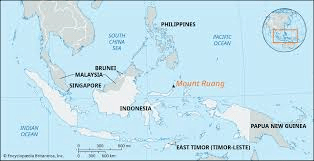
- Mount Ruang is an active stratovolcano located in North Sulawesi, Indonesia. As part of the Pacific Ring of Fire, it is known for its frequent and explosive eruptions, impacting local communities, aviation, and biodiversity.
Key Facts About Mount Ruang
- Location: North Sulawesi, Indonesia.
- Type: Active stratovolcano with a history of powerful eruptions.
- Elevation: 725 meters (2,379 feet) above sea level.
- Tectonic Setting: Formed due to the Indo-Australian Plate subducting beneath the Eurasian Plate.
Eruptive History of Mount Ruang
- Frequent eruptions, with major events recorded in 1871, 1904, 1914, 2002, and more recently.
- 2002 Eruption:
- Produced lava flows and heavy ashfall.
- Affected nearby communities and ecosystems.
- Caused air travel disruptions due to ash clouds.
Hazards and Environmental Impact
- Lava flows, pyroclastic surges, and ashfall threaten local settlements.
- Tsunami risk from potential underwater landslides.
- Evacuations and flight cancellations are common during eruptions.
Ecological Significance and the Wallace Line
- Located near the Wallace Line, a natural boundary that separates Asian and Australasian species.
- Surrounding islands harbor unique flora and fauna, adapted to volcanic soil and frequent disturbances.
Monitoring and Disaster Preparedness
- The Indonesian Volcanology Agency (PVMBG) actively monitors seismic activity.
- Early warning systems help protect local populations.
- Evacuation plans and hazard assessments mitigate risks.
Conclusion
- Mount Ruang remains a crucial geological and ecological landmark, impacting tectonic studies, biodiversity, and disaster preparedness in Indonesia. Continued monitoring and risk management are essential for safeguarding communities.
Download the PREPP App and attempt FREE IAS Exam Mock Tests and get complete study material!
*The article might have information for the previous academic years, please refer the official website of the exam.
How likely are you to recommend Prepp.in to a friend or a colleague?
Not so likely
Highly likely
UPSC CSE (IAS) 2027 Prelims Mock Test Series
Live Quizzes
Quizzes
Live Tests

• Live
Live Test : UPSC CSE Prelims CSAT (Paper-II) (Oct 08 - 11)
120 Minutes
80 Questions
200 Marks
English, Hindi
MEDIUM
Test will end in 05:30:44
Full Tests
Full Test - 04: UPSC CSE Prelims CSAT (Paper-II)
120 Minutes
80 Questions
200 Marks
English, Hindi
MEDIUM
Attempted by 19 aspirants in 12 hours
Full Test - 03: UPSC CSE Prelims CSAT (Paper-II)
120 Minutes
80 Questions
200 Marks
English, Hindi
MEDIUM
Attempted by 20 aspirants in 12 hours
Previous Year Papers
UPSC CSE Prelims 2026 GS Paper 1 Question Paper (24-May-2026)
120 Minutes
100 Questions
200 Marks
2,989 Attempted
English, Hindi
MEDIUM
Attempted by 12 aspirants in 12 hours
UPSC CSE Prelims 2026 CSAT Paper 2 Question Paper (24-May-2026)
120 Minutes
80 Questions
200 Marks
3,167 Attempted
English, Hindi
MEDIUM
Attempted by 13 aspirants in 12 hours
Videos

17 February 2025 | The Hindu Must Read Articles | Current Affairs
7,202 Views
•4
•7 months ago

16 February 2026 | The Hindu Must Read Articles | Current Affairs
6,962 Views
•4
•7 months ago

13 February 2026 | The Hindu Must Read Articles | Current Affairs
8,765 Views
•5
•7 months ago

12 February 2026 | The Hindu Must Read Articles | Current Affairs
5,788 Views
•4
•7 months ago






Also Check
IAS Exam Overview
IAS Exam Admit Card
IAS Exam Question Paper 2026
IAS Exam Mains Syllabus
IAS Exam Application Process
IAS Exam Eligibility
IAS Exam Result
IAS Exam Exam Pattern
IAS Exam CSAT Syllabus
IAS Exam Answer Key
IAS Exam Previous Year Paper
IAS Exam Current Affairs
IAS Exam Mains Question Paper
IAS Exam IAS Courses
IAS Exam UPSC Study Notes
IAS Exam Foundation Course 2024
IAS Exam Prelims Question Paper
IAS Exam Exam Center
IAS Exam Foundation Course 2025
IAS Exam Notification 2026
IAS Exam IAS Success Stories
IAS Exam Salary
IAS Exam Cutoff
IAS Exam Mock Tests
IAS Exam News


Comments