Menhirs of Mudumal: Telangana’s Ancient Megalithic Marvel on UNESCO’s Tentative List
Why in the News?
The Menhirs of Mudumal, an ancient megalithic site in Telangana’s Narayanpet district, have been added to India’s tentative list of UNESCO World Heritage Sites. This significant recognition highlights the site's historical, cultural, and astronomical importance.
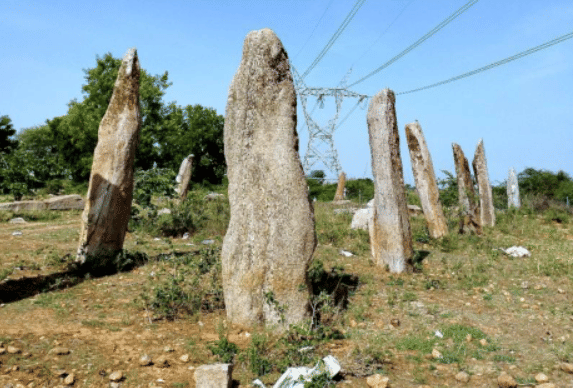
Menhirs of Mudumal in UNESCO’s Tentative List
Other Sites Added to India’s Tentative List: Along with the Mudumal Menhirs, five other historical and cultural sites have been included in India’s UNESCO tentative list:
- Kanger Valley National Park (Chhattisgarh)
- Ashokan Edict Sites (across multiple states)
- Chausath Yogini Temples (Madhya Pradesh and Odisha)
- Gupta Temples (multiple states)
- Palace-Fortresses of the Bundelas (Madhya Pradesh and Uttar Pradesh)
India’s Total UNESCO Tentative Sites
- With these additions, India now has 62 sites on its tentative list, a key step toward full UNESCO World Heritage Site recognition.
Significance of Inclusion in UNESCO’s List
- Being included in UNESCO’s tentative list brings multiple benefits:
- Global Recognition: Enhances the site's cultural and historical value on an international platform.
- Conservation & Protection: Facilitates better preservation efforts.
- Tourism Boost: Encourages domestic and international tourism, benefiting local communities.
Menhirs of Mudumal: An Ancient Megalithic Site
Historical Significance
- The Mudumal Menhirs date back 3,500 to 4,000 years, making them one of the oldest and most well-preserved megalithic sites in Telangana.
A Megalithic-Era Burial Site
- Archaeologists believe that the menhirs were likely part of a large burial complex from the megalithic era in South India. These standing stones were possibly used for funerary rituals and ancestor worship.
First Archaeological Study
- The site was first documented in 2003 by archaeologist K.P. Rao, who researched its historical and astronomical significance.
Astronomical Significance of Mudumal Menhirs
Celestial Alignments
- The site comprises around 80 large menhirs and several hundred smaller alignment stones, carefully positioned to align with the sun during solstices and equinoxes.
Oldest Star Map in South Asia
- One of the menhirs features cup-mark depressions depicting the Ursa Major constellation, making it the oldest known star map in South Asia.
Advanced Astronomical Knowledge
- The precise positioning of the Mudumal Menhirs indicates that ancient builders had a deep understanding of solar movements and celestial phenomena, showcasing their advanced knowledge of astronomy.
Conclusion
The Menhirs of Mudumal stand as a remarkable testament to India’s ancient megalithic culture, blending history, archaeology, and astronomy. Their addition to UNESCO’s tentative list not only brings global recognition but also paves the way for enhanced conservation efforts and increased heritage tourism in Telangana.
Download the PREPP App and attempt FREE IAS Exam Mock Tests and get complete study material!
*The article might have information for the previous academic years, please refer the official website of the exam.
How likely are you to recommend Prepp.in to a friend or a colleague?
Not so likely
Highly likely
UPSC CSE (IAS) 2027 Prelims Mock Test Series
Live Quizzes
Quizzes
Live Tests

• Live
Live Test : UPSC CSE Prelims CSAT (Paper-II) (Oct 08 - 11)
120 Minutes
80 Questions
200 Marks
English, Hindi
MEDIUM
Test will end in 05:29:43
Full Tests
Full Test - 04: UPSC CSE Prelims CSAT (Paper-II)
120 Minutes
80 Questions
200 Marks
English, Hindi
MEDIUM
Attempted by 19 aspirants in 12 hours
Full Test - 03: UPSC CSE Prelims CSAT (Paper-II)
120 Minutes
80 Questions
200 Marks
English, Hindi
MEDIUM
Attempted by 20 aspirants in 12 hours
Previous Year Papers
UPSC CSE Prelims 2026 GS Paper 1 Question Paper (24-May-2026)
120 Minutes
100 Questions
200 Marks
2,989 Attempted
English, Hindi
MEDIUM
Attempted by 12 aspirants in 12 hours
UPSC CSE Prelims 2026 CSAT Paper 2 Question Paper (24-May-2026)
120 Minutes
80 Questions
200 Marks
3,167 Attempted
English, Hindi
MEDIUM
Attempted by 13 aspirants in 12 hours
Videos

17 February 2025 | The Hindu Must Read Articles | Current Affairs
7,202 Views
•4
•7 months ago

16 February 2026 | The Hindu Must Read Articles | Current Affairs
6,962 Views
•4
•7 months ago

13 February 2026 | The Hindu Must Read Articles | Current Affairs
8,765 Views
•5
•7 months ago

12 February 2026 | The Hindu Must Read Articles | Current Affairs
5,788 Views
•4
•7 months ago






Also Check
IAS Exam Overview
IAS Exam Admit Card
IAS Exam Question Paper 2026
IAS Exam Mains Syllabus
IAS Exam Application Process
IAS Exam Eligibility
IAS Exam Result
IAS Exam Exam Pattern
IAS Exam CSAT Syllabus
IAS Exam Answer Key
IAS Exam Previous Year Paper
IAS Exam Current Affairs
IAS Exam Mains Question Paper
IAS Exam IAS Courses
IAS Exam UPSC Study Notes
IAS Exam Foundation Course 2024
IAS Exam Prelims Question Paper
IAS Exam Exam Center
IAS Exam Foundation Course 2025
IAS Exam Notification 2026
IAS Exam IAS Success Stories
IAS Exam Salary
IAS Exam Cutoff
IAS Exam Mock Tests
IAS Exam News


Comments