Martial Law in South Korea: Defense Minister Resigns Amid Political Backlash
Why in the News?
South Korea’s political landscape faced a seismic shift as Defense Minister Kim Yong-hyun resigned following widespread criticism over the recent declaration of martial law.
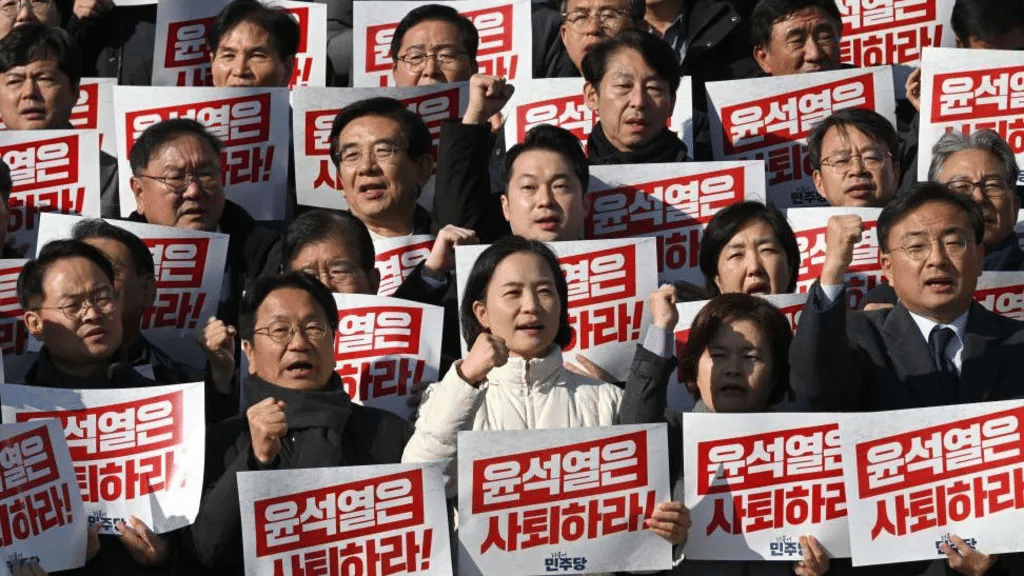
Key Updates on South Korea’s Political Turmoil
- New Nomination: President Yoon Suk Yeol has nominated Choi Byung-hyuk, South Korea's ambassador to Saudi Arabia, as the new Defense Minister.
- Martial Law Overturned: Martial law, declared late Tuesday night, was revoked within hours following a domestic backlash and rejection by the National Assembly.
- Opposition’s Stand: The Democratic Party, the largest opposition group, labeled the declaration as “treason” and initiated impeachment proceedings against President Yoon.
What is Martial Law?
Martial law is the temporary imposition of direct military control over civilian governance, typically enacted during emergencies when civil authorities cannot maintain order.
Legal Basis in South Korea
- Constitutional Authority: The South Korean president has the power to declare martial law during emergencies such as war or internal uprisings.
- Role of the National Assembly: The Assembly must be informed immediately and holds the authority to revoke martial law by a majority vote.
Historical Context
- Authoritarian Era: Martial law was frequently declared during South Korea’s authoritarian period, most notably in 1979 after President Park Chung-hee’s assassination.
- Democratic Transition: Since 1987, martial law has become an extreme and obsolete measure under South Korea’s democratic framework.
Why Did South Korea Declare Martial Law?
1. Declining Popularity of President Yoon Suk Yeol
- Approval ratings plummeted to 17% amid corruption allegations involving the First Lady and administrative scandals.
- Recent election defeats further weakened his authority.
2. Tensions with an Opposition-Controlled Parliament
- The opposition-controlled National Assembly proposed budget cuts and initiated impeachment proceedings against cabinet members, heightening political tensions.
3. Failed Reforms and Public Distrust
- Yoon’s failure to deliver promised reforms eroded public confidence, compounded by scandals involving stock manipulation and power misuse.
4. Claims of “Anti-State Forces”
- Yoon justified martial law in a televised address, citing threats from “anti-state forces.” Critics dismissed these claims as unfounded, viewing the move as a desperate bid to consolidate power.
South Korea’s Presidential System: A Closer Look
- Direct Presidential Elections: Presidents serve a fixed five-year term, with impeachment being the only legal means of removal.
- Presidential Powers: The president has significant authority over military operations, foreign policy, and the executive branch, making opposition control of the legislature insufficient to directly oust the leader.
Impacts of the Martial Law Declaration
Domestic Fallout
- Public Protests: Thousands gathered outside the National Assembly to oppose the move, deepening political divides.
- Economic Instability: Markets reacted negatively, raising concerns about South Korea’s political stability.
Global Repercussions
- Damage to Democratic Reputation: South Korea’s image as a stable democracy in East Asia suffered, drawing criticism from international observers.
- U.S. Disappointment: The U.S. Deputy Secretary of State called the martial law declaration a misstep, emphasizing its potential to destabilize the region.
- North Korea’s Advantage: Political unrest in South Korea may provide an opening for North Korea to exploit.
What’s Next for South Korea?
- Impeachment Efforts: The opposition is rallying support for President Yoon’s impeachment, aiming to secure the required majority in the National Assembly.
- Internal Dissent: Yoon faces growing challenges within his own party, further undermining his leadership.
- Restoring Stability: South Korea must navigate political turbulence to restore confidence domestically and internationally.
Key Takeaways
The brief imposition of martial law in South Korea has triggered significant political and economic consequences, spotlighting the fragility of its democracy and raising questions about the current administration’s leadership.
Download the PREPP App and attempt FREE IAS Exam Mock Tests and get complete study material!
*The article might have information for the previous academic years, please refer the official website of the exam.
How likely are you to recommend Prepp.in to a friend or a colleague?
Not so likely
Highly likely
UPSC CSE (IAS) 2027 Prelims Mock Test Series
Live Quizzes
Quizzes
Live Tests

• Live
Live Test : UPSC CSE Prelims CSAT (Paper-II) (Oct 08 - 11)
120 Minutes
80 Questions
200 Marks
English, Hindi
MEDIUM
Test will end in 05:28:58
Full Tests
Full Test - 04: UPSC CSE Prelims CSAT (Paper-II)
120 Minutes
80 Questions
200 Marks
English, Hindi
MEDIUM
Attempted by 19 aspirants in 12 hours
Full Test - 03: UPSC CSE Prelims CSAT (Paper-II)
120 Minutes
80 Questions
200 Marks
English, Hindi
MEDIUM
Attempted by 20 aspirants in 12 hours
Previous Year Papers
UPSC CSE Prelims 2026 GS Paper 1 Question Paper (24-May-2026)
120 Minutes
100 Questions
200 Marks
2,989 Attempted
English, Hindi
MEDIUM
Attempted by 12 aspirants in 12 hours
UPSC CSE Prelims 2026 CSAT Paper 2 Question Paper (24-May-2026)
120 Minutes
80 Questions
200 Marks
3,167 Attempted
English, Hindi
MEDIUM
Attempted by 13 aspirants in 12 hours
Videos

17 February 2025 | The Hindu Must Read Articles | Current Affairs
7,202 Views
•4
•7 months ago

16 February 2026 | The Hindu Must Read Articles | Current Affairs
6,962 Views
•4
•7 months ago

13 February 2026 | The Hindu Must Read Articles | Current Affairs
8,765 Views
•5
•7 months ago

12 February 2026 | The Hindu Must Read Articles | Current Affairs
5,788 Views
•4
•7 months ago






Also Check
IAS Exam Overview
IAS Exam Admit Card
IAS Exam Question Paper 2026
IAS Exam Mains Syllabus
IAS Exam Application Process
IAS Exam Eligibility
IAS Exam Result
IAS Exam Exam Pattern
IAS Exam CSAT Syllabus
IAS Exam Answer Key
IAS Exam Previous Year Paper
IAS Exam Current Affairs
IAS Exam Mains Question Paper
IAS Exam IAS Courses
IAS Exam UPSC Study Notes
IAS Exam Foundation Course 2024
IAS Exam Prelims Question Paper
IAS Exam Exam Center
IAS Exam Foundation Course 2025
IAS Exam Notification 2026
IAS Exam IAS Success Stories
IAS Exam Salary
IAS Exam Cutoff
IAS Exam Mock Tests
IAS Exam News


Comments