Mangroves: Importance, Threats & Conservation Efforts
Why in news?
- Adani Electricity Mumbai Infra Ltd. (AEMIL) Granted Permission to Cut 209 Mangroves.
- The Bombay High Court recently permitted Adani Electricity Mumbai Infra Ltd. (AEMIL) to cut 209 mangroves for constructing a high-voltage transmission line.
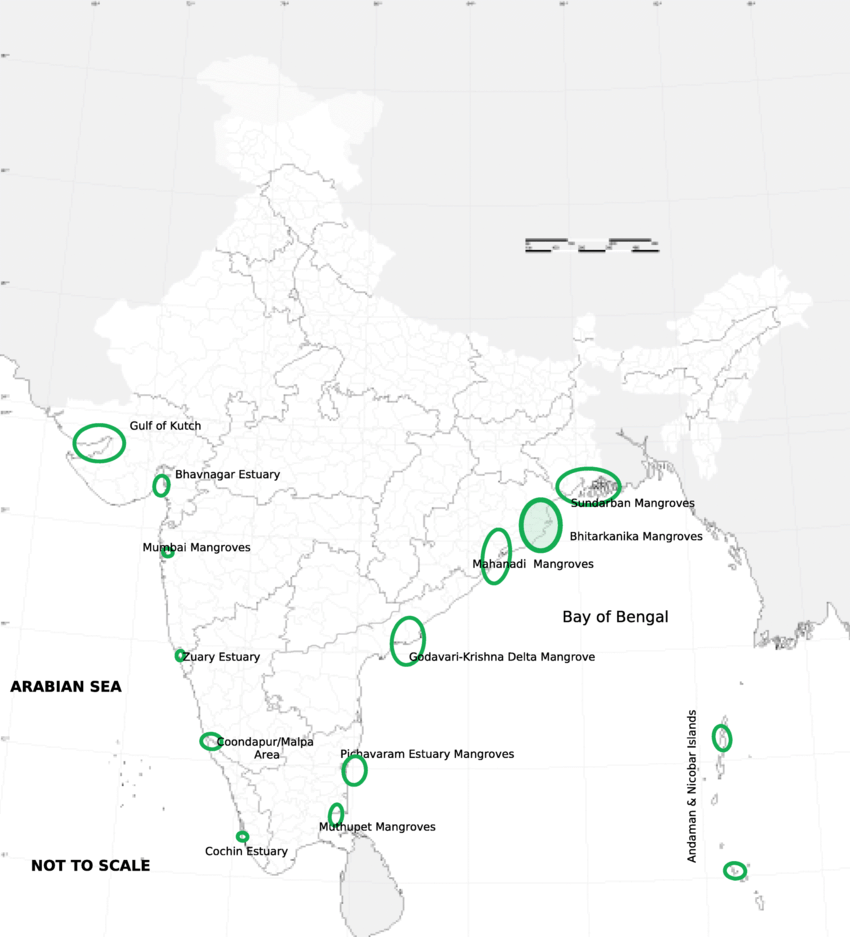
- This decision highlights the ongoing challenges faced by India's mangrove ecosystems due to urbanization and industrial projects.
What Are Mangroves?
- Mangroves are salt-tolerant trees and shrubs that grow in coastal intertidal zones where freshwater meets seawater.
- These unique ecosystems play a crucial role in coastal protection, biodiversity conservation, and climate change mitigation.
Global & Indian Distribution of Mangroves
- Global Presence: Found between latitudes 30° N and 30° S, with the densest coverage within 5° of the equator.
- India: As per the Indian State Forest Report 2021, mangrove cover in India accounts for 0.15% of the total geographical area, with major mangrove forests in:
- Sundarbans (West Bengal)
- Odisha
- Andhra Pradesh
- Gujarat
- Andaman and Nicobar Islands
Unique Biological Adaptations
- Mangroves have evolved specialized features to survive in harsh coastal environments:
- Aerial breathing roots (pneumatophores) for oxygen absorption.
- Salt-filtering mechanisms to remove excess salt.
- Waxy leaves to reduce water loss.
Key Benefits of Mangrove Forests
Coastal Protection: Mangrove forests act as natural breakwaters, reducing the impact of waves, storm surges, and coastal erosion.
Carbon Sequestration: Mangroves absorb and store carbon 3-4 times more efficiently than tropical forests, making them vital for climate change mitigation.
Biodiversity Hotspots: They provide nursery grounds for fish, support diverse marine life, and serve as a habitat for endangered species like the Royal Bengal Tiger and migratory birds.
Economic Benefits: Local communities depend on mangroves for sustainable fishing, timber, eco-tourism, and protection from natural disasters.
Major Threats to Mangrove Ecosystems
Urban Expansion & Industrial Projects
- Rapid coastal development for industries, housing, and tourism is leading to mangrove deforestation and habitat fragmentation.
Aquaculture & Shrimp Farming
- Conversion of mangrove forests into shrimp farms is a major cause of habitat destruction.
Climate Change & Rising Sea Levels
- Mangroves are highly vulnerable to sea-level rise, altered rainfall patterns, and extreme weather events.
Overexploitation & Poor Management
- Unregulated harvesting of mangrove resources and poor watershed management further degrade these vital ecosystems.
Mangrove Conservation Initiatives
- Mangroves for the Future (MFF): Led by IUCN and UNDP, this initiative promotes mangrove rehabilitation through community participation and policy reforms.
- REDD+ Mechanism: The REDD+ (Reducing Emissions from Deforestation and Forest Degradation) framework provides funding for mangrove conservation worldwide.
- India’s MISHTI Program
- MISHTI (Mangrove Initiative for Shoreline Habitats & Tangible Incomes) aims to restore 540 sq. km of mangroves across nine states and three union territories.
-
Launched on World Environment Day (June 5, 2023) by the Ministry of Environment, Forest & Climate Change.
- Legal Protections & Policies
-
Coastal Regulation Zone (CRZ) Notification restricts commercial activities in mangrove areas.
-
Environmental Protection Acts safeguard mangrove ecosystems from illegal deforestation and encroachment.
-
- Community-Based Conservation Efforts: Local conservation programs involve communities in mangrove restoration, sustainable resource management, and alternative livelihood development.
Conclusion
- Mangroves are irreplaceable ecosystems that protect coastal communities, store carbon, and support biodiversity.
- However, increasing human activities and climate change threaten their survival. Strengthening legal protections, conservation programs, and community engagement is essential for safeguarding India’s mangrove forests.
Download the PREPP App and attempt FREE IAS Exam Mock Tests and get complete study material!

Live Test : UPSC CSE Prelims CSAT (Paper-II) (Oct 08 - 11)
Full Test - 04: UPSC CSE Prelims CSAT (Paper-II)
Full Test - 03: UPSC CSE Prelims CSAT (Paper-II)
UPSC CSE Prelims 2026 GS Paper 1 Question Paper (24-May-2026)
UPSC CSE Prelims 2026 CSAT Paper 2 Question Paper (24-May-2026)

17 February 2025 | The Hindu Must Read Articles | Current Affairs

16 February 2026 | The Hindu Must Read Articles | Current Affairs

13 February 2026 | The Hindu Must Read Articles | Current Affairs









Comments