Mako Shark: First Shortfin Mako Shark Tagged in the Mediterranean
Why in the News?
For the first time, researchers from Virginia Tech in the United States have tagged a young shortfin mako shark (Isurus oxyrinchus) in the Mediterranean Sea, marking a significant achievement in marine research and conservation efforts.
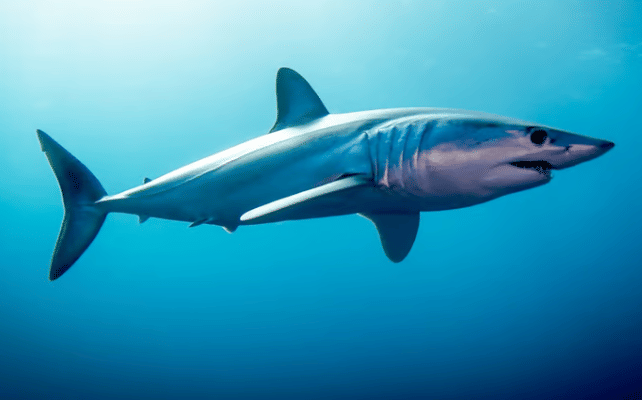
What is a Mako Shark?
- Scientific Name: Isurus oxyrinchus
- Common Names: Shortfin mako, blue pointer, bonito shark
- Etymology: The term "mako" originates from the Māori language (New Zealand), meaning either "shark" or "shark tooth."
Mako sharks play an essential role in maintaining the balance of ocean ecosystems by regulating marine species populations.
Habitat and Distribution
- Habitat: Found in offshore temperate and tropical seas worldwide. Prefers water temperatures above 16°C (61°F).
- Global Range: Commonly sighted in regions such as New Zealand, the Gulf of Mexico, and Argentina.
Characteristics and Behavior
- Size: Can grow up to 4 meters (13 feet) in length and weigh as much as 570 kg (1,260 lbs).
- Appearance: Notable for its cylindrical body, metallic blue dorsal side, and white underside.
- Speed: Known as one of the fastest shark species, reaching speeds of up to 74 km/h (46 mph).
- Adaptation: Exhibits endothermy, enabling it to maintain a body temperature higher than the surrounding water.
Threats to Mako Sharks
Mako sharks face numerous threats that jeopardize their survival, including:
- Overfishing: Targeted for sport and commercial purposes due to their size and speed.
- Bycatch: Often caught unintentionally in fishing gear aimed at other species.
- Habitat Loss: Marine ecosystems are being degraded and destroyed by human activity.
Conservation Status
- IUCN Red List: Endangered
- CITES Listing: Appendix II
Efforts are ongoing to raise awareness and enforce stricter conservation measures to protect this vital species.
Download the PREPP App and attempt FREE IAS Exam Mock Tests and get complete study material!
*The article might have information for the previous academic years, please refer the official website of the exam.
How likely are you to recommend Prepp.in to a friend or a colleague?
Not so likely
Highly likely
UPSC CSE (IAS) 2027 Prelims Mock Test Series
Live Quizzes
Quizzes
Live Tests

• Live
Live Test : UPSC CSE Prelims CSAT (Paper-II) (Oct 08 - 11)
120 Minutes
80 Questions
200 Marks
English, Hindi
MEDIUM
Test will end in 05:29:45
Full Tests
Full Test - 04: UPSC CSE Prelims CSAT (Paper-II)
120 Minutes
80 Questions
200 Marks
English, Hindi
MEDIUM
Attempted by 19 aspirants in 12 hours
Full Test - 03: UPSC CSE Prelims CSAT (Paper-II)
120 Minutes
80 Questions
200 Marks
English, Hindi
MEDIUM
Attempted by 20 aspirants in 12 hours
Previous Year Papers
UPSC CSE Prelims 2026 GS Paper 1 Question Paper (24-May-2026)
120 Minutes
100 Questions
200 Marks
2,989 Attempted
English, Hindi
MEDIUM
Attempted by 12 aspirants in 12 hours
UPSC CSE Prelims 2026 CSAT Paper 2 Question Paper (24-May-2026)
120 Minutes
80 Questions
200 Marks
3,167 Attempted
English, Hindi
MEDIUM
Attempted by 13 aspirants in 12 hours
Videos

17 February 2025 | The Hindu Must Read Articles | Current Affairs
7,202 Views
•4
•7 months ago

16 February 2026 | The Hindu Must Read Articles | Current Affairs
6,962 Views
•4
•7 months ago

13 February 2026 | The Hindu Must Read Articles | Current Affairs
8,765 Views
•5
•7 months ago

12 February 2026 | The Hindu Must Read Articles | Current Affairs
5,788 Views
•4
•7 months ago






Also Check
IAS Exam Overview
IAS Exam Admit Card
IAS Exam Question Paper 2026
IAS Exam Mains Syllabus
IAS Exam Application Process
IAS Exam Eligibility
IAS Exam Result
IAS Exam Exam Pattern
IAS Exam CSAT Syllabus
IAS Exam Answer Key
IAS Exam Previous Year Paper
IAS Exam Current Affairs
IAS Exam Mains Question Paper
IAS Exam IAS Courses
IAS Exam UPSC Study Notes
IAS Exam Foundation Course 2024
IAS Exam Prelims Question Paper
IAS Exam Exam Center
IAS Exam Foundation Course 2025
IAS Exam Notification 2026
IAS Exam IAS Success Stories
IAS Exam Salary
IAS Exam Cutoff
IAS Exam Mock Tests
IAS Exam News


Comments