Little Bunting Spotted for the First Time in Rajasthan: A Rare Sight
Why in the News?
The Little Bunting, a small migratory bird, was recently spotted for the first time in Rajasthan, marking a significant observation for bird watchers and researchers alike. Experts believe climate change could be a possible factor behind this unusual sighting, as the bird was seen outside its typical range.
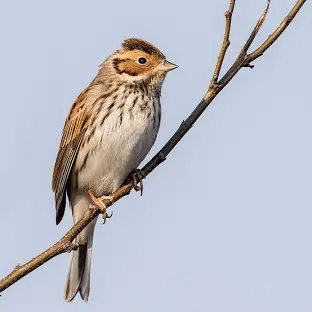
About the Little Bunting
- Scientific Name: Emberiza pusilla
- Name Origin: "Pusilla" is Latin for "very small," a fitting description of this tiny bird.
- Family: The Little Bunting belongs to the Emberizidae family, which includes buntings and sparrows.
- IUCN Status: Classified as Least Concern on the IUCN Red List due to its wide distribution and stable population.
Habitat and Distribution
- Habitat: The Little Bunting prefers coniferous woodlands with some birch or willow trees. During migration and winter, it is often found in agricultural fields.
- Breeding Range: The bird breeds in regions spanning northeast Europe, northern Siberia, and the Russian Far East.
- Wintering Range: It migrates to subtropical regions, including northern India, southern China, and parts of northern Southeast Asia.
Characteristics and Behavior
- Size: A small passerine bird measuring 12-14 cm in length.
- Appearance:
- White underparts with dark streaks on the breast and sides.
- A distinct chestnut face with a white malar stripe, black crown stripes, and a white eye-ring.
- Call: The Little Bunting is known for its sharp, distinctive "zik" call.
- Behavior: It is a migratory bird that adapts well to agricultural habitats during the winter months.
Unusual Sighting in Rajasthan
The recent sighting of the Little Bunting in Mount Abu, Rajasthan, has sparked curiosity among ornithologists and nature enthusiasts. This bird's appearance outside its traditional wintering range is unusual, prompting speculation that climate change and environmental factors may be influencing its migration patterns.
Significance of the Sighting
- Highlights the potential impact of climate change on bird migration.
- Provides an opportunity for further research and observation of migratory species in Rajasthan.
- Reinforces the importance of protecting habitats to support diverse bird populations.
Conclusion
The Little Bunting's first recorded presence in Rajasthan is an exciting development for both the scientific community and birdwatching enthusiasts. It emphasizes the need to monitor changes in bird migration patterns as an indicator of environmental shifts.
Download the PREPP App and attempt FREE IAS Exam Mock Tests and get complete study material!

Live Test : UPSC CSE Prelims CSAT (Paper-II) (Oct 08 - 11)
Full Test - 04: UPSC CSE Prelims CSAT (Paper-II)
Full Test - 03: UPSC CSE Prelims CSAT (Paper-II)
UPSC CSE Prelims 2026 GS Paper 1 Question Paper (24-May-2026)
UPSC CSE Prelims 2026 CSAT Paper 2 Question Paper (24-May-2026)

17 February 2025 | The Hindu Must Read Articles | Current Affairs

16 February 2026 | The Hindu Must Read Articles | Current Affairs

13 February 2026 | The Hindu Must Read Articles | Current Affairs









Comments