LID-568: The Super-Eddington Black Hole Defying Expectations
Why in News?
- Exceeding the Eddington Limit: LID-568 is feeding at nearly 40 times the Eddington limit, a phenomenon known as super-Eddington accretion. This extraordinary growth rate challenges existing black hole theories.
- Exceptional Accretion Behavior: This black hole was observed during a rapid and short-lived feeding episode, offering new insights into the fast growth of supermassive black holes.
- Implications for Black Hole Formation: The discovery suggests that supermassive black holes could grow much faster in brief bursts, without requiring long, sustained accretion processes.
- Galaxy Environment: The galaxy hosting LID-568 shows a lack of star formation, possibly due to powerful black hole-driven outflows that prevent matter from accumulating.
- Future Research Directions: Ongoing observations by the James Webb Space Telescope (JWST) will continue to investigate the mechanisms behind super-Eddington accretion and explore how common this phenomenon might be in other black holes.
About LID-568: Key Facts
- Identification & Discovery: LID-568 is a supermassive black hole located around 1.5 billion years after the Big Bang. It was first detected by the Chandra X-ray Observatory and later studied in detail using the James Webb Space Telescope’s (JWST) infrared capabilities. Its faintness had made earlier observations challenging.
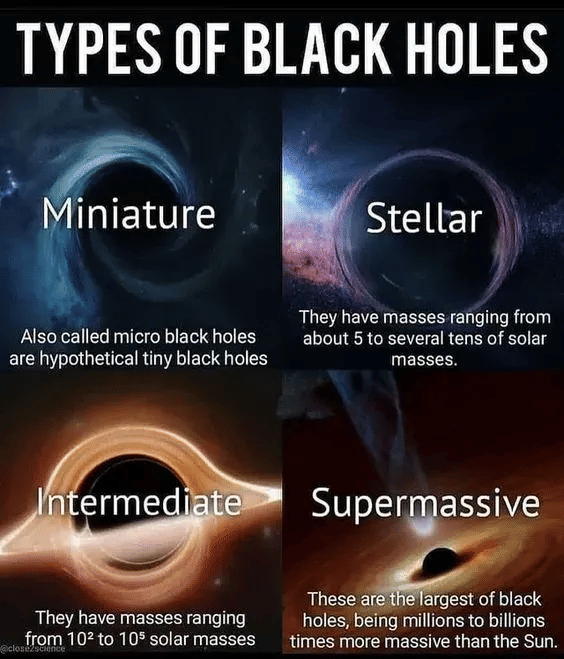
- Expansion Rate: LID-568 is expanding at an extraordinary rate, surpassing the Eddington limit by 40 times. This rapid growth contradicts previous models and challenges the established understanding of black hole formation and growth.
- The Eddington Limit: The Eddington limit defines the maximum rate at which a black hole can feed on material. When this limit is surpassed, the outward radiation pressure from accreting material balances the gravitational pull. LID-568’s super-Eddington accretion suggests that alternative mechanisms may be at play.
- Mass and Size: LID-568 has a mass of approximately 10 million times that of the Sun, making it about 2.5 times the size of Sagittarius A*, the supermassive black hole at the center of our galaxy, the Milky Way.
- Theoretical Implications: LID-568’s rapid growth may provide crucial clues into the formation of supermassive black holes in the early universe. It challenges existing theories, particularly in the context of the Big Bang and the initial stages of galaxy formation.
- Primordial Black Hole: LID-568 may be a primordial black hole, potentially formed from the collapse of gas clouds or the explosion of early universe stars rather than stellar collapse alone.
- James Webb Space Telescope: The discovery of LID-568 was possible thanks to JWST’s cutting-edge infrared observation technology, which is designed to study distant cosmic phenomena with unprecedented sensitivity.
Conclusion:
- The discovery of LID-568 is a game-changer for astrophysics, offering new insights into the rapid growth of supermassive black holes. It challenges existing theories about black hole formation and opens up exciting possibilities for further exploration using the James Webb Space Telescope.
Download the PREPP App and attempt FREE IAS Exam Mock Tests and get complete study material!
*The article might have information for the previous academic years, please refer the official website of the exam.
How likely are you to recommend Prepp.in to a friend or a colleague?
Not so likely
Highly likely
UPSC CSE (IAS) 2027 Prelims Mock Test Series
Live Quizzes
Quizzes
Live Tests

• Live
Live Test : UPSC CSE Prelims CSAT (Paper-II) (Oct 08 - 11)
120 Minutes
80 Questions
200 Marks
English, Hindi
MEDIUM
Test will end in 22:54:32
Full Tests
Full Test - 04: UPSC CSE Prelims CSAT (Paper-II)
120 Minutes
80 Questions
200 Marks
English, Hindi
MEDIUM
Attempted by 20 aspirants in 12 hours
Full Test - 03: UPSC CSE Prelims CSAT (Paper-II)
120 Minutes
80 Questions
200 Marks
English, Hindi
MEDIUM
Attempted by 21 aspirants in 12 hours
Previous Year Papers
UPSC CSE Prelims 2026 GS Paper 1 Question Paper (24-May-2026)
120 Minutes
100 Questions
200 Marks
2,973 Attempted
English, Hindi
MEDIUM
Attempted by 13 aspirants in 12 hours
UPSC CSE Prelims 2026 CSAT Paper 2 Question Paper (24-May-2026)
120 Minutes
80 Questions
200 Marks
3,150 Attempted
English, Hindi
MEDIUM
Attempted by 14 aspirants in 12 hours
Videos

17 February 2025 | The Hindu Must Read Articles | Current Affairs
7,202 Views
•4
•7 months ago

16 February 2026 | The Hindu Must Read Articles | Current Affairs
6,962 Views
•4
•7 months ago

13 February 2026 | The Hindu Must Read Articles | Current Affairs
8,765 Views
•5
•7 months ago

12 February 2026 | The Hindu Must Read Articles | Current Affairs
5,788 Views
•4
•7 months ago






Also Check
IAS Exam Overview
IAS Exam Admit Card
IAS Exam Question Paper 2026
IAS Exam Mains Syllabus
IAS Exam Application Process
IAS Exam Eligibility
IAS Exam Result
IAS Exam Exam Pattern
IAS Exam CSAT Syllabus
IAS Exam Answer Key
IAS Exam Previous Year Paper
IAS Exam Current Affairs
IAS Exam Mains Question Paper
IAS Exam IAS Courses
IAS Exam UPSC Study Notes
IAS Exam Foundation Course 2024
IAS Exam Prelims Question Paper
IAS Exam Exam Center
IAS Exam Foundation Course 2025
IAS Exam Notification 2026
IAS Exam IAS Success Stories
IAS Exam Salary
IAS Exam Cutoff
IAS Exam Mock Tests
IAS Exam News


Comments