Ken-Betwa Link Project: Transforming Water Management in India
Why in the News?
Prime Minister Narendra Modi recently laid the foundation stone for the Ken-Betwa River Linking Project in Khajuraho, Madhya Pradesh, marking a historic step in India's water management initiatives.
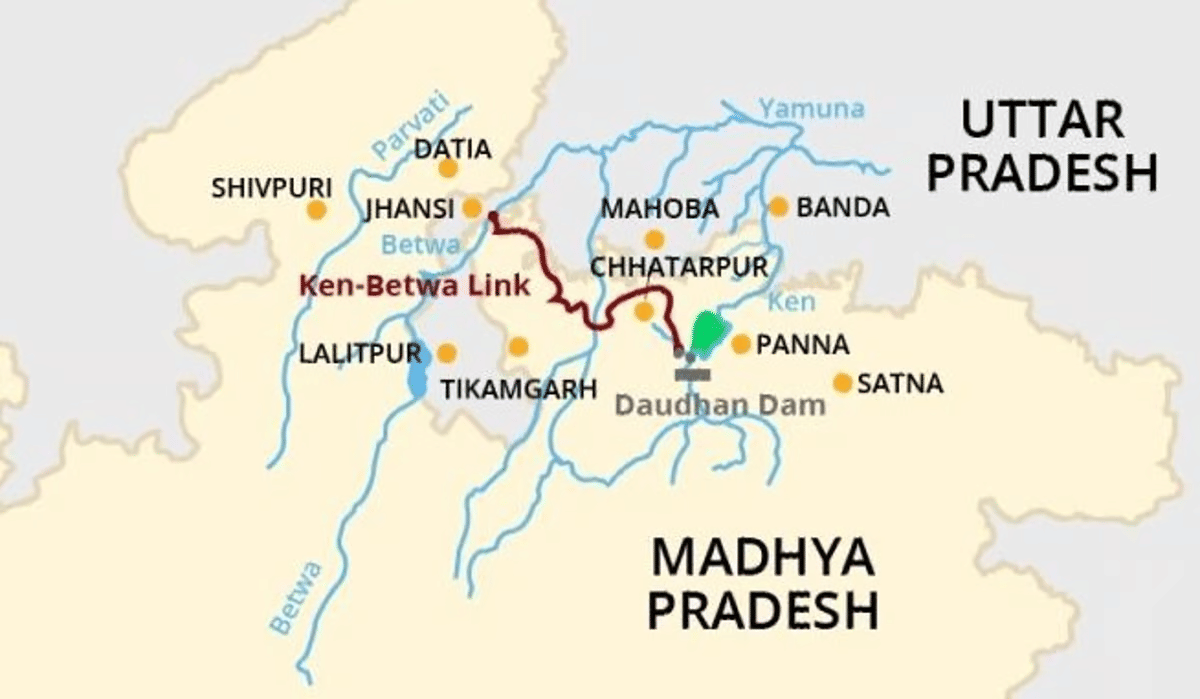
Key Highlights of the Ken-Betwa Link Project
Purpose
The Ken-Betwa Link Project aims to transfer water from the Ken River to the Betwa River, both tributaries of the Yamuna River, to tackle water scarcity.
Benefited Regions
The project is set to transform the Bundelkhand region, encompassing 13 districts in Uttar Pradesh and Madhya Pradesh, by addressing water shortages and enhancing agricultural productivity.
Infrastructure and Outputs
The project includes significant infrastructure development:
- A 221-km canal, including a 2-km tunnel.
- Construction of the Daudhan Dam.
- Provisions for irrigation, drinking water supply, and power generation.
Key Benefits:
- Irrigation for 10.62 lakh hectares of farmland.
- Drinking water supply for 62 lakh people.
- Combined hydropower and solar energy generation of 130 MW.
Phases of Implementation
- Phase I: Construction of the Daudhan Dam and Ken-Betwa Link Canal.
- Phase II: Development of the Lower Orr Dam, Bina Complex Project, and Kotha Barrage.
Detailed Overview of the Ken and Betwa Rivers
Ken River
- Origin: The Ken River originates in Madhya Pradesh's Kaimur Hills.
- Ecological Importance: It flows through the Panna National Park, home to species like gharials, tigers, and vultures.
Betwa River
- Origin: The Betwa River rises in the Vindhya Range of Madhya Pradesh.
- Agricultural Significance: It is a vital resource for agriculture in the region, supporting communities in both Madhya Pradesh and Uttar Pradesh.
Historical Timeline of the Ken-Betwa Link Project
- 1980: Included in the National Perspective Plan for interlinking rivers.
- 2005: A tripartite MoU was signed among the Centre and the two states.
- 2008: Declared a National Project.
- 2018: Detailed Project Report (DPR) finalized.
- March 22, 2021: A Memorandum of Agreement was signed between the Ministry of Jal Shakti and the governments of Madhya Pradesh and Uttar Pradesh.
Concerns and Challenges
Environmental Impact
- Approximately 98 square kilometers of the Panna National Park and Tiger Reserve will be submerged.
- Loss of 2-3 million trees, impacting local ecosystems.
Wildlife and Displacement Issues
- Threats to habitats of tigers, vultures, and gharials.
- Displacement of over 6,600 families with concerns over inadequate compensation.
Hydrological and Economic Concerns
- Disputes over surplus water availability in the Ken River.
- Calls for exploring alternative water management solutions.
Expected Benefits
Water Supply and Agriculture
- Reliable drinking water for nearly 62 lakh residents in Bundelkhand.
- Irrigation support for over 10 lakh hectares of farmland.
Energy and Economic Growth
- Generation of 103 MW of hydropower and 27 MW of solar energy.
- Boost to agriculture, reduction in drought-driven migration, and overall regional development.
National Impact
The success of this project is expected to set a precedent for future river-linking initiatives across India, fostering sustainable water management and regional development.
Conclusion
The Ken-Betwa River Linking Project represents a bold step in addressing India's water challenges. While concerns over environmental impact and displacement persist, the project’s potential benefits in water supply, energy generation, and regional development underscore its significance.
Download the PREPP App and attempt FREE IAS Exam Mock Tests and get complete study material!

Live Test : UPSC CSE Prelims CSAT (Paper-II) (Oct 08 - 11)
Full Test - 04: UPSC CSE Prelims CSAT (Paper-II)
Full Test - 03: UPSC CSE Prelims CSAT (Paper-II)
UPSC CSE Prelims 2026 GS Paper 1 Question Paper (24-May-2026)
UPSC CSE Prelims 2026 CSAT Paper 2 Question Paper (24-May-2026)

17 February 2025 | The Hindu Must Read Articles | Current Affairs

16 February 2026 | The Hindu Must Read Articles | Current Affairs

13 February 2026 | The Hindu Must Read Articles | Current Affairs









Comments