K-4 Ballistic Missile
Why in news?
India successfully tested the K-4 nuclear-capable ballistic missile from the INS Arighaat submarine in the Bay of Bengal, strengthening its nuclear deterrence. This test positions India among nations capable of launching nuclear missiles from land, air, and sea.
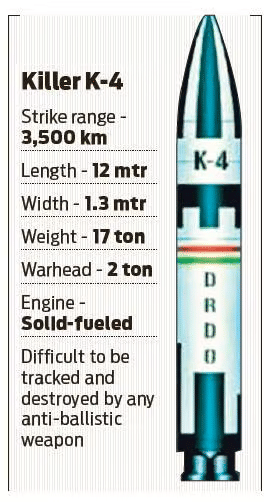
About K-4 missile
- The K-4 ballistic missile is a crucial component of India’s nuclear triad, developed by the Defence Research and Development Organisation (DRDO). It is a submarine-launched ballistic missile (SLBM) designed to enhance India’s strategic deterrence capabilities.
- Development: The K-4 missile is developed by DRDO to strengthen India's nuclear deterrence through submarine-launched ballistic missile systems.
- Range and Payload: The K-4 has a range of 3,500 km and can carry a nuclear warhead weighing up to 2,000 kg, enhancing India’s second-strike capability.
- Platform: The K-4 missile is designed for nuclear-powered submarines like the Arihant-class, which are key to India’s strategic deterrence.
- Guidance and Accuracy: It features advanced guidance systems for precise targeting and reliable performance.
- Significance for UPSC: The K-4 missile’s development is a critical aspect of India’s defense policy and nuclear strategy, making it relevant for General Studies Paper 2 (International Relations) and Paper 3 (Security issues) of the UPSC Mains.
- Strategic Deterrence: As part of India’s nuclear triad, the K-4 contributes to India’s second-strike capability, ensuring a strong defense posture and alignment with India’s no-first-use policy.
- Testing and Deployment: The K-4 missile has undergone successful tests and will be integrated into India’s nuclear-powered submarines, enhancing the country’s naval strategic capabilities.
Download the PREPP App and attempt FREE IAS Exam Mock Tests and get complete study material!
*The article might have information for the previous academic years, please refer the official website of the exam.
How likely are you to recommend Prepp.in to a friend or a colleague?
Not so likely
Highly likely
UPSC CSE (IAS) 2027 Prelims Mock Test Series
Live Quizzes
Quizzes
Live Tests

• Live
Live Test : UPSC CSE Prelims CSAT (Paper-II) (Oct 08 - 11)
120 Minutes
80 Questions
200 Marks
English, Hindi
MEDIUM
Test will end in 23:35:12
Full Tests
Full Test - 04: UPSC CSE Prelims CSAT (Paper-II)
120 Minutes
80 Questions
200 Marks
English, Hindi
MEDIUM
Attempted by 19 aspirants in 12 hours
Full Test - 03: UPSC CSE Prelims CSAT (Paper-II)
120 Minutes
80 Questions
200 Marks
English, Hindi
MEDIUM
Attempted by 21 aspirants in 12 hours
Previous Year Papers
UPSC CSE Prelims 2026 GS Paper 1 Question Paper (24-May-2026)
120 Minutes
100 Questions
200 Marks
2,972 Attempted
English, Hindi
MEDIUM
Attempted by 13 aspirants in 12 hours
UPSC CSE Prelims 2026 CSAT Paper 2 Question Paper (24-May-2026)
120 Minutes
80 Questions
200 Marks
3,149 Attempted
English, Hindi
MEDIUM
Attempted by 14 aspirants in 12 hours
Videos

17 February 2025 | The Hindu Must Read Articles | Current Affairs
7,202 Views
•4
•7 months ago

16 February 2026 | The Hindu Must Read Articles | Current Affairs
6,962 Views
•4
•7 months ago

13 February 2026 | The Hindu Must Read Articles | Current Affairs
8,765 Views
•5
•7 months ago

12 February 2026 | The Hindu Must Read Articles | Current Affairs
5,788 Views
•4
•7 months ago






Also Check
IAS Exam Overview
IAS Exam Admit Card
IAS Exam Question Paper 2026
IAS Exam Mains Syllabus
IAS Exam Application Process
IAS Exam Eligibility
IAS Exam Result
IAS Exam Exam Pattern
IAS Exam CSAT Syllabus
IAS Exam Answer Key
IAS Exam Previous Year Paper
IAS Exam Current Affairs
IAS Exam Mains Question Paper
IAS Exam IAS Courses
IAS Exam UPSC Study Notes
IAS Exam Foundation Course 2024
IAS Exam Prelims Question Paper
IAS Exam Exam Center
IAS Exam Foundation Course 2025
IAS Exam Notification 2026
IAS Exam IAS Success Stories
IAS Exam Salary
IAS Exam Cutoff
IAS Exam Mock Tests
IAS Exam News


Comments