Jharkhand High Court Halts 75% Job Quota in Private Sector
Why in the News?
The Jharkhand High Court has recently stayed the implementation of the Jharkhand State Employment of Local Candidates in Private Sector Act, 2021, raising constitutional concerns. Here’s a detailed analysis of the court ruling, legal implications, and the broader impact of domicile-based reservations.
Jharkhand High Court Ruling
- Stay on Implementation: The High Court’s stay order pauses the enforcement of the law, citing potential conflicts with constitutional principles.
- Provisions of the Act:
- Mandated a 75% reservation for local candidates in private-sector jobs with monthly salaries up to ₹40,000.
- Aimed to boost employment for Jharkhand’s residents.
- Petition by Industries:
- The Adityapur Small Industries Association challenged the law, arguing that it violated:
- Article 14: Ensuring the right to equality.
- Article 19(1)(g): Guaranteeing freedom to practice any profession.
- Petitioners referenced the Punjab and Haryana High Court’s rejection of a similar law in Haryana as a legal precedent.
- The Adityapur Small Industries Association challenged the law, arguing that it violated:
Constitutional Provisions on Private Sector Reservation
- Article 14 - Right to Equality:
- Prohibits discrimination and ensures equal treatment under the law.
- Domicile-based reservations in private jobs risk being deemed discriminatory.
- Article 19(1)(g) - Freedom to Practice Any Profession:
- Guarantees citizens the right to work freely.
- Imposing hiring restrictions on non-locals could infringe this right.
- Article 16(3):
- Allows Parliament to prescribe residence-based criteria for government jobs but excludes private employment.
Key Judicial Precedents
- DP Joshi vs. Madhya Bharat (1955):
- Upheld domicile-based reservation for educational institutions under “reasonable classification.”
- Dr. Pradeep Jain v. Union of India (1984):
- Advocated balancing local interests with broader equality principles.
Understanding Domicile Reservation
- Definition:
- Prioritizes local residents for jobs or education based on residency rather than birthplace.
- Key Features:
- Often applies to lower- or semi-skilled roles.
- Enforced through quotas in government and private sectors.
- Legal Basis:
- Draws authority from Articles 15 and 16 but mainly applies to public sector opportunities.
- Criticisms:
- Promotes regionalism and undermines national integration.
- May lead to unequal development among states.
Reasons for Local Job Quotas in Private Sector
- High Local Unemployment:
- States with high unemployment argue quotas ensure jobs for residents.
- Resentment Against Migrants:
- Locals perceive migrants as competitors for jobs.
- Government Incentives:
- Businesses receiving state subsidies are expected to prioritize local employment.
- Political Pressure:
- Quotas are often politically motivated to secure local voter support.
- Skill Mismatch:
- Locals may lack qualifications for high-paying roles, making quotas for lower-paying jobs essential.
Current Status of Domicile-Based Quotas in India
- Haryana’s Precedent:
- Haryana’s 75% job quota for locals, introduced in 2020, was later struck down.
- Other States:
- States like Andhra Pradesh, Karnataka, and Jharkhand have proposed similar laws.
- Judicial Scrutiny:
- Most such laws face constitutional challenges.
- Enforcement Mechanisms:
- Vary by state; some rely on self-certification by companies, others mandate audits.
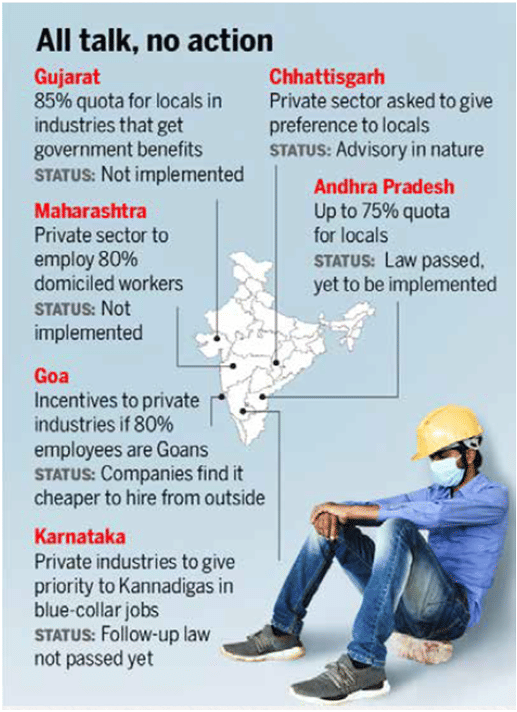
Challenges with Local Job Quotas
- Constitutional Conflicts:
- Potential violations of Articles 14 and 19(1)(g).
- Business Impact:
- Companies claim quotas restrict hiring the best talent, reducing efficiency.
- Stringent laws may deter investment.
- Workforce Division:
- Promotes resentment against non-local workers.
- Implementation Issues:
- Monitoring compliance is complex.
- Employers may underreport salaries to avoid quotas.
- Undermining Meritocracy:
- Prioritizing residency over merit could harm productivity.
- Economic Inequality:
- Wealthier locals may benefit disproportionately, sidelining marginalized groups.
Way Forward
- Focus on Skill Development:
- Invest in vocational training and education for local residents.
- Collaborate with industries to design market-relevant programs.
- Incentivize Local Hiring:
- Offer tax breaks or subsidies to companies hiring local talent.
- Promote Regional Cooperation:
- Facilitate inter-state agreements for balanced labor mobility.
- Strengthen Labor Laws:
- Ensure fair wages and working conditions for all workers, local or migrant.
- Foster Merit-Based Selection:
- Develop systems where merit and residency coexist.
- Leverage Technology:
- Use digital platforms for transparent recruitment.
- Encourage remote work to expand job opportunities.
Conclusion
Domicile-based reservations in private sector jobs present significant constitutional and practical challenges. While addressing local unemployment is crucial, policies must balance local interests with merit, fairness, and economic growth. Enhancing skills and fostering regional collaboration could provide a sustainable alternative to restrictive job quotas.
Download the PREPP App and attempt FREE IAS Exam Mock Tests and get complete study material!

Live Test : UPSC CSE Prelims CSAT (Paper-II) (Oct 08 - 11)
Full Test - 04: UPSC CSE Prelims CSAT (Paper-II)
Full Test - 03: UPSC CSE Prelims CSAT (Paper-II)
UPSC CSE Prelims 2026 GS Paper 1 Question Paper (24-May-2026)
UPSC CSE Prelims 2026 CSAT Paper 2 Question Paper (24-May-2026)

17 February 2025 | The Hindu Must Read Articles | Current Affairs

16 February 2026 | The Hindu Must Read Articles | Current Affairs

13 February 2026 | The Hindu Must Read Articles | Current Affairs









Comments