ISRO's SpaDeX Mission: Latest Updates and Insights
Why in the News?
The Indian Space Research Organisation (ISRO) has delayed its ambitious Space Docking Experiment (SpaDeX) mission for the second time. Here are the latest developments, technical details, and the significance of this groundbreaking mission:
News Details
- Initial Schedule and Delays:
- Originally scheduled for launch on December 30, 2024, the docking experiment was set for January 7, 2025.
- The docking was postponed to January 9, 2025, and later further delayed due to technical issues.
- Technical Challenges:
- During the January 9 attempt, a trajectory drift in the spacecrafts exceeded permissible limits after a non-visibility period, necessitating a second postponement.
- Current Status:
- Satellites SDX01 (Chaser) and SDX02 (Target) are currently positioned 1.5 km apart.
- ISRO aims to maneuver the satellites closer to 500 meters in preparation for future docking stages.
About the SpaDeX Mission
- Mission Overview:
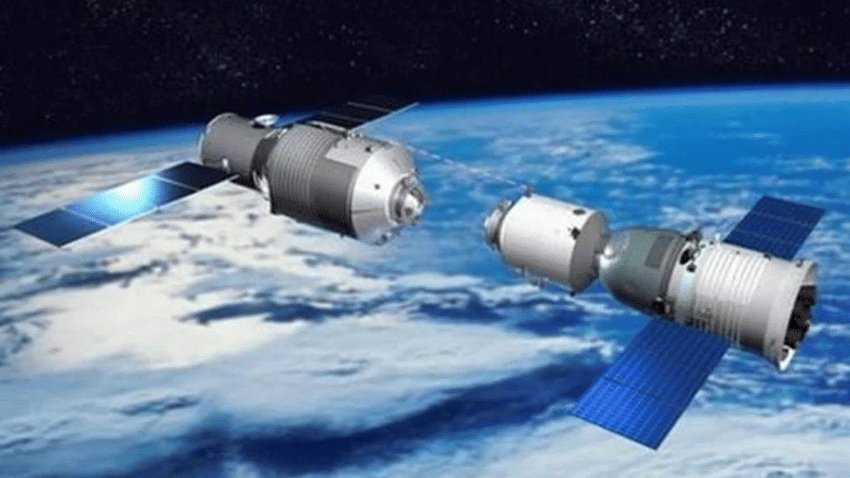
The SpaDeX mission is a cost-effective technology demonstration showcasing India’s capability to conduct in-space docking of small spacecraft. It includes operations such as rendezvous, docking, and undocking.
- Components:
- SDX01 (Chaser) and SDX02 (Target) serve as the mission’s primary payloads.
- Step-by-Step Docking Plan:
The Chaser satellite will approach the Target satellite in incremental stages: 5 km, 1.5 km, 500 m, 225 m, 15 m, and finally 3 m before achieving docking at an altitude of 470 km above Earth.
- Payload Details:
- Chaser (Spacecraft A): Equipped with a High-Resolution Camera for detailed imaging.
- Target (Spacecraft B): Features a Miniature Multispectral Payload for natural resource monitoring and vegetation studies.
- Launch Vehicle: The PSLV-C60 rocket, ISRO’s final mission of 2024, carried SpaDeX alongside 24 secondary payloads.
Significance of SpaDeX
- Technological Advancement:
A successful SpaDeX mission will position India as the fourth country after the US, Russia, and China to demonstrate in-space docking capability, marking a critical milestone in space exploration.
- Applications in Future Missions:
- Chandrayaan 4: Enables bringing lunar samples back to Earth.
- Human Lunar Mission (2040): Supports India’s plans for a manned lunar mission.
- Bharatiya Antariksh Station (2035): Advances India’s proposed space station.
- Cost-Effective Solution:
The SpaDeX mission aligns with India’s vision of achieving self-reliance (Aatmanirbhar Bharat) in advanced space technologies.
- Enabling Multi-Launch Missions:
Docking technology allows coordination of multiple rocket launches for unified mission objectives, essential for complex space endeavors.
- Strengthening Space Capabilities:
Mastering docking technology reinforces ISRO’s position as a global leader in space technology, fostering international collaborations and paving the way for deep-space exploration.
Download the PREPP App and attempt FREE IAS Exam Mock Tests and get complete study material!

Live Test : UPSC CSE Prelims CSAT (Paper-II) (Oct 08 - 11)
Full Test - 04: UPSC CSE Prelims CSAT (Paper-II)
Full Test - 03: UPSC CSE Prelims CSAT (Paper-II)
UPSC CSE Prelims 2026 GS Paper 1 Question Paper (24-May-2026)
UPSC CSE Prelims 2026 CSAT Paper 2 Question Paper (24-May-2026)

17 February 2025 | The Hindu Must Read Articles | Current Affairs

16 February 2026 | The Hindu Must Read Articles | Current Affairs

13 February 2026 | The Hindu Must Read Articles | Current Affairs









Comments