INTERPOL Silver Notice: A Revolutionary Tool for Asset Tracing and Recovery
Why in the News?
The recently introduced Interpol Silver Notice has been lauded as a groundbreaking tool for tracing and recovering illicit assets, surpassing the efficiency of traditional Mutual Legal Assistance Treaties (MLATs). According to the Central Bureau of Investigation (CBI) Director, this initiative enhances global cooperation in combating financial crimes and disrupting criminal networks.
Key Highlights
CBI Director's Insight
- CBI Director Praveen Sood emphasized that the concept of the Silver Notice was proposed by Prime Minister Narendra Modi in 2015 and is now a reality.
- The pilot project, involving 52 countries, commenced in 2023 and will continue until at least November 2025.
What is the Interpol Silver Notice?
The Silver Notice is the latest addition to Interpol’s colour-coded alert system, specifically designed to track and recover assets associated with crimes such as:
- Fraud
- Corruption
- Drug Trafficking
- Environmental Offenses
Features and Impact
- Real-time Information Sharing: Facilitates complex investigations by sharing crucial data promptly.
- Global Collaboration: Leverages Interpol’s extensive network, making it more effective than bilateral MLATs.
- Pilot Phase Details: During the pilot phase, 500 Silver Notices will be issued to participating nations.
- Targeted Outcomes: Aims to recover illicit wealth and dismantle the financial networks of organized crime.
Comparison: Silver Notice vs. MLATs
- MLATs: Operate on a bilateral basis, often causing delays due to complex legal procedures.
- Silver Notice: Provides a multilateral approach, ensuring broader and faster access to critical information.
Interpol Notices: A Quick Guide
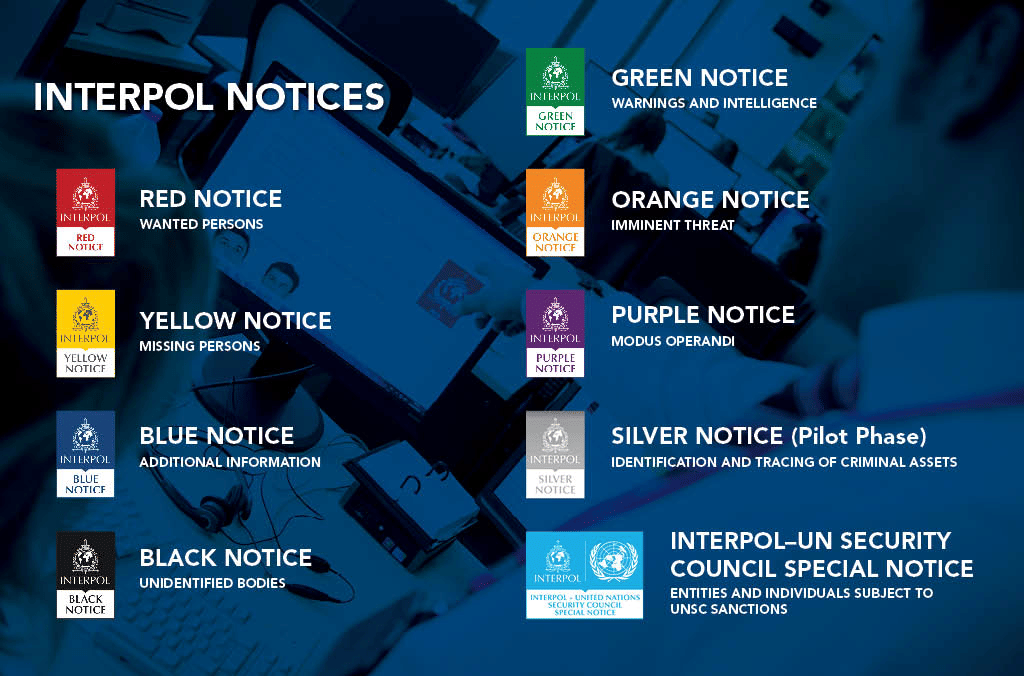
Interpol’s notices are categorized by colour to serve specific purposes:
- Red Notice: Locates and arrests individuals for prosecution or sentencing.
- Yellow Notice: Helps find missing persons or identify those unable to identify themselves.
- Blue Notice: Gathers additional information on a person’s identity or activities.
- Black Notice: Seeks information on unidentified bodies.
- Green Notice: Warns about individuals posing threats to public safety.
- Orange Notice: Alerts of imminent threats from events, objects, or processes.
- Purple Notice: Requests details about criminal modus operandi and concealment methods.
- Silver Notice: Focuses on tracing and recovering criminally obtained assets.
About Interpol
Interpol, or the International Criminal Police Organization, fosters global collaboration among law enforcement agencies in 195 member countries.
A Brief History
- Founded in 1923 in Vienna as the International Criminal Police Commission (ICPC).
- Renamed Interpol in 1956 after adopting a new constitution.
- Headquarters: Lyon, France.
Functions
- Issues colour-coded notices to assist in locating individuals, identifying risks, and sharing criminal intelligence.
- Coordinates efforts to combat transnational crimes such as:
- Human Trafficking
- Terrorism
- Drug Trade
- Cybercrime
Conclusion
The Interpol Silver Notice marks a significant advancement in international law enforcement. By streamlining the process of asset tracing and recovery, it promises to be a pivotal tool in disrupting the financial operations of criminal networks worldwide. Its pilot phase’s success will determine its role as a permanent feature in the fight against global crime.
Download the PREPP App and attempt FREE IAS Exam Mock Tests and get complete study material!

Live Test : UPSC CSE Prelims CSAT (Paper-II) (Oct 08 - 11)
Full Test - 04: UPSC CSE Prelims CSAT (Paper-II)
Full Test - 03: UPSC CSE Prelims CSAT (Paper-II)
UPSC CSE Prelims 2026 GS Paper 1 Question Paper (24-May-2026)
UPSC CSE Prelims 2026 CSAT Paper 2 Question Paper (24-May-2026)

17 February 2025 | The Hindu Must Read Articles | Current Affairs

16 February 2026 | The Hindu Must Read Articles | Current Affairs

13 February 2026 | The Hindu Must Read Articles | Current Affairs









Comments