INTERNATIONAL SPACE STATION: Comprehensive Overview and Latest Updates
Why in news?
- SpaceX delays ISS mission to bring stuck NASA astronauts Sunita Williams, Butch Wilmore home.
Introduction
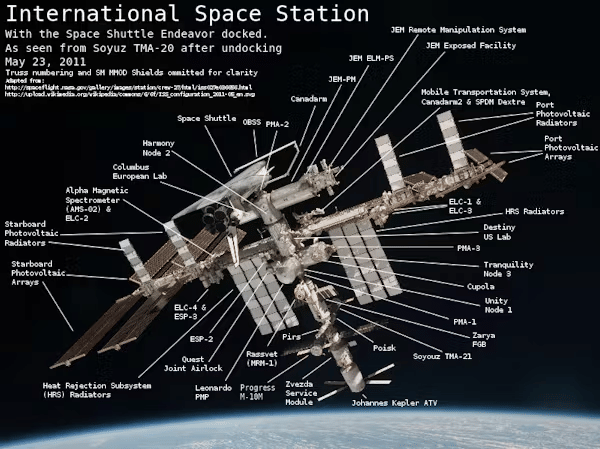
- The International Space Station (ISS) is the largest man-made object in space.
- Launched on November 20, 1998, the ISS has been continuously inhabited since 2011.
- It serves as a habitat for astronauts and a platform for scientific research in microgravity.
![International Space Station]()
Participating Agencies
- The ISS is a joint project involving:
- United States (NASA)
- Russia (Roscosmos)
- Europe (ESA)
- Japan (JAXA)
- Canada (CSA)
Orbit and Speed
- The ISS orbits Earth at an altitude of about 400 km.
- It travels at a speed of 28,000 km/h, completing one orbit every 90 minutes.
Objectives
- Expanding scientific knowledge about space and microgravity.
- Conducting experiments in physics, biology, and medicine.
- Serving as a platform for international cooperation in space exploration.
Significance
- Recognized as one of the most successful examples of international diplomacy and collaboration.
- Functions as a testbed for long-duration space missions, crucial for preparing for crewed missions to Mars and the Moon.
Space Medicine Research
- Provides insights into treatments for conditions such as Alzheimer’s, Parkinson’s, and cancer.
- Enables the study of microgravity effects on the human body, aiding research on aging, bone loss, and muscle atrophy.
Human Spaceflight Expertise
- Acts as a training ground for astronauts preparing for deep-space missions.
- Facilitates critical understanding of human adaptability to extended space travel.
Major Discoveries
- Development of new water purification systems.
- Breakthroughs in drug development and treatments for immune system conditions.
- Discovery of steadily burning cool flames.
- Enhanced understanding of the fifth state of matter.
- Testing of tissue chips for medical advancements.
- Insights into pulsars, black holes, and cosmic phenomena.
- Enabled 3D printing in microgravity to support space missions.
- Contributions to fluid physics and colloid research.
Monitoring and Environmental Insights
- ISS plays a vital role in:
- Monitoring climate change and natural disasters.
- Collecting data on over 100 billion cosmic particles.
- Deploying CubeSats for enhanced satellite communication and observation.
Current Status and Future Plans
- Following the Ukraine War (2022), ESA ended future collaborations with Russia.
- Russia announced plans to withdraw from the ISS to build its own space station.
- The US and Europe committed to supporting the ISS until 2030.
- ESA is developing a new space station called Starlab.
Other Space Station Initiatives
- China's Tiangong space station became fully operational in late 2022, accommodating up to three astronauts at a 450 km orbit.
- India aims to build the Bhartiya Antriksh Station by 2035, designed to support astronauts for 15-20 days in a 400 km orbit.
Conclusion
- The ISS continues to be a symbol of scientific progress, innovation, and international unity, paving the way for future deep-space missions and technological breakthroughs.
Download the PREPP App and attempt FREE IAS Exam Mock Tests and get complete study material!
*The article might have information for the previous academic years, please refer the official website of the exam.
How likely are you to recommend Prepp.in to a friend or a colleague?
Not so likely
Highly likely
UPSC CSE (IAS) 2027 Prelims Mock Test Series
Live Quizzes
Quizzes
Live Tests

• Live
Live Test : UPSC CSE Prelims CSAT (Paper-II) (Oct 08 - 11)
120 Minutes
80 Questions
200 Marks
English, Hindi
MEDIUM
Test will end in 05:30:45
Full Tests
Full Test - 04: UPSC CSE Prelims CSAT (Paper-II)
120 Minutes
80 Questions
200 Marks
English, Hindi
MEDIUM
Attempted by 19 aspirants in 12 hours
Full Test - 03: UPSC CSE Prelims CSAT (Paper-II)
120 Minutes
80 Questions
200 Marks
English, Hindi
MEDIUM
Attempted by 20 aspirants in 12 hours
Previous Year Papers
UPSC CSE Prelims 2026 GS Paper 1 Question Paper (24-May-2026)
120 Minutes
100 Questions
200 Marks
2,989 Attempted
English, Hindi
MEDIUM
Attempted by 12 aspirants in 12 hours
UPSC CSE Prelims 2026 CSAT Paper 2 Question Paper (24-May-2026)
120 Minutes
80 Questions
200 Marks
3,167 Attempted
English, Hindi
MEDIUM
Attempted by 13 aspirants in 12 hours
Videos

17 February 2025 | The Hindu Must Read Articles | Current Affairs
7,202 Views
•4
•7 months ago

16 February 2026 | The Hindu Must Read Articles | Current Affairs
6,962 Views
•4
•7 months ago

13 February 2026 | The Hindu Must Read Articles | Current Affairs
8,765 Views
•5
•7 months ago

12 February 2026 | The Hindu Must Read Articles | Current Affairs
5,788 Views
•4
•7 months ago






Also Check
IAS Exam Overview
IAS Exam Admit Card
IAS Exam Question Paper 2026
IAS Exam Mains Syllabus
IAS Exam Application Process
IAS Exam Eligibility
IAS Exam Result
IAS Exam Exam Pattern
IAS Exam CSAT Syllabus
IAS Exam Answer Key
IAS Exam Previous Year Paper
IAS Exam Current Affairs
IAS Exam Mains Question Paper
IAS Exam IAS Courses
IAS Exam UPSC Study Notes
IAS Exam Foundation Course 2024
IAS Exam Prelims Question Paper
IAS Exam Exam Center
IAS Exam Foundation Course 2025
IAS Exam Notification 2026
IAS Exam IAS Success Stories
IAS Exam Salary
IAS Exam Cutoff
IAS Exam Mock Tests
IAS Exam News


Comments